












Sem Resultado
Ver Todos Os Resultados
Newsletters
Agroportal
  • Login
  • Registar
  • Sugeridas
  • Notícias
    • Notícias
    • Nacional
    • Internacional
    • Comunicados
    helicóptero de incêndios céu azul

    Incêndios preocupam no pós-Kristin. Estamos preparados para o verão ou vamos correr atrás do prejuízo?

    Luís Rochartre lidera o CoLAB ForestWISE – Laboratório Colaborativo para Gestão Integrada da Floresta e do Fogo

    Cerca 140 concelhos de doze distritos de Portugal em perigo máximo de incêndio

    fogo chamas armazém

    Programa de Reabilitação para Incendiários começa em julho em sete cadeias

    PS/Açores pede informação detalhada sobre execução do programa “Agroacrescenta”

    Copa Cogeca

    Crise dos fertilizantes: a Comissão conclui a sua resposta a curto prazo, mas esta continua a ser insuficiente

    Porbatata acompanha debates estratégicos no Congresso Europatat 2026

    Federação Agrícola dos Açores

    Presidente da Federação Agrícola dos Açores exige firmeza na defesa do posei e da autonomia regional

    Bolieiro diz que usou “dureza das palavras” para reivindicar apoios para agricultores açorianos

  • Opinião

    Acordo UE-Mercosul: uma oportunidade estratégica para proteger e valorizar as marcas dos produtos agrícolas portugueses

    Barragens Não Resolvem Desertificação; Resolvem Estatística

    Água, agricultura e adaptação climática no Algarve: estamos a escolher as soluções certas?

    Manuel Chaveiro Soares

    Importa criar condições para melhorar a competitivade agrícola

    António Covas

    O mundo agro rural, entre o bio produtivismo e o pós-produtivismo

    Valorizar o azeite português: um desígnio coletivo para o futuro

    Apoios ao Investimento Agrícola: Permanentes, Estruturados e sem Ilusões

    A Falácia das Taxas: Quem paga aos agricultores pelo carbono que sequestram?

    PARCA: da coragem inicial à impotência institucional

  • Eventos
  • Dossiers

    Dossiers I

    • Agricultura Biológica
    • Apoios
    • Artigos Técnicos
    • Biossoluções
    • Cadeia Alimentar
    • Fertilizantes
    • Financiamento
    • Fitofarmacêuticos

    Dossiers II

    • Florestas
    • Futuro da PAC
    • Inovação
    • Mercados
    • Newsletters e Revistas
    • Recomendações Agroflorestais
    • Seguros

    Últimas

    Luís Rochartre lidera o CoLAB ForestWISE – Laboratório Colaborativo para Gestão Integrada da Floresta e do Fogo

    13/06/2026

    Aceite de oliva: sin tendencia clara en los precios en origen

    13/06/2026

    Almendras: mercado sin apenas cambios

    13/06/2026

    Crise dos fertilizantes: a Comissão conclui a sua resposta a curto prazo, mas esta continua a ser insuficiente

    12/06/2026

    Bolieiro diz que usou “dureza das palavras” para reivindicar apoios para agricultores açorianos

    12/06/2026

    Carneiro defende aumento da comparticipação no gasóleo agrícola e incentivos aos fertilizantes

    12/06/2026
  • Serviços
    • Diretório
    • Emprego
    • Máquinas Agrícolas
    • Meteorologia
    • Terrenos Agrícolas
    • Arquivo Agroportal
Agroportal
  • Sugeridas
  • Notícias
    • Notícias
    • Nacional
    • Internacional
    • Comunicados
    helicóptero de incêndios céu azul

    Incêndios preocupam no pós-Kristin. Estamos preparados para o verão ou vamos correr atrás do prejuízo?

    Luís Rochartre lidera o CoLAB ForestWISE – Laboratório Colaborativo para Gestão Integrada da Floresta e do Fogo

    Cerca 140 concelhos de doze distritos de Portugal em perigo máximo de incêndio

    fogo chamas armazém

    Programa de Reabilitação para Incendiários começa em julho em sete cadeias

    PS/Açores pede informação detalhada sobre execução do programa “Agroacrescenta”

    Copa Cogeca

    Crise dos fertilizantes: a Comissão conclui a sua resposta a curto prazo, mas esta continua a ser insuficiente

    Porbatata acompanha debates estratégicos no Congresso Europatat 2026

    Federação Agrícola dos Açores

    Presidente da Federação Agrícola dos Açores exige firmeza na defesa do posei e da autonomia regional

    Bolieiro diz que usou “dureza das palavras” para reivindicar apoios para agricultores açorianos

  • Opinião

    Acordo UE-Mercosul: uma oportunidade estratégica para proteger e valorizar as marcas dos produtos agrícolas portugueses

    Barragens Não Resolvem Desertificação; Resolvem Estatística

    Água, agricultura e adaptação climática no Algarve: estamos a escolher as soluções certas?

    Manuel Chaveiro Soares

    Importa criar condições para melhorar a competitivade agrícola

    António Covas

    O mundo agro rural, entre o bio produtivismo e o pós-produtivismo

    Valorizar o azeite português: um desígnio coletivo para o futuro

    Apoios ao Investimento Agrícola: Permanentes, Estruturados e sem Ilusões

    A Falácia das Taxas: Quem paga aos agricultores pelo carbono que sequestram?

    PARCA: da coragem inicial à impotência institucional

  • Eventos
  • Dossiers

    Dossiers I

    • Agricultura Biológica
    • Apoios
    • Artigos Técnicos
    • Biossoluções
    • Cadeia Alimentar
    • Fertilizantes
    • Financiamento
    • Fitofarmacêuticos

    Dossiers II

    • Florestas
    • Futuro da PAC
    • Inovação
    • Mercados
    • Newsletters e Revistas
    • Recomendações Agroflorestais
    • Seguros

    Últimas

    Luís Rochartre lidera o CoLAB ForestWISE – Laboratório Colaborativo para Gestão Integrada da Floresta e do Fogo

    13/06/2026

    Aceite de oliva: sin tendencia clara en los precios en origen

    13/06/2026

    Almendras: mercado sin apenas cambios

    13/06/2026

    Crise dos fertilizantes: a Comissão conclui a sua resposta a curto prazo, mas esta continua a ser insuficiente

    12/06/2026

    Bolieiro diz que usou “dureza das palavras” para reivindicar apoios para agricultores açorianos

    12/06/2026

    Carneiro defende aumento da comparticipação no gasóleo agrícola e incentivos aos fertilizantes

    12/06/2026
  • Serviços
    • Diretório
    • Emprego
    • Máquinas Agrícolas
    • Meteorologia
    • Terrenos Agrícolas
    • Arquivo Agroportal
Sem Resultado
Ver Todos Os Resultados
Agroportal
sorgo

Small grains deliver big returns for African farmers facing climate change

por Cornell Alliance for Science
19-10-2021 | 15:16
em Últimas, Internacional, Notícias inovação, Inovação, Dossiers
Tempo De Leitura: 6 mins
A A
Partilhe no FacebookPartilhe no TwitterEnviar para o WhatsappEnviar para o TelegramEnviar para o LinkedIn

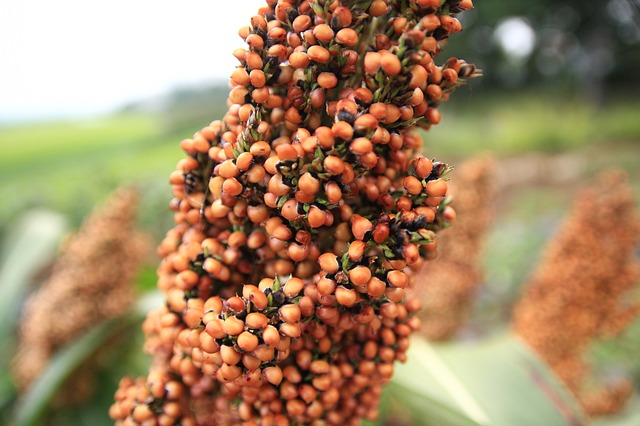
The rains are long gone and the field is dry, but the sorghum crop is flush with luscious green leaves, foretelling a good harvest.

The stubby, thin sorghum stalks, which delicately balance bi-color heads of grain, crowd farmer Simangaliso Ncube’s one-hectare plot in Mapulubusi village in Zimbabwe.

Ncube planted the sorghum in the 2019-20 season, which was considered the best in years in a parched region that suffers recurring droughts and widespread food scarcity. She wades into the field, past wide, pointed leaves that reach out like arms waving for attention.

Traditional grains like sorghum and millets are securing food, nutrition and income for smallholder farmers in Africa, where climate change-driven extreme weather pummells agriculture. Hardy crops, many grown for generations, are getting new attention as food for the future because of their ability to thrive — even in harsh conditions.

Going with the grain

Ncube has always harvested something from her sorghum patch, even during a drought year. She is committed to keep growing the hardy cereal, which is slowly re-finding its place on African household menus. This season she is expecting to harvest 20, 50-kilogram bags of sorghum. In the last season, Ncube and her husband harvested five bags.

“Even in the poorest of rains, I bet on sorghum to harvest something,” Ncube says, cradling a head of sorghum in her hands as if she were fixing an uncombed tuft of hair.

“My family loves sorghum and we enjoy it,” Ncube chuckles, explaining why she has been growing sorghum for more than 10 years.

In maize–mad Africa, it will take more than an occasional plateful of sorghum and millet for these drought tolerant crops to claim staple status. But nutrient-rich small grains, which hold the key to health and wealth for smallholder farmers, may be making a comeback, aided by climate change.

In Ethiopia, 36-year-old Hawa Muhammed had grown local sorghum varieties for 20 years before she was introduced to improved varieties that are more resilient than maize or teff, a beloved cereal cultivated across the Horn of Africa and used as a key ingredient for making traditional injera, a sour flatbread.

Hawa planted three varieties of improved sorghum on less than a hectare of land each and harvested about 3.9 tonnes in total. She sells a 100-kg bag of sorghum grain for 1800 Ethiopian birr (US$41).

“I am happy with the improved variety because it has short maturity period [three months] and a high yield of six quintals over the local one and has good product-making quality,” said Hawa, one of more than 8,000 farmers trained by Melkassa Agricultural Research Center in Ethiopia on cultivating improved sorghum varieties.

“Farmers have switched to cultivating improved sorghum varieties due to their yield and short maturity period,” says researcher Irreessa Galaa, who is working in a project to boost demand for sorghum through value addition in the production of injera and bread in urban areas.

In times of climate uncertainty, the diversification of staple crops can guarantee food system resilience, which scientists say has been lessened by  the erosion of agricultural biodiversity. They point to traditional African grains like barley, millets and sorghum, as well as cowpea and leafy vegetables, as key to achieving food security and nutrition.

Healthy food for people and the planet

Hardy grains can help climate-proof African diets through their ability to withstand droughts and semi-arid conditions, according to a new study by researchers from Barilla Foundation and Federico II University in Naples, who assessed different foods according to their impact on human and planetary health.

The researchers designed a “Double Health and Climate Pyramid” that communicates the features of a balanced, healthy and sustainable diet by advising on the appropriate frequency of consumption for all food groups.

Marta Antonelli, head of research at the Barilla Foundation and one of the report’s authors, says the African cultural pyramid informs policymakers and fosters the adoption of healthier and more sustainable dietary patterns at international, national and local levels, while mitigating climate change, and supporting food and agriculture companies.

The Double Pyramid report recommends redirecting agricultural subsidies from staple crops to nutritious and sustainable food, including traditional foods across Africa, such as teff in Ethiopia and pearl millet in West Africa.

“Africa needs agricultural systems that draw on people’s knowledge and benefit our health, culture, social justice and the environment,” says Million Belay, a member of the Barilla Foundation Advisory Board and general coordinator of the Alliance for Food Sovereignty in Africa.

Research shows that African countries have high levels of agricultural biodiversity and this should be leveraged by national governments to prioritize local crops, fruits and vegetables that are adapted to local conditions, can produce high yields and are diverse and nutritious in increasingly challenging conditions, Belay said.

Breeding for resilience

In Zimbabwe, scientists at the International Crop Research Institute for Semi-Arid Tropics (ICRISAT) are also breeding adapted traditional grain crops, including pearl millet and sorghum that offer higher levels of nutrition while being able to cope with difficult growing conditions of high temperatures, low rainfall and drought.

The Intergovernmental Panel on Climate Change (IPCC), the global body for assessing climate change science, has predicted that increases in global mean temperature of less than 1.8 to 5.4 degrees Fahrenheit (1 to 3 degrees Celsius) above 1990 levels will produce beneficial impacts in some regions and harmful ones in others, with serious implications for agriculture and food security.

Traditional crops are sustainable, nutritious and have a low carbon footprint relative to maize arising from carbon dioxide, methane and nutritious oxide emitted to the atmosphere during production, explains Hapson Mushoriwa, the lead breeder for eastern and southern Africa at ICRISAT in Zimbabwe.

Recognizing the importance of indigenous hardy crops for the global food system, the United Nations General Assembly has adopted a resolution sponsored by the government of India to declare 2023 as the international year of millets.

According ICRISAT, millets — also called nutri-cereals — are an important staple cereal crop for millions of smallholder dryland farmers across Asia and sub-Saharan Africa. Millets also help tackle poor diet, environmental issues and rural poverty. They are climate-smart, making them a good risk management strategy for farmers.

Africa needs to promote nutri-cereals through supportive policies and investment to move traditional food into the mainstream diet, says, Simbarashe Sibanda, leader of the Nutrition Sensitive Agriculture Program at the Food, Agriculture and Natural Resources Policy Analysis Network (FARNPAN), a policy think tank based in Pretoria, South Africa.

Digging in to smart and forgotten foods

The Forum for Agricultural Research in Africa (FARA) and the Global Forum on Agricultural Research and Innovation (GFAR) are leading an Africa-wide consultation on food systems to develop a manifesto on orphan crops, which include millet, teff, groundnuts and yam.  These are underused crops that are not widely traded and therefore considered minor when compared to wheat, maize and rice.

“The continent has a vast potential to feed itself and one of the ways is through forgotten foods,” Aggrey Agumya, director of research and Innovation at FARA, told a food systems webinar. “They are nutrient-dense, resilient, indigenous and well adapted but underutilized, which is an irony.”

Jacqueline Hughes, director general of ICRISAT, concurred that forgotten foods have never received global importance or been the focus of concerted efforts to improve productivity or quality. Nor have they been the focus of global value chains.

“These crops are adapted to very challenging environments, which resonates extremely well with our current climate challenges,” notes Hughes. She says that forgotten foods should be an integral part of Africa’s strategy to reduce dependence on food imports and to improve food and nutrition security.

By Busani Bafana

Imprimir Artigo
Publicação Anterior

OE22: Legislação e regulação laboral são matérias do foro da concertação social

Próxima Publicação

Portugueses querem produtos saudáveis e sustentáveis mas esbarram no preço, indisponibilidade nos pontos de venda e falta de conhecimento sobre as marcas

Artigos Relacionados

helicóptero de incêndios céu azul
Nacional

Incêndios preocupam no pós-Kristin. Estamos preparados para o verão ou vamos correr atrás do prejuízo?

13/06/2026
Nacional

Luís Rochartre lidera o CoLAB ForestWISE – Laboratório Colaborativo para Gestão Integrada da Floresta e do Fogo

13/06/2026
Nacional

Cerca 140 concelhos de doze distritos de Portugal em perigo máximo de incêndio

13/06/2026
Próxima Publicação

Portugueses querem produtos saudáveis e sustentáveis mas esbarram no preço, indisponibilidade nos pontos de venda e falta de conhecimento sobre as marcas

Discussão sobre este post

Opinião

Últimas

Acordo UE-Mercosul: uma oportunidade estratégica para proteger e valorizar as marcas dos produtos agrícolas portugueses

por Luís Caixinhas
07/06/2026

Ler maisDetails
Últimas

Barragens Não Resolvem Desertificação; Resolvem Estatística

por Nuno Mamede Santos
24/05/2026

Ler maisDetails

Subscrever as nossas newsletteres

Subscrever as nossas Newsletters Agroportal

Verifique na sua caixa de correio ou na pasta de spam para confirmar a sua subscrição.

Comunicados

Copa Cogeca

Crise dos fertilizantes: a Comissão conclui a sua resposta a curto prazo, mas esta continua a ser insuficiente

12/06/2026

Porbatata acompanha debates estratégicos no Congresso Europatat 2026

12/06/2026
Advertisement

Temas em destaque

Candidaturas PU Guerra Médio Oriente Mercosul ovibeja PAC pós 2027 Simplificação PAC Temporais vinho Água que Une

Eventos

Junho 2026
STQQSSD
1 2 3 4 5 6 7
8 9 10 11 12 13 14
15 16 17 18 19 20 21
22 23 24 25 26 27 28
29 30      
« Mai   Jul »

Sobre Nós

O Agroportal.pt é uma plataforma de informação digital que reúne a informação relevante sobre agricultura. Tem um foco na Política Agrícola Comum e a sua aplicação em Portugal.

Menu

  • Quem somos
  • Relatórios anuais
  • Envie-nos informação
  • Publicidade
  • Newsletters
  • Estatuto Editorial
  • Ficha técnica
  • Proteção de Dados Pessoais
  • Disclaimer
Facebook twitter Circle Instagram Rss Feed

© Agroportal. All Rights reserved.

Bem-Vindo De Volta!

Sign In with Facebook
Sign In with Google
OR

Faça login na sua conta abaixo

Esqueceu-se da senha? Registar

Criar Uma Nova Conta!

Sign Up with Facebook
Sign Up with Google
OR

Preencha os campos abaixo para se registar

* Ao se registar-se no nosso site, você concorda com os Termos e Condições e a Política de Privacidade .
Todos os campos são necessários. Entrar

Obter a sua senha

Indique por favor o seu nome de utilizador ou endereço de E-mail para repor a sua senha.

Entrar
  • Login
  • Registar
Sem Resultado
Ver Todos Os Resultados
  • Sugeridas
  • Notícias
    • Nacional
    • Internacional
    • Comunicados
  • Opinião
  • Eventos
  • Dossiers
    • Agricultura Biológica
    • Apoios
    • Artigos Técnicos
    • Biossoluções
    • Cadeia Alimentar
    • Fertilizantes
    • Financiamento
    • Fitofarmacêuticos
    • Florestas
    • Futuro da PAC
    • Inovação
    • Mercados e Cotações agrícolas
    • Newsletters e Revistas
    • Recomendações Agroflorestais
    • Seguros agrícolas
  • Serviços
    • Diretório
    • Emprego
    • Máquinas Agrícolas
    • Meteorologia
    • Terrenos Agrícolas
    • Arquivo Agroportal

© Agroportal. All Rights reserved.

Este site usa cookies. Ao continuar a utilizar este site, está a dar consentimento à utilização de cookies. Visite a nossa Política de Protecção de dados e Cookies.