











Sem Resultado
Ver Todos Os Resultados
Newsletters
Agroportal
  • Login
  • Registar
  • Sugeridas
  • Notícias
    • Notícias
    • Nacional
    • Internacional
    • Comunicados
    helicóptero de incêndios céu azul

    Incêndios: Produtores de vinho e azeite em Mirandela com grandes prejuízos

    vinha uvas

    Incêndios: Fogo afeta vindima e campanha de azeitona em Valpaços

    Novo parvovírus suíno detetado na Holanda alastra a mais países europeus

    Stihl lança plataforma AllPro para equipamentos profissionais

    Estado reforça capital da EDIA em 4,27 milhões de euros

    fogo bombeiros

    Incêndios: Frente em Mirandela e Vinhais causa mais preocupações, reativações em Valpaços

    Comissão Europeia alerta que Portugal pode falhar erradicação da brucelose animal

    Alentejo prevê aumento de 20% na produção de vinho

    meat

    Importadores europeus antecipam compras de carne brasileira antes de possível suspensão em setembro

  • Opinião

    Azeites de Portugal: tratar diferente o que é diferente

    Manuel Chaveiro Soares

    Sobre a excelência da alimentação em Portugal

    Produzir bem já não chega: eficiência, estratégia e os desafios da engorda de bovinos

    Segurança Alimentar Europeia Como Ativo Estratégico

    Sabemos distinguir um frango do campo. Porque não conseguimos distinguir um Azeite de Olival Tradicional?

    Carlos Neves

    Promoções que despromovem a produção de leite de Portugal

    Georgete Felix

    O balanço invisível da agricultura

    Acordo UE-Mercosul

    Manuel Chaveiro Soares

    Melhoramento genético dos frangos de carne: importância para os consumidores e o ambiente

  • Eventos
  • Dossiers

    Dossiers I

    • Agricultura Biológica
    • Apoios
    • Artigos Técnicos
    • Biossoluções
    • Cadeia Alimentar
    • Fertilizantes
    • Financiamento
    • Fitofarmacêuticos

    Dossiers II

    • Florestas
    • Futuro da PAC
    • Inovação
    • Mercados
    • Newsletters e Revistas
    • Recomendações Agroflorestais
    • Seguros

    Últimas

    Logo GPP

    Relatório semanal de acompanhamento dos mercados do setor da agricultura – 20 a 26 de julho de 2026

    31/07/2026
    leite

    Cotações – Leite – Junho 2026

    30/07/2026

    CRISPR | Edição genética transforma planta silvestre em nova cultura agrícola de inverno

    30/07/2026

    CAP considera apoio de 20 milhões “quase uma afronta” e admite protestos

    30/07/2026

    Pagamento do apoio extraordinário ao gasóleo colorido e marcado

    30/07/2026

    Apoio de 20 milhões chega esta semana a quase 60 mil agricultores

    30/07/2026
  • Serviços
    • Diretório
    • Emprego
    • Máquinas Agrícolas
    • Meteorologia
    • Terrenos Agrícolas
    • Arquivo Agroportal
Agroportal
  • Sugeridas
  • Notícias
    • Notícias
    • Nacional
    • Internacional
    • Comunicados
    helicóptero de incêndios céu azul

    Incêndios: Produtores de vinho e azeite em Mirandela com grandes prejuízos

    vinha uvas

    Incêndios: Fogo afeta vindima e campanha de azeitona em Valpaços

    Novo parvovírus suíno detetado na Holanda alastra a mais países europeus

    Stihl lança plataforma AllPro para equipamentos profissionais

    Estado reforça capital da EDIA em 4,27 milhões de euros

    fogo bombeiros

    Incêndios: Frente em Mirandela e Vinhais causa mais preocupações, reativações em Valpaços

    Comissão Europeia alerta que Portugal pode falhar erradicação da brucelose animal

    Alentejo prevê aumento de 20% na produção de vinho

    meat

    Importadores europeus antecipam compras de carne brasileira antes de possível suspensão em setembro

  • Opinião

    Azeites de Portugal: tratar diferente o que é diferente

    Manuel Chaveiro Soares

    Sobre a excelência da alimentação em Portugal

    Produzir bem já não chega: eficiência, estratégia e os desafios da engorda de bovinos

    Segurança Alimentar Europeia Como Ativo Estratégico

    Sabemos distinguir um frango do campo. Porque não conseguimos distinguir um Azeite de Olival Tradicional?

    Carlos Neves

    Promoções que despromovem a produção de leite de Portugal

    Georgete Felix

    O balanço invisível da agricultura

    Acordo UE-Mercosul

    Manuel Chaveiro Soares

    Melhoramento genético dos frangos de carne: importância para os consumidores e o ambiente

  • Eventos
  • Dossiers

    Dossiers I

    • Agricultura Biológica
    • Apoios
    • Artigos Técnicos
    • Biossoluções
    • Cadeia Alimentar
    • Fertilizantes
    • Financiamento
    • Fitofarmacêuticos

    Dossiers II

    • Florestas
    • Futuro da PAC
    • Inovação
    • Mercados
    • Newsletters e Revistas
    • Recomendações Agroflorestais
    • Seguros

    Últimas

    Logo GPP

    Relatório semanal de acompanhamento dos mercados do setor da agricultura – 20 a 26 de julho de 2026

    31/07/2026
    leite

    Cotações – Leite – Junho 2026

    30/07/2026

    CRISPR | Edição genética transforma planta silvestre em nova cultura agrícola de inverno

    30/07/2026

    CAP considera apoio de 20 milhões “quase uma afronta” e admite protestos

    30/07/2026

    Pagamento do apoio extraordinário ao gasóleo colorido e marcado

    30/07/2026

    Apoio de 20 milhões chega esta semana a quase 60 mil agricultores

    30/07/2026
  • Serviços
    • Diretório
    • Emprego
    • Máquinas Agrícolas
    • Meteorologia
    • Terrenos Agrícolas
    • Arquivo Agroportal
Sem Resultado
Ver Todos Os Resultados
Agroportal

Biodegradable glitter and pollution-eating microalgae: the new materials inspired by nature

por Horizon - EU
27-05-2020 | 22:00
em Últimas, Internacional
Tempo De Leitura: 7 mins
A A
Partilhe no FacebookPartilhe no TwitterEnviar para o WhatsappEnviar para o TelegramEnviar para o LinkedIn

Nature has spent millions of years evolving answers to problems. It has come up with ingenious solutions to build strong structures, harvest energy and produce iridescent colours. Scientists are increasingly turning to the natural world for inspiration to create new, greener materials and technologies.

In the lab of Dr Silvia Vignolini at the University of Cambridge, UK, scientists are designing biodegradable glitter and natural dyes for food colouring and cosmetics as part of a project called PlaMatSu.

To do this, they are using cellulose – a natural fibre, which gives strength and stiffness to trees and plants. It is what we make paper from. ‘It is the most abundant material we have on the planet,’ said Dr Vignolini. ‘Everyone thinks of its strength, but not everyone knows you can use cellulose to make pigments.’

Pure cellulose is snow white. To conjure colours, Dr Vignolini carves tiny shapes out of cellulose that light bounces off of as bright colours – something called structural colour.

‘By structuring material on a nanoscale, light interacts with it in a way that creates colour,’ Dr Vignolini said. We are more familiar with this phenomenon than we might realise – think of the hues soap bubbles generate by bending light or a butterfly’s colourful wings. In these examples, colour changes according to the angle of view.

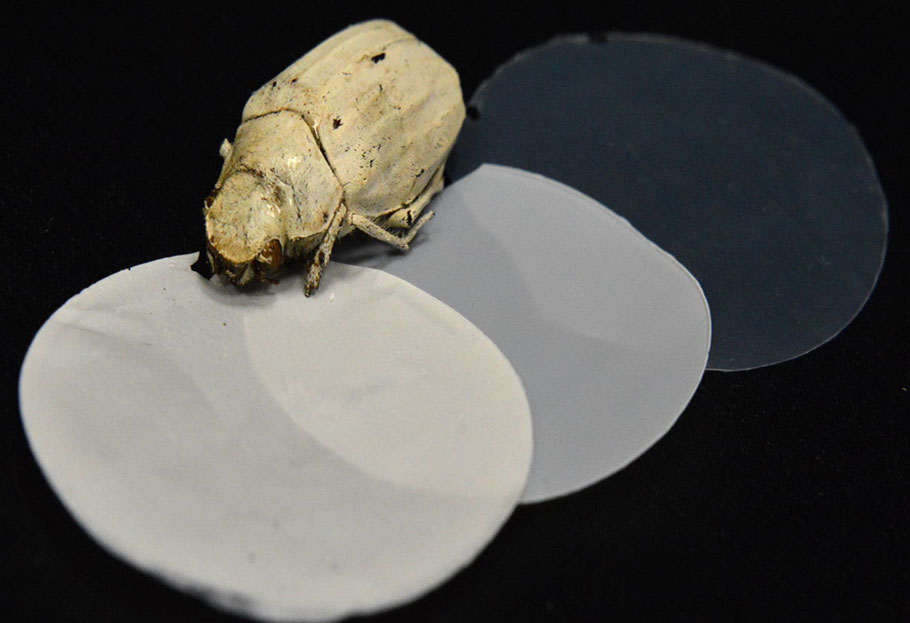
Dr Vignolini was inspired by the iridescent colours of the natural world caused by a material’s structure rather than the presence of pigments. The shiny metallic blue fruit of marble berry (Pollia condensate) is one of the most striking examples that Dr Vignolini has studied, with colour reflectance changing between cells and giving the fruit a glittery appearance. A different example is the Cyphochilus beetle, which she discovered is whiter than paper thanks to ultra-thin scales deflecting all colours.

Structural colour

Dr Vignolini’s lab has used structural colour to make fully biodegradable pigments and glitter, which could be used in makeup or as confetti, for instance. Conventional glitter is made from polymer microparticles, whereas Dr Vignolini’s glitter is made only of specially shaped cellulose.

‘This is made from the same material that is in every cell wall of plants. It makes 40% of a salad,’ said Dr Vignolini of her glitter. ‘It’s not harmful if it disperses into the environment, and it is also edible.’ 

She collaborates with cosmetic companies to generate plant-based, biodegradable pigments, including for makeup and skin care.  

She also works on new structural food colourings from organic waste as the food industry is working towards replacing synthetic colourants. ‘We can use the leftover stuff from paper making processes, or agricultural waste, like mango or banana peel, which is rich in cellulose, and then use it to make colouration,’ said Dr Vignolini. 

Others in the PlaMatSu network are looking beyond colour to deploy surface ideas drawn from nature. Teams at the University of Freiburg, Germany, and University of Fribourg, Switzerland, are looking at how rough plant surfaces deter insects. They could make biodegradable materials that might be sprayed to hinder bugs from feeding on a crop or walls to deter bugs.

For Professor Gianluca Maria Farinola at the University of Bari, Italy, a synthetic chemist, the beautiful light-manipulating structures of tiny algae called diatoms hold many possible uses.

He has investigated molecules and nanostructures for LED technologies, solar cells and optical devices. While teaching undergrad environmental science students, he encountered diatoms. He became inspired to create bionic algae that can manipulate light for laser technologies or to deliver drugs. 

‘By structuring material on a nanoscale, light interacts with it in a way that creates colour.’

Dr Silvia Vignolini, University of Cambridge, UK

Diatoms

Diatoms are single celled algae, each one encased in silica, their own glass house. These can be fan or rod-shaped, zigzag, circular, or triangular. ‘They are beautiful natural objects which have inspired artists, fashion designers and architects,’ said Prof. Farinola. They occur in seas, lakes and ponds and manufacture at least 20% of the oxygen that we breathe.   

‘The biggest species can be seen with the naked eye, but only as small dots,’ said Prof. Farinola. ‘You cannot appreciate the beauty of their shape and structure.’

Under a microscope, you may see their glass houses potted with pores, or with a variety of ridges and elevations. These markings assist them to focus the best wavelengths of light to the cell for photosynthesis, while scattering or filtering out harmful wavelengths. It makes them natural photonic structures, meaning that they are able to manipulate light.

‘Photonic crystals are used a lot in laser technologies,’ said Prof. Farinola, and he believes diatoms can inspire us to create new photonic technologies which could be for light detection, computing or robotics, for example.

As part of the BEEP network exploring bioinspired solar harvesting materials, Prof. Farinola is taking on a PhD student to study diatom photosynthesis and create a bionic diatom with an extra piece of light-gathering equipment – certain molecules.

‘We incorporate molecules which cover a range of wavelengths that the diatom does not naturally absorb,’ said Prof. Farinola. This acts as an artificial antenna, to absorb extra light and supercharge photosynthesis. This should boost diatom growth in a tank of seawater.
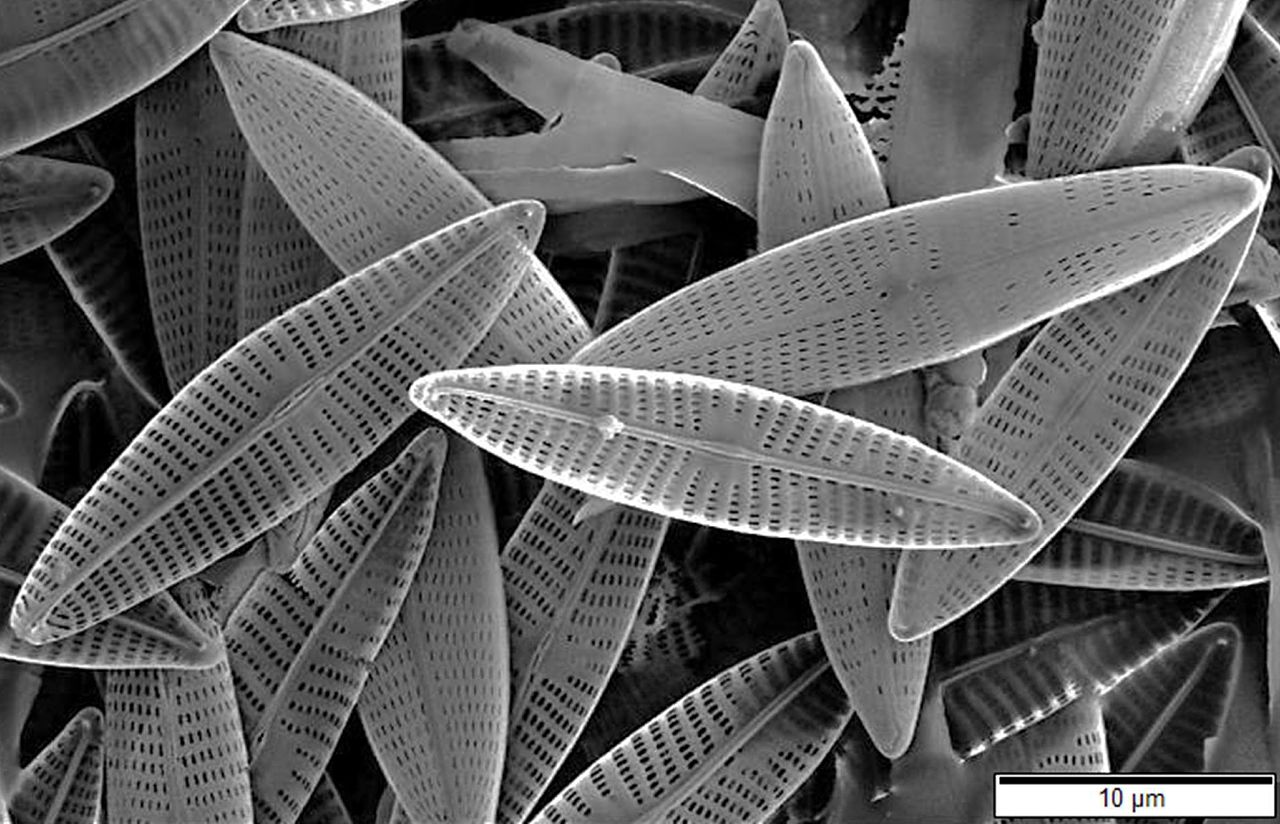
The microscopic structures of diatoms help them manipulate light, leading to hopes they could be used in new technologies for light detection, computing or robotics. Image credit - Mogana Das Murtey and Patchamuthu Ramasamy, licenced under CC BY-SA 3.0

Prof. Farinola’s research may see special diatoms grown for delivering drugs. His lab in Bari can either modify their glasshouses after removing the cell inside, or attach a substance to diatom food to sneak it inside the shell. Already, his group attached antioxidant molecules on diatoms’ shells that then snagged the antibiotic ciprofloxacin, which could potentially be delivered inside a patient.

In another example, living diatoms took up bisphosphonates, which is a drug well known for improving bone status in osteoporosis patients. ‘We then remove all the living matter and we have silica with bisphosphonate left,’ said Prof. Farinola. He envisions covering an implant with these silica shells in order to stimulate bone growth after surgery, though this has not yet been tried in patients. 

His team is also looking at how silica from diatom shells could be used to clean up different pollutants in the environment. The researchers covered the shells of dead diatoms with a special polymer (polydopamine) and stuck on enzymes which could in principle be used to break down pollutants, according to Prof. Farinola.

By bringing together biologists, algae experts, physicists, synthetic chemists and emerging researchers, BEEP aims to explore how microorganisms can help us generate new technologies. 

‘We want to breach the boundary between biology, chemistry and physics in the context of studying plants,’ said Dr Vignolini, who coordinates BEEP. She sees this network and PlatMaSu as hopefully enabling new, greener materials that meet social needs.

Pigment vs structural colour

Pigment colour absorbs and reflects different wavelengths of visible light, each of which corresponds to a particular colour. If a painted wall absorbs all wavelengths of light except for blue, then the wall will look blue. Chemical pigments produce a colour that looks the same from all angles and will fade over time.

In contrast, structural colour does not absorb light but instead reflects it from structures such as scales. The wavelength of the reflected light depends on the orientation of the object and the angle from which the viewer sees it. Multi-layered structures can cause iridescence, as the colour changes depending on the viewing angle. Unlike chemical pigments, structural colour is resistant to fading. It is widespread in the natural world, and can be found in chameleons and peacock feathers.

The research in this article was funded by the EU. If you liked this article, please consider sharing it on social media.
Imprimir Artigo
Publicação Anterior

A Terra e os Homens – Episódio 10

Próxima Publicação

Avisos Agrícolas 27/05/2020: Vinha, Kiwi, Mirtilos, Macieira, Pereira e Batateira

Artigos Relacionados

helicóptero de incêndios céu azul
Nacional

Incêndios: Produtores de vinho e azeite em Mirandela com grandes prejuízos

31/07/2026
vinha uvas
Nacional

Incêndios: Fogo afeta vindima e campanha de azeitona em Valpaços

31/07/2026
Últimas

Novo parvovírus suíno detetado na Holanda alastra a mais países europeus

31/07/2026
Próxima Publicação
Avisos Agrícolas

Avisos Agrícolas 27/05/2020: Vinha, Kiwi, Mirtilos, Macieira, Pereira e Batateira

Discussão sobre este post

Opinião

Últimas

Azeites de Portugal: tratar diferente o que é diferente

por José Martino
26/07/2026

Ler maisDetails
Manuel Chaveiro Soares
Últimas

Sobre a excelência da alimentação em Portugal

por Manuel Chaveiro Soares
19/07/2026

Ler maisDetails

Subscrever as nossas newsletteres

Subscrever as nossas Newsletters Agroportal

Verifique na sua caixa de correio ou na pasta de spam para confirmar a sua subscrição.

Comunicados

caja rural del sur

Desbloquear o Crescimento de Portugal

31/07/2026
IFAP

Setor dos cereais praganosos e milho grão – Comunicação das quantidade entregues – 2026

31/07/2026
Advertisement

Temas em destaque

Candidaturas PU Guerra Médio Oriente Mercosul ovibeja PAC pós 2027 Simplificação PAC Temporais vinho Água que Une

Eventos

Agosto 2026
STQQSSD
      1 2
3 4 5 6 7 8 9
10 11 12 13 14 15 16
17 18 19 20 21 22 23
24 25 26 27 28 29 30
31       
« Jul   Set »

Sobre Nós

O Agroportal.pt é uma plataforma de informação digital que reúne a informação relevante sobre agricultura. Tem um foco na Política Agrícola Comum e a sua aplicação em Portugal.

Menu

  • Quem somos
  • Relatórios anuais
  • Envie-nos informação
  • Publicidade
  • Newsletters
  • Estatuto Editorial
  • Ficha técnica
  • Proteção de Dados Pessoais
  • Disclaimer
Facebook twitter Circle Instagram Rss Feed

© Agroportal. All Rights reserved.

Bem-Vindo De Volta!

Sign In with Facebook
Sign In with Google
OR

Faça login na sua conta abaixo

Esqueceu-se da senha? Registar

Criar Uma Nova Conta!

Sign Up with Facebook
Sign Up with Google
OR

Preencha os campos abaixo para se registar

* Ao se registar-se no nosso site, você concorda com os Termos e Condições e a Política de Privacidade .
Todos os campos são necessários. Entrar

Obter a sua senha

Indique por favor o seu nome de utilizador ou endereço de E-mail para repor a sua senha.

Entrar
  • Login
  • Registar
Sem Resultado
Ver Todos Os Resultados
  • Sugeridas
  • Notícias
    • Nacional
    • Internacional
    • Comunicados
  • Opinião
  • Eventos
  • Dossiers
    • Agricultura Biológica
    • Apoios
    • Artigos Técnicos
    • Biossoluções
    • Cadeia Alimentar
    • Fertilizantes
    • Financiamento
    • Fitofarmacêuticos
    • Florestas
    • Futuro da PAC
    • Inovação
    • Mercados e Cotações agrícolas
    • Newsletters e Revistas
    • Recomendações Agroflorestais
    • Seguros agrícolas
  • Serviços
    • Diretório
    • Emprego
    • Máquinas Agrícolas
    • Meteorologia
    • Terrenos Agrícolas
    • Arquivo Agroportal

© Agroportal. All Rights reserved.

Este site usa cookies. Ao continuar a utilizar este site, está a dar consentimento à utilização de cookies. Visite a nossa Política de Protecção de dados e Cookies.