















Sem Resultado
Ver Todos Os Resultados
Newsletters
Agroportal
  • Login
  • Registar
  • Sugeridas
  • Notícias
    • Notícias
    • Nacional
    • Internacional
    • Comunicados
    CCDR Algarve

    Ataque informático à CCDR Algarve

    IVV

    Relatório de Análise Sectorial – Preços na exportação de vinhos tranquilos ano 2025

    Da pegada de carbono à biodiversidade: a estratégia que quer transformar a produção de pequenos frutos

    Proteção Civil diz que greve da força especial não afeta atividade e sindicato critica

    França: lei de emergência agrícola reintroduz dois pesticidas proibidos e divide partidos

    Edição genética ajuda a identificar mecanismo de defesa do arroz contra fogo bacteriano

    Edição genética ajuda a identificar mecanismo de defesa do arroz contra fogo bacteriano

    Governo regulamenta matadouros móveis para reduzir transporte de animais

    Buçaco recebe título de primeira Floresta Terapêutica da Península Ibérica

  • Opinião
    Manuel Chaveiro Soares

    Sobre a excelência da alimentação em Portugal

    Produzir bem já não chega: eficiência, estratégia e os desafios da engorda de bovinos

    Segurança Alimentar Europeia Como Ativo Estratégico

    Sabemos distinguir um frango do campo. Porque não conseguimos distinguir um Azeite de Olival Tradicional?

    Carlos Neves

    Promoções que despromovem a produção de leite de Portugal

    Georgete Felix

    O balanço invisível da agricultura

    Acordo UE-Mercosul

    Manuel Chaveiro Soares

    Melhoramento genético dos frangos de carne: importância para os consumidores e o ambiente

    A escolha certa!

  • Eventos
  • Dossiers

    Dossiers I

    • Agricultura Biológica
    • Apoios
    • Artigos Técnicos
    • Biossoluções
    • Cadeia Alimentar
    • Fertilizantes
    • Financiamento
    • Fitofarmacêuticos

    Dossiers II

    • Florestas
    • Futuro da PAC
    • Inovação
    • Mercados
    • Newsletters e Revistas
    • Recomendações Agroflorestais
    • Seguros

    Últimas

    IVV

    Relatório de Análise Sectorial – Preços na exportação de vinhos tranquilos ano 2025

    20/07/2026

    França: lei de emergência agrícola reintroduz dois pesticidas proibidos e divide partidos

    20/07/2026

    Edição genética ajuda a identificar mecanismo de defesa do arroz contra fogo bacteriano

    20/07/2026

    Cotações – Aves e Ovos – 13 a 19 de julho de 2026

    20/07/2026

    Buçaco recebe título de primeira Floresta Terapêutica da Península Ibérica

    20/07/2026

    OGM | EFSA propõe simplificar a avaliação de risco de culturas geneticamente modificadas com múltiplas características

    20/07/2026
  • Serviços
    • Diretório
    • Emprego
    • Máquinas Agrícolas
    • Meteorologia
    • Terrenos Agrícolas
    • Arquivo Agroportal
Agroportal
  • Sugeridas
  • Notícias
    • Notícias
    • Nacional
    • Internacional
    • Comunicados
    CCDR Algarve

    Ataque informático à CCDR Algarve

    IVV

    Relatório de Análise Sectorial – Preços na exportação de vinhos tranquilos ano 2025

    Da pegada de carbono à biodiversidade: a estratégia que quer transformar a produção de pequenos frutos

    Proteção Civil diz que greve da força especial não afeta atividade e sindicato critica

    França: lei de emergência agrícola reintroduz dois pesticidas proibidos e divide partidos

    Edição genética ajuda a identificar mecanismo de defesa do arroz contra fogo bacteriano

    Edição genética ajuda a identificar mecanismo de defesa do arroz contra fogo bacteriano

    Governo regulamenta matadouros móveis para reduzir transporte de animais

    Buçaco recebe título de primeira Floresta Terapêutica da Península Ibérica

  • Opinião
    Manuel Chaveiro Soares

    Sobre a excelência da alimentação em Portugal

    Produzir bem já não chega: eficiência, estratégia e os desafios da engorda de bovinos

    Segurança Alimentar Europeia Como Ativo Estratégico

    Sabemos distinguir um frango do campo. Porque não conseguimos distinguir um Azeite de Olival Tradicional?

    Carlos Neves

    Promoções que despromovem a produção de leite de Portugal

    Georgete Felix

    O balanço invisível da agricultura

    Acordo UE-Mercosul

    Manuel Chaveiro Soares

    Melhoramento genético dos frangos de carne: importância para os consumidores e o ambiente

    A escolha certa!

  • Eventos
  • Dossiers

    Dossiers I

    • Agricultura Biológica
    • Apoios
    • Artigos Técnicos
    • Biossoluções
    • Cadeia Alimentar
    • Fertilizantes
    • Financiamento
    • Fitofarmacêuticos

    Dossiers II

    • Florestas
    • Futuro da PAC
    • Inovação
    • Mercados
    • Newsletters e Revistas
    • Recomendações Agroflorestais
    • Seguros

    Últimas

    IVV

    Relatório de Análise Sectorial – Preços na exportação de vinhos tranquilos ano 2025

    20/07/2026

    França: lei de emergência agrícola reintroduz dois pesticidas proibidos e divide partidos

    20/07/2026

    Edição genética ajuda a identificar mecanismo de defesa do arroz contra fogo bacteriano

    20/07/2026

    Cotações – Aves e Ovos – 13 a 19 de julho de 2026

    20/07/2026

    Buçaco recebe título de primeira Floresta Terapêutica da Península Ibérica

    20/07/2026

    OGM | EFSA propõe simplificar a avaliação de risco de culturas geneticamente modificadas com múltiplas características

    20/07/2026
  • Serviços
    • Diretório
    • Emprego
    • Máquinas Agrícolas
    • Meteorologia
    • Terrenos Agrícolas
    • Arquivo Agroportal
Sem Resultado
Ver Todos Os Resultados
Agroportal

A CAP built to last: four adjustments towards a durable farm budget

por CAP Reform
28-06-2026 | 09:42
em Últimas, Notícias futuro da PAC, Blogs
Tempo De Leitura: 5 mins
A A
Partilhe no FacebookPartilhe no TwitterEnviar para o WhatsappEnviar para o TelegramEnviar para o LinkedIn

Cora Petrick and Nikolai Pushkarev are associated with the Think Tank Agora Agriculture based in Germany and Brussels.

The proposed reduction in earmarked funding for agriculture in the EU’s next budget has generated significant controversy. Yet, financial pressure on the Common Agricultural Policy (CAP) is not new. Adjusted for inflation and per hectare of agricultural land, the CAP budget has declined by about 40 percent over the past 25 years, as shown in the figure below.

This downward trend could continue in the next budgetary period. Under current proposals, the minimum annual CAP budget per hectare from 2028 onward would be about half the funding level in 2000. The final allocation of EU funding for the CAP will depend on national decisions and the size of the overall EU budget. Even if the CAP budget ultimately turns out to be higher than initially proposed, it is unlikely to reverse the long-term decline.

We argue that this downward budgetary trend is linked to the CAP’s ongoing difficulty to focus on and demonstrate its societal added value. As the next CAP is negotiated, we propose four adjustments to the Commission’s proposal that Member States and the European Parliament can adopt to ensure a more targeted and justifiable use of limited public funds. Rewarding farmers for producing essential public services, like climate and biodiversity protection, is central to a sustainable and competitive European agriculture and a promising story to invest in.
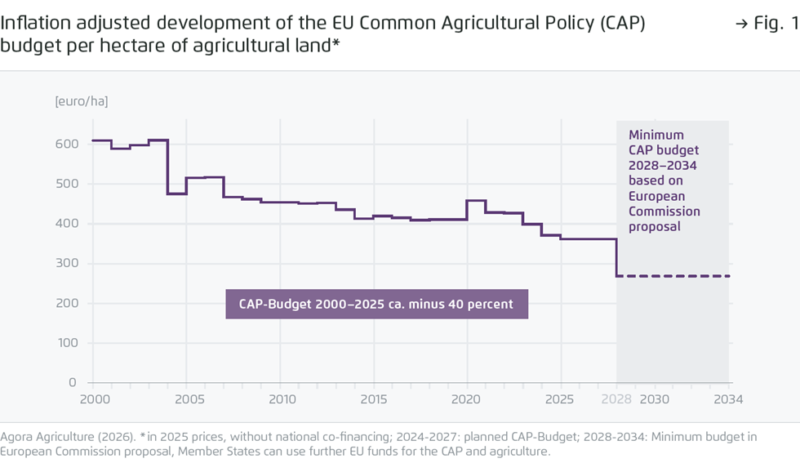
Source: Original figure and data from Agora Agriculture study “Die Zukunft von Landnutzung und Ernährung in Deutschland”.

In each successive EU budget cycle, agriculture competes for funding with other policy priorities. Despite agriculture’s vital role in achieving societal goals such as resilient ecosystems and climate change mitigation, CAP funding is widely criticised in the scientific literature for delivering insufficient results against these aims.

Meanwhile, public spending remains essential for an EU agricultural sector that is both internationally competitive and environmentally sustainable. Private markets do not adequately remunerate the valuable public services that agriculture can provide. Requiring farmers to deliver these services beyond a baseline level, without sufficient support, would put their competitiveness at risk in the current open global trade environment.

Government incentives are therefore needed to increase the supply of public goods from agriculture. This, in turn, requires a long-term policy commitment to allocate taxpayers’ money.  To secure such a commitment, governments must demonstrate that these funds are well spent. To date, the CAP has struggled to provide this justification.

The policy’s main instruments, such as area-based and coupled income support, are based on ambiguous goals, and their contribution to societal objectives is very limited. As a result, most current CAP spending is ill-suited to demonstrate European added value.

The CAP’s declining budget may indeed signal a diminishing trust that public money is well spent on agriculture compared to other societal needs. To remain relevant, the CAP must become more targeted to societal objectives and find a more convincing story to tell. Delivering public services at scale and doing so in a way that is both effective and verifiable, offers a more targeted use of funds and a more promising narrative.

We believe that the following four adjustments to the current CAP proposal are important steps towards unlocking this potential:

  1. Reduce national co-financing rates for public goods interventions within the ring-fenced CAP budget. Currently, eco-schemes are fully funded by the EU, and member states can use 100% EU-financed first pillar funds for certain second pillar agri-environmental measures. Under the next CAP, similar interventions would require national co-financing, and the rate for agri-environmental measures would increase by approximately 10 percentage points. This change makes these measures less attractive to national governments and regions, especially given tighter budgets.
  • Reintroduce a minimum spending share for agri-environmental, climate and animal welfare measures within the ring-fenced CAP budget. Dedicating a minimum share of the budget for public goods, as is done in the CAP today, is essential to maintain consistent funding for these objectives. Furthermore, it helps level the playing field between EU countries and prevents pressure to reduce funding for public goods to gain a temporary competitive advantage over other member states.
  • Remove the minimum rate per hectare for degressive area-based income support. This flexibility would allow countries to allocate CAP funds to payments with greater societal value. The maximum per-hectare amount would still provide a common framework for income payments.
  • Make some currently mandatory CAP instruments optional. Removing the requirement for countries to plan an intervention they may not want, such as degressive area-based and coupled income support, payments for natural and other area-specific constraints and support for risk management, would free up funds and administrative capacity for measures that could be better aligned with public goods objectives.

Within the structure of the current proposal, these four changes would make the CAP more effective and credible. They also seek to strike a balance between maintaining common aspects of the CAP while providing sufficient flexibility for countries to address the specific challenges and opportunities of agriculture in their respective regions.

However, these four changes are only a partial solution. A firm commitment is needed to phase out purely area-based direct income payments in favour of a CAP focused on incentivising public goods, including climate and environmental protection, animal welfare, and, where appropriate, social cohesion. Introducing national co-financing for direct area-based income support could be a first step, making other measures more attractive by comparison.

This is not a far-fetched idea. Political confidence in the long-term viability of area-based income support payments appears to be waning. One indication is the attempt in the Commission’s proposal to justify these payments by linking them to social need. Another is the recommendation in the “Strategic Dialogue on the Future of EU Agriculture” that the CAP should gradually transition to a new set of policy tools.

Committing to phasing out area-based income support would initiate the development of a credible, long-term incentive system for farmers, with a predictable and viable transition between payment models. This would enable an agricultural budget focused on delivering public value and one that is built to last.

This post is written by Cora Petrick and Nikolai Pushkarev.

O artigo foi publicado originalmente em CAP Reform.

Imprimir Artigo
Publicação Anterior

O balanço invisível da agricultura

Próxima Publicação

Vacuno: persisten los descensos en los precios

Artigos Relacionados

CCDR Algarve
Nacional

Ataque informático à CCDR Algarve

20/07/2026
IVV
Últimas

Relatório de Análise Sectorial – Preços na exportação de vinhos tranquilos ano 2025

20/07/2026
Últimas

Da pegada de carbono à biodiversidade: a estratégia que quer transformar a produção de pequenos frutos

20/07/2026
Próxima Publicação

Vacuno: persisten los descensos en los precios

Opinião

Manuel Chaveiro Soares
Últimas

Sobre a excelência da alimentação em Portugal

por Manuel Chaveiro Soares
19/07/2026

Ler maisDetails
Últimas

Produzir bem já não chega: eficiência, estratégia e os desafios da engorda de bovinos

por Vítor Santos
12/07/2026

Ler maisDetails

Subscrever as nossas newsletteres

Subscrever as nossas Newsletters Agroportal

Verifique na sua caixa de correio ou na pasta de spam para confirmar a sua subscrição.

Comunicados

CCDR Algarve

Ataque informático à CCDR Algarve

20/07/2026
IVV

Relatório de Análise Sectorial – Preços na exportação de vinhos tranquilos ano 2025

20/07/2026
Advertisement

Temas em destaque

Candidaturas PU Guerra Médio Oriente Mercosul ovibeja PAC pós 2027 Simplificação PAC Temporais vinho Água que Une

Eventos

Julho 2026
STQQSSD
   1 2 3 4 5
6 7 8 9 10 11 12
13 14 15 16 17 18 19
20 21 22 23 24 25 26
27 28 29 30 31   
« Jun   Ago »

Sobre Nós

O Agroportal.pt é uma plataforma de informação digital que reúne a informação relevante sobre agricultura. Tem um foco na Política Agrícola Comum e a sua aplicação em Portugal.

Menu

  • Quem somos
  • Relatórios anuais
  • Envie-nos informação
  • Publicidade
  • Newsletters
  • Estatuto Editorial
  • Ficha técnica
  • Proteção de Dados Pessoais
  • Disclaimer
Facebook twitter Circle Instagram Rss Feed

© Agroportal. All Rights reserved.

Bem-Vindo De Volta!

Sign In with Facebook
Sign In with Google
OR

Faça login na sua conta abaixo

Esqueceu-se da senha? Registar

Criar Uma Nova Conta!

Sign Up with Facebook
Sign Up with Google
OR

Preencha os campos abaixo para se registar

* Ao se registar-se no nosso site, você concorda com os Termos e Condições e a Política de Privacidade .
Todos os campos são necessários. Entrar

Obter a sua senha

Indique por favor o seu nome de utilizador ou endereço de E-mail para repor a sua senha.

Entrar
  • Login
  • Registar
Sem Resultado
Ver Todos Os Resultados
  • Sugeridas
  • Notícias
    • Nacional
    • Internacional
    • Comunicados
  • Opinião
  • Eventos
  • Dossiers
    • Agricultura Biológica
    • Apoios
    • Artigos Técnicos
    • Biossoluções
    • Cadeia Alimentar
    • Fertilizantes
    • Financiamento
    • Fitofarmacêuticos
    • Florestas
    • Futuro da PAC
    • Inovação
    • Mercados e Cotações agrícolas
    • Newsletters e Revistas
    • Recomendações Agroflorestais
    • Seguros agrícolas
  • Serviços
    • Diretório
    • Emprego
    • Máquinas Agrícolas
    • Meteorologia
    • Terrenos Agrícolas
    • Arquivo Agroportal

© Agroportal. All Rights reserved.

Este site usa cookies. Ao continuar a utilizar este site, está a dar consentimento à utilização de cookies. Visite a nossa Política de Protecção de dados e Cookies.