




















The European Parliament approved last Tuesday evening the common position on the CAP Transitional Regulation previously agreed with the Council. Once the Council gives its formal approval, it will take effect from 1 January 2021. The Regulation provides legal certainty regarding the rules for payments to farmers by continuing the application of the rules of the current CAP frameworkin the two calendar years 2021 and 2022 under the ‘old rules, new money’ principle.
The Regulation makes necessary amendments to the four CAP Regulations that make up the 2013 CAP reform (direct payments, rural development, single common market organisation, and horizontal matters). It also governs the spending of the EAFRD element of the European Union Recovery Instrument (EURI) during the two-year period 2021-2022. In this post, we focus on the rules introduced to govern EURI expenditure.
Although the Transitional Regulation broadly continues existing rules, there are some novel features that are worth noting. The co-legislature has taken the opportunity to increase the attractiveness of risk management instruments by allowing Member States to lower the threshold of 30% in mutual funds and income stabilisation schemes that triggers compensation to farmers for a drop in production or income to not lower than 20%. It also exempts income averaging measures in national tax codes from the application of State aid rules.
Furthermore, to limit a significant carry-over of commitments from the current programming period for rural development to the CAP Strategic Plans, the duration of new multiannual commitments in relation to agri-environment-climate (AEC) measures, organic farming and animal welfare should, as a general rule, be limited to a period of a maximum of three years. From 2022, the extension of existing commitments should be limited to one year. I previously summarised the detailed changes in the Transitional Regulation in this post.
The European Union Recovery Instrument (EURI)
The inclusion of the EURI top-up of €8 billion in current prices for EAFRD in the Transitional Regulation was a victory for the Council and Parliament. The Commission had originally proposed that this money (it had also proposed twice this amount) would be committed over the years 2022-2024. However, it eventually agreed to bring the funding forward to 2021-2022 provided there was a focus on Green Deal objectives.
According to the Transitional Regulation, the additional resources provided by the EURI should pave the way for a resilient, sustainable and digital economic recovery in line with the objectives of the Union’s environmental and climate commitments and with the new ambitions set out in the European Green Deal. This is implemented in three commitments in the additional Article 58a inserted in the EAFRD Regulation.
- The requirement that 30% of EAFRD resources should be used for agri-environment-climate objectives does not apply to the additional EURI resources. This is replaced by a ‘no regression’ principle, which is set out in Article 1(2) and Article 7(12). Article 1(2) establishes that amended Rural Development Programmes (RDPs) submitted to cover the years 2021 and 2022 should at least maintain the same overall share of the EAFRD contribution for agri-environment-climate measures as in the existing RDP. Article 7(12) provides that these same minimum shares also apply to the additional EURI resources used in each RDP.
- In addition, at least 37% of the additional resources provided by the EURI should be devoted to measures that are particularly beneficial to the environment and climate, as well as to animal welfare and LEADER. A list of potential measures appended includes:
- (a) organic farming;
- (b) mitigation of, and adaptation to, climate change, including reduction of greenhouse gas emissions from agriculture;
- (c) soil conservation, including the enhancement of soil fertility through carbon sequestration;
- (d) improvement of the use and management of water, including water saving;
- (e) creation, conservation and restoration of habitats favourable to biodiversity;
- (f) reduction of the risks and impacts of pesticide and antimicrobial use;
- (g) animal welfare;
- (h) LEADER cooperation activities.
- Moreover, at least 55% of the additional EURI resources should be devoted to measures that promote economic and social development in rural areas, namely to investments in physical assets, farm and business development, support for basic services and village renewal in rural areas and co-operation. Again, an indicative list is provided that includes:
- (a) short supply chains and local markets;
- (b) resource efficiency, including precision and smart farming, innovation, digitalisation and modernisation of production machinery and equipment;
- (c) safety conditions at work;
- (d) renewable energy, circular and bio-economy;
- (e) access to high-quality ICT in rural areas.
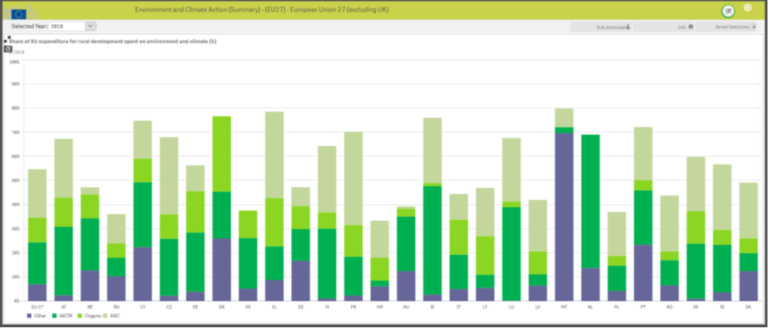
There is the potential for conflicting obligations between these three obligations. If a Member State has allocated a high share (more than 45%) of its EAFRD spending in the 2014-2020 period to AEC measures, it would be unable to meet the minimum 55% share of resources to be allocated to economic and social development in rural areas. In this situation, the Regulation allows the Member State either to derogate from the 55% obligation or to derogate from the non-regression principle. It is thus left to the Member State to decide which priority should apply. As shown in the chart below, many Member States will likely find themselves in this position (the chart shows the situation in one year, 2018, whereas the ‘no regression’ principle refers to the RDP as a whole, but data for earlier years suggests the 2018 figures may if anything be conservative).
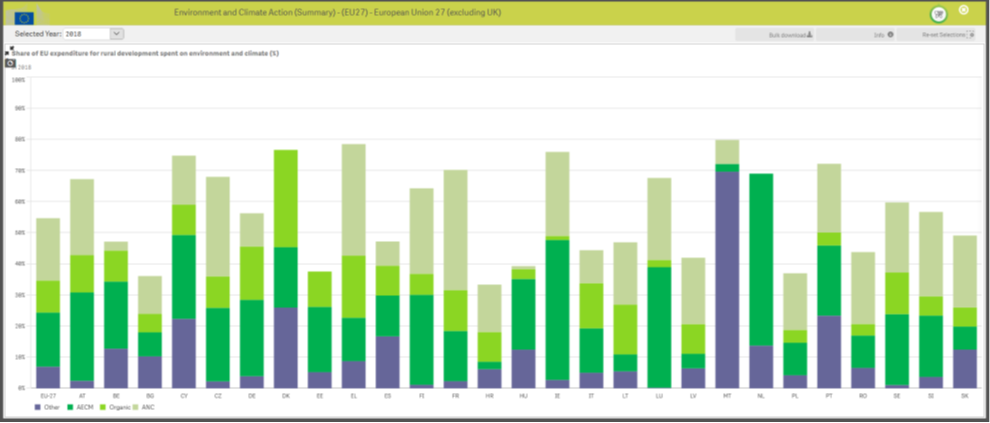 Source: DG AGRI Agri Food Data Portal
The maximum EAFRD contribution rate is set at 100%. This means there is no requirement on Member States to provide matching funds to draw down the Recovery Instrument money. However, they are at liberty to add to this EAFRD funding in their amended RDPs if they wish.
The other main change is that the maximum support rate for beneficiaries (both primary producers and those processing and marketing agricultural products) receiving aid for physical investments under the EURI in so-called ‘other’ regions (regions that are not less developed nor transition regions so, effectively, developed regions) is increased. This is normally 40% for physical investments but can be increased by up to 20 percentage points for specific investments (young farmers, collective investments, areas facing natural constraints, EIP operations).
These support rates can now be increased by up to a further 35 percentage points for operations “contributing to a resilient, sustainable and digital economic recovery”, provided that the maximum combined support does not exceed 90%. Even as a stimulus to economic recovery, whether it makes sense to grant aid physical investments in the developed rural regions in Europe up to 90% is open to question. Certainly, existing businesses might well be concerned if a competitor pops up on their doorstep with a 90% public subsidy of their investment costs.
Conclusions
The Commission’s motive to hold back EURI reinforcement of EAFRD spending for one year until the CAP Strategic Plans were supposed to be in place had some logic. However, given that their purpose is to assist recovery and to ‘build back better’ after the COVID-19 pandemic, it makes sense to make these funds available to Member States at the earliest opportunity. The Commission had already decided to frontload the MFF portion of EAFRD funding in 2021, with the result that there is a significant increase in resources available for commitment under revised RDPs. The attached spreadsheet presents the EAFRD funds available by Member State. It is now up to Member States to submit revised RDPs for approval to show how they plan to spend these resources and to disburse these funds to beneficiaries.
The expressed objective of these EURI funds is to pave the way for a resilient, sustainable and digital economic recovery in line with the objectives of the Union’s environmental and climate commitments and with the new ambitions set out in the European Green Deal. This will be ensured by setting out three, potentially conflicting, principles: ‘no regression’ in the share of EURI funds allocated to AEC measures; a minimum 37% share devoted to AEC measures, animal welfare and LEADER; and a minimum 55% share devoted to economic and social development in rural areas.
Member States can avail of a derogation from this 55% minimum if funds are needed to meet their ‘no regression’ commitment, but it is also the case that Member States can derogate from their ‘no regression’ commitment if they wish to increase spending on grant-aiding physical investments on farms, for example. There must be at least a danger in this construction that progress towards the green transition is overshadowed by investments that simply support production regardless of the warm words in the Regulation that this investment “contributes to a resilient, sustainable and digital economic recovery in line, inter alia, with the agrienvironment-climate objectives pursued under this Regulation”.
This post was written by Alan Matthews

O artigo foi publicado originalmente em CAP Reform.
























Discussão sobre este post