














Sem Resultado
Ver Todos Os Resultados
Newsletters
Agroportal
  • Login
  • Registar
  • Sugeridas
  • Notícias
    • Notícias
    • Nacional
    • Internacional
    • Comunicados

    PS defende instalação do Centro de Competências da Caça e Biodiversidade em Mértola

    Agricultor pulveriza vinha perto de escola: Duas funcionárias no hospital

    wolf

    “Salvar o lobo não pode significar condenar raças autóctones”, alertam criadores

    WOAH lança o relatório anual «The State of the World’s Animal Health 2026»

    Comissão Europeia pt

    Comissão Europeia lança consulta pública sobre as Diretivas Aves e Habitats

    Alemanha abre fábrica que transforma resíduos vegetais em plásticos

    Azeite português acelera rumo à liderança global, mas enfrenta desafio crítico da mão de obra e da inovação

    Feira Mostra de Mação regressa em julho com nova imagem e aposta no presunto

    Autarquia de Sintra aprova adesão à cogestão do Parque Natural

  • Opinião
    Manuel Chaveiro Soares

    Importa criar condições para melhorar a competitivade agrícola

    António Covas

    O mundo agro rural, entre o bio produtivismo e o pós-produtivismo

    Valorizar o azeite português: um desígnio coletivo para o futuro

    Apoios ao Investimento Agrícola: Permanentes, Estruturados e sem Ilusões

    A Falácia das Taxas: Quem paga aos agricultores pelo carbono que sequestram?

    PARCA: da coragem inicial à impotência institucional

    João Dinis

    Pastores e queijo da serra

    Sofia Almeida

    O lobo-ibérico é um teste à seriedade das políticas de conservação

    Jovem Empresário Rural Não Agrícola, Precisam-se!

  • Eventos
  • Dossiers

    Dossiers I

    • Agricultura Biológica
    • Apoios
    • Artigos Técnicos
    • Biossoluções
    • Cadeia Alimentar
    • Fertilizantes
    • Financiamento
    • Fitofarmacêuticos

    Dossiers II

    • Florestas
    • Futuro da PAC
    • Inovação
    • Mercados
    • Newsletters e Revistas
    • Recomendações Agroflorestais
    • Seguros

    Últimas

    Agricultor pulveriza vinha perto de escola: Duas funcionárias no hospital

    13/05/2026

    Alemanha abre fábrica que transforma resíduos vegetais em plásticos

    13/05/2026

    Estudo | Cientistas descobrem um gene que ajuda sementes de tomate a germinar em condições de calor extremo

    13/05/2026

    Execução das áreas de gestão de paisagem a diferentes velocidades – Governo

    13/05/2026

    Bruxelas pondera usar receitas do mercado de carbono para aliviar custos dos fertilizantes

    13/05/2026

    Predicting financial distress in Iberian farms: unveiling the fragility of small-scale agriculture

    13/05/2026
  • Serviços
    • Diretório
    • Emprego
    • Máquinas Agrícolas
    • Meteorologia
    • Terrenos Agrícolas
    • Arquivo Agroportal
Agroportal
  • Sugeridas
  • Notícias
    • Notícias
    • Nacional
    • Internacional
    • Comunicados

    PS defende instalação do Centro de Competências da Caça e Biodiversidade em Mértola

    Agricultor pulveriza vinha perto de escola: Duas funcionárias no hospital

    wolf

    “Salvar o lobo não pode significar condenar raças autóctones”, alertam criadores

    WOAH lança o relatório anual «The State of the World’s Animal Health 2026»

    Comissão Europeia pt

    Comissão Europeia lança consulta pública sobre as Diretivas Aves e Habitats

    Alemanha abre fábrica que transforma resíduos vegetais em plásticos

    Azeite português acelera rumo à liderança global, mas enfrenta desafio crítico da mão de obra e da inovação

    Feira Mostra de Mação regressa em julho com nova imagem e aposta no presunto

    Autarquia de Sintra aprova adesão à cogestão do Parque Natural

  • Opinião
    Manuel Chaveiro Soares

    Importa criar condições para melhorar a competitivade agrícola

    António Covas

    O mundo agro rural, entre o bio produtivismo e o pós-produtivismo

    Valorizar o azeite português: um desígnio coletivo para o futuro

    Apoios ao Investimento Agrícola: Permanentes, Estruturados e sem Ilusões

    A Falácia das Taxas: Quem paga aos agricultores pelo carbono que sequestram?

    PARCA: da coragem inicial à impotência institucional

    João Dinis

    Pastores e queijo da serra

    Sofia Almeida

    O lobo-ibérico é um teste à seriedade das políticas de conservação

    Jovem Empresário Rural Não Agrícola, Precisam-se!

  • Eventos
  • Dossiers

    Dossiers I

    • Agricultura Biológica
    • Apoios
    • Artigos Técnicos
    • Biossoluções
    • Cadeia Alimentar
    • Fertilizantes
    • Financiamento
    • Fitofarmacêuticos

    Dossiers II

    • Florestas
    • Futuro da PAC
    • Inovação
    • Mercados
    • Newsletters e Revistas
    • Recomendações Agroflorestais
    • Seguros

    Últimas

    Agricultor pulveriza vinha perto de escola: Duas funcionárias no hospital

    13/05/2026

    Alemanha abre fábrica que transforma resíduos vegetais em plásticos

    13/05/2026

    Estudo | Cientistas descobrem um gene que ajuda sementes de tomate a germinar em condições de calor extremo

    13/05/2026

    Execução das áreas de gestão de paisagem a diferentes velocidades – Governo

    13/05/2026

    Bruxelas pondera usar receitas do mercado de carbono para aliviar custos dos fertilizantes

    13/05/2026

    Predicting financial distress in Iberian farms: unveiling the fragility of small-scale agriculture

    13/05/2026
  • Serviços
    • Diretório
    • Emprego
    • Máquinas Agrícolas
    • Meteorologia
    • Terrenos Agrícolas
    • Arquivo Agroportal
Sem Resultado
Ver Todos Os Resultados
Agroportal
ceifa trigo

Quest to reduce greenhouse gases needs modern farming techniques, not organics, research shows

por Genetic Literacy Project
26-07-2019 | 11:30
em Internacional
Tempo De Leitura: 7 mins
A A
Partilhe no FacebookPartilhe no TwitterEnviar para o WhatsappEnviar para o TelegramEnviar para o LinkedIn

[Fonte: GLP] To feed a global population that has expanded from 3.7 billion in 1970 to about 7.7 billion today, agriculture has had to up its game. During this same time, agriculture (both plants and livestock) production has more than doubled.

This means that more land has been transformed for agricultural production, which has garnered concern from ag officials, environmentalists and scientists alike. They all have voiced concerns about reduction in biodiversity, and the elimination of habitat for wild species of animals and plants.

Pro-organic (often anti-GMO, and anti-“corporate farming”) advocates point to the overall environmental benefits from growing organic (or at least smaller scale) crops. Many of those arguments follow the US Department of Agriculture’s National Organic Standards Board’s official definition of what is organic:

Organic agriculture is an ecological production management system that promotes and enhances biodiversity, biological cycles, and soil biological activity. It is based on minimal use of off-farm inputs and on management practices that restore, maintain, or enhance ecological harmony. The primary goal of organic agriculture is to optimize the health and productivity of interdependent communities of soil life, plants, animals and people.

More than atmospherics

But there’s another concern about the earthly impacts of agriculture: the composition of the atmosphere, and climate change. Most agricultural practices — tilling soil, using fossil fuel-driven equipment to apply fertilizers and pesticides, and the chemicals used themselves — all contribute to the release of greenhouse gases such as methane, carbon dioxide and certain organic chemicals (using that term in its technical, chemical sense) which have been connected to changes in the planet’s climate.

These emission sources come from livestock fermentation of food (producing methane), manure handling (methane and nitrous oxide), nitrogen fertilizer, rice cultivation (methane), equipment use (carbon dioxide), manufacturing of fertilizers, machinery and facilities (carbon dioxide), land use change (carbon dioxide) and fodder production (carbon dioxide, methane and nitrous oxide).

organic

So, fewer inputs and less land would mean less greenhouse gas released, right? Correct. However, a number of environmental advocates, including the $67 billion organic/natural food industry, have advocated a shift from conventional farming to organic growing, which they argue aids in preserving biodiversity and soils.

Biodiversity and soil health may be helped by some organic practices. However, the yield gap between organic and conventional growing remains persistent, and largely in favor of conventional farming. The USDA and other organizations have been researching ways to boost organic farming yields, including the use of conservation tillage. And there are a few crops like hay, rye and alfalfa, where organic systems show a similar or even larger yield than conventional approaches, according to research by agricultural consultant Steve Savage. But the overall gap remains stacked against organic. So far, it just takes less land to grow conventionally and intensively.
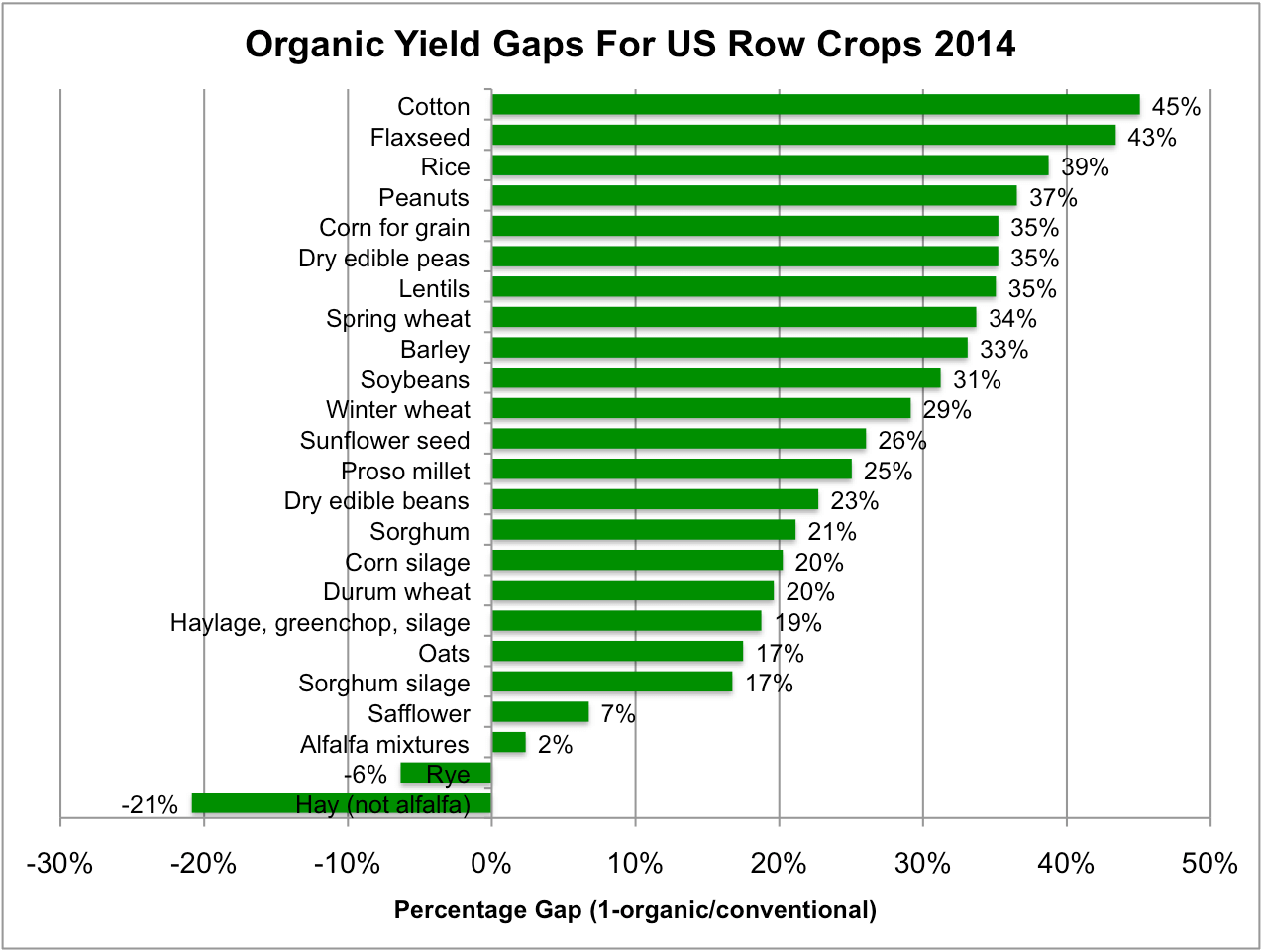
Row Crop Gaps
Organic yields are substantially lower for many major row crops

Industry waiting to exhale

Less land means fewer greenhouse gases, and intensive farming can squeeze more turnips and other foods out of the ground. A study in 2016 by researchers at the Universities of Copenhagen, Aberdeen and Greenwich (UK) analyzed 40 years of agricultural production and greenhouse gases from several regions around the world, including Central Asia, South America, Eastern Europe, the Middle East, Sub-Saharan Africa and North America.

A different tack on greenhouse gas emissions

The researchers took a different methodological tack in their study. Instead of doing what most climate change/agricultural output researchers do, they measured emissions in each geographic area by looking at emissions per unit of product. This created data on the actual intensity of greenhouse gas emissions for each agricultural product. This way, for example, they could tell that rice production in Asia and elsewhere contributed mightily to greenhouse gases, because of methane produced.

The study also revealed that the most industrialized countries, which used more technologically advanced inputs including but not limited to genetic modifications, emitted the least amount of greenhouse gas per product produced.

A great “uncoupling”

It also revealed that these technological advances have helped agriculture “uncouple” from greenhouse gas production. Overall, global greenhouse gas emission per unit of crop produced has decreased 39 percent for crops between 1970 and 2007, and decreased 44 percent for livestock during the same period. But this “uncoupling,” or decrease in greenhouse gases, has not been seen in developing countries, which are so far the source of that doubling in agricultural production.

cattle

Regional differences, they saw, were dramatic. Emissions per unit crop dropped by 94 percent in Oceania, by 27 percent in sub-Saharan Africa, by 56 percent in Europe, and an increase in GHGs per unit of 4 percent in North America. Now, that sounds like a contradiction. Why would North America go up and Africa go down, and still be called a decoupling from intensive ag? Because the land under agricultural use has actually been reduced in industrialized, intensive areas like North America, Europe and Oceania. The latter three areas have reduced agricultural regions by 10 percent (118 million hectares), while developing countries have increased their farming regions by 13 percent (447 million hectares). So proportionally, intensive agriculture emits less gas. North America ends up being the most climate efficient crop and (one of the most) efficient livestock producer, because while 14 percent of agricultural production came from North America in 2007, only 4 percent of greenhouse gas emissions did. And while production has increased steadily, total emissions have been relatively static (there’s that 4 percent number), with a total effect of reducing emissions.

Land use change (switching from wild lands to agriculture) and agriculture are responsible for a quarter of all greenhouse gas emissions from human acts. And 90 percent of emissions from those land use changes emanate from agriculture. That means that ag is the focal point for that 25 percent of greenhouse gas on earth. But agriculture’s getting more efficient, thanks to a range of technologies that keep greenhouse gases in the ground and reduce the need for land changes—and a growing area is genetic modifications, whether they be transgenic, cisgenic, gene editing, or more efficient breeding methods.

As the authors of the European study concluded “further intensification is necessary, so we need to make sure that this intensification is sustainable.”

A version of this article previously ran on the GLP on September 19, 2017.

Andrew Porterfield is a writer and editor, and has worked with numerous academic institutions, companies and non-profits in the life sciences. BIO. Follow him on Twitter @AMPorterfield.

The GLP featured this article to reflect the diversity of news, opinion and analysis. The viewpoint is the author’s own. The GLP’s goal is to stimulate constructive discourse on challenging science issues.
Imprimir Artigo
Publicação Anterior

Two-year Field Trial Shows Cry1Ie Maize Has No Effect on Soil Animals

Próxima Publicação

Défice da balança comercial portuguesa de produtos agrícolas e agroalimentares subiu em 2018

Artigos Relacionados

Últimas

Trade in agricultural products: €24.7 billion surplus

12/05/2026
Últimas

Plant Health 4 Life – reinforcing simple actions that protect plants

12/05/2026
EIT Food
Últimas

Trust in Europe’s food system is recovering – but gaps between actors persist, new report finds

12/05/2026
Próxima Publicação

Défice da balança comercial portuguesa de produtos agrícolas e agroalimentares subiu em 2018

Discussão sobre este post

Opinião

Manuel Chaveiro Soares
Últimas

Importa criar condições para melhorar a competitivade agrícola

por Manuel Chaveiro Soares
13/05/2026

Ler mais
António Covas
Últimas

O mundo agro rural, entre o bio produtivismo e o pós-produtivismo

por António Covas
10/05/2026

Ler mais

Subscrever as nossas newsletteres

Subscrever as nossas Newsletters Agroportal

Verifique na sua caixa de correio ou na pasta de spam para confirmar a sua subscrição.

Comunicados

WOAH lança o relatório anual «The State of the World’s Animal Health 2026»

13/05/2026
Comissão Europeia pt

Comissão Europeia lança consulta pública sobre as Diretivas Aves e Habitats

13/05/2026
Advertisement

Temas em destaque

Candidaturas PU Guerra Médio Oriente Mercosul ovibeja PAC pós 2027 Simplificação PAC Temporais vinho Água que Une

Eventos

Maio 2026
STQQSSD
     1 2 3
4 5 6 7 8 9 10
11 12 13 14 15 16 17
18 19 20 21 22 23 24
25 26 27 28 29 30 31
« Abr   Jun »

Sobre Nós

O Agroportal.pt é uma plataforma de informação digital que reúne a informação relevante sobre agricultura. Tem um foco na Política Agrícola Comum e a sua aplicação em Portugal.

Menu

  • Quem somos
  • Relatórios anuais
  • Envie-nos informação
  • Publicidade
  • Newsletters
  • Estatuto Editorial
  • Ficha técnica
  • Proteção de Dados Pessoais
  • Disclaimer
Facebook twitter Circle Instagram Rss Feed

© Agroportal. All Rights reserved.

  • Login
  • Registar
Sem Resultado
Ver Todos Os Resultados
  • Sugeridas
  • Notícias
    • Nacional
    • Internacional
    • Comunicados
  • Opinião
  • Eventos
  • Dossiers
    • Agricultura Biológica
    • Apoios
    • Artigos Técnicos
    • Biossoluções
    • Cadeia Alimentar
    • Fertilizantes
    • Financiamento
    • Fitofarmacêuticos
    • Florestas
    • Futuro da PAC
    • Inovação
    • Mercados e Cotações agrícolas
    • Newsletters e Revistas
    • Recomendações Agroflorestais
    • Seguros agrícolas
  • Serviços
    • Diretório
    • Emprego
    • Máquinas Agrícolas
    • Meteorologia
    • Terrenos Agrícolas
    • Arquivo Agroportal

© Agroportal. All Rights reserved.

Bem-Vindo De Volta!

Sign In with Facebook
Sign In with Google
OU

Faça login na sua conta abaixo

Esqueceu-se da senha? Registar

Criar Uma Nova Conta!

Sign Up with Facebook
Sign Up with Google
OU

Preencha os campos abaixo para se registar

* Ao se registar-se no nosso site, você concorda com os Termos e Condições e a Política de Privacidade .
Todos os campos são necessários. Entrar

Obter a sua senha

Indique por favor o seu nome de utilizador ou endereço de E-mail para repor a sua senha.

Entrar
Este site usa cookies. Ao continuar a utilizar este site, está a dar consentimento à utilização de cookies. Visite a nossa Política de Protecção de dados e Cookies.