


















Sem Resultado
Ver Todos Os Resultados
Newsletters
Agroportal
  • Login
  • Registar
  • Sugeridas
  • Notícias
    • Notícias
    • Nacional
    • Internacional
    • Comunicados

    PS/Açores pede informação detalhada sobre execução do programa “Agroacrescenta”

    Copa Cogeca

    Crise dos fertilizantes: a Comissão conclui a sua resposta a curto prazo, mas esta continua a ser insuficiente

    Porbatata acompanha debates estratégicos no Congresso Europatat 2026

    Federação Agrícola dos Açores

    Presidente da Federação Agrícola dos Açores exige firmeza na defesa do posei e da autonomia regional

    Bolieiro diz que usou “dureza das palavras” para reivindicar apoios para agricultores açorianos

    Comissão Europeia pt

    Comissão Europeia propõe ajuda financeira de 540 milhões de euros e outros apoios para agricultores que enfrentam crise no setor dos adubos

    Carneiro defende aumento da comparticipação no gasóleo agrícola e incentivos aos fertilizantes

    Parlamento aprova Lei de Política Criminal que prevê reclusos a limparem matas

    Bombeiros sem receber: atraso do Estado preocupa corporações em plena época de incêndios

  • Opinião

    Acordo UE-Mercosul: uma oportunidade estratégica para proteger e valorizar as marcas dos produtos agrícolas portugueses

    Barragens Não Resolvem Desertificação; Resolvem Estatística

    Água, agricultura e adaptação climática no Algarve: estamos a escolher as soluções certas?

    Manuel Chaveiro Soares

    Importa criar condições para melhorar a competitivade agrícola

    António Covas

    O mundo agro rural, entre o bio produtivismo e o pós-produtivismo

    Valorizar o azeite português: um desígnio coletivo para o futuro

    Apoios ao Investimento Agrícola: Permanentes, Estruturados e sem Ilusões

    A Falácia das Taxas: Quem paga aos agricultores pelo carbono que sequestram?

    PARCA: da coragem inicial à impotência institucional

  • Eventos
  • Dossiers

    Dossiers I

    • Agricultura Biológica
    • Apoios
    • Artigos Técnicos
    • Biossoluções
    • Cadeia Alimentar
    • Fertilizantes
    • Financiamento
    • Fitofarmacêuticos

    Dossiers II

    • Florestas
    • Futuro da PAC
    • Inovação
    • Mercados
    • Newsletters e Revistas
    • Recomendações Agroflorestais
    • Seguros

    Últimas

    Copa Cogeca

    Crise dos fertilizantes: a Comissão conclui a sua resposta a curto prazo, mas esta continua a ser insuficiente

    12/06/2026

    Bolieiro diz que usou “dureza das palavras” para reivindicar apoios para agricultores açorianos

    12/06/2026

    Carneiro defende aumento da comparticipação no gasóleo agrícola e incentivos aos fertilizantes

    12/06/2026

    Parlamento aprova Lei de Política Criminal que prevê reclusos a limparem matas

    12/06/2026

    Dos 32 mil hectares de floresta atingida pelas tempestades na zona Centro, o Estado só prioriza a limpeza de cerca de seis mil

    12/06/2026

    ForestSTATS assinala um ano de atividade ao serviço do conhecimento sobre a floresta portuguesa

    12/06/2026
  • Serviços
    • Diretório
    • Emprego
    • Máquinas Agrícolas
    • Meteorologia
    • Terrenos Agrícolas
    • Arquivo Agroportal
Agroportal
  • Sugeridas
  • Notícias
    • Notícias
    • Nacional
    • Internacional
    • Comunicados

    PS/Açores pede informação detalhada sobre execução do programa “Agroacrescenta”

    Copa Cogeca

    Crise dos fertilizantes: a Comissão conclui a sua resposta a curto prazo, mas esta continua a ser insuficiente

    Porbatata acompanha debates estratégicos no Congresso Europatat 2026

    Federação Agrícola dos Açores

    Presidente da Federação Agrícola dos Açores exige firmeza na defesa do posei e da autonomia regional

    Bolieiro diz que usou “dureza das palavras” para reivindicar apoios para agricultores açorianos

    Comissão Europeia pt

    Comissão Europeia propõe ajuda financeira de 540 milhões de euros e outros apoios para agricultores que enfrentam crise no setor dos adubos

    Carneiro defende aumento da comparticipação no gasóleo agrícola e incentivos aos fertilizantes

    Parlamento aprova Lei de Política Criminal que prevê reclusos a limparem matas

    Bombeiros sem receber: atraso do Estado preocupa corporações em plena época de incêndios

  • Opinião

    Acordo UE-Mercosul: uma oportunidade estratégica para proteger e valorizar as marcas dos produtos agrícolas portugueses

    Barragens Não Resolvem Desertificação; Resolvem Estatística

    Água, agricultura e adaptação climática no Algarve: estamos a escolher as soluções certas?

    Manuel Chaveiro Soares

    Importa criar condições para melhorar a competitivade agrícola

    António Covas

    O mundo agro rural, entre o bio produtivismo e o pós-produtivismo

    Valorizar o azeite português: um desígnio coletivo para o futuro

    Apoios ao Investimento Agrícola: Permanentes, Estruturados e sem Ilusões

    A Falácia das Taxas: Quem paga aos agricultores pelo carbono que sequestram?

    PARCA: da coragem inicial à impotência institucional

  • Eventos
  • Dossiers

    Dossiers I

    • Agricultura Biológica
    • Apoios
    • Artigos Técnicos
    • Biossoluções
    • Cadeia Alimentar
    • Fertilizantes
    • Financiamento
    • Fitofarmacêuticos

    Dossiers II

    • Florestas
    • Futuro da PAC
    • Inovação
    • Mercados
    • Newsletters e Revistas
    • Recomendações Agroflorestais
    • Seguros

    Últimas

    Copa Cogeca

    Crise dos fertilizantes: a Comissão conclui a sua resposta a curto prazo, mas esta continua a ser insuficiente

    12/06/2026

    Bolieiro diz que usou “dureza das palavras” para reivindicar apoios para agricultores açorianos

    12/06/2026

    Carneiro defende aumento da comparticipação no gasóleo agrícola e incentivos aos fertilizantes

    12/06/2026

    Parlamento aprova Lei de Política Criminal que prevê reclusos a limparem matas

    12/06/2026

    Dos 32 mil hectares de floresta atingida pelas tempestades na zona Centro, o Estado só prioriza a limpeza de cerca de seis mil

    12/06/2026

    ForestSTATS assinala um ano de atividade ao serviço do conhecimento sobre a floresta portuguesa

    12/06/2026
  • Serviços
    • Diretório
    • Emprego
    • Máquinas Agrícolas
    • Meteorologia
    • Terrenos Agrícolas
    • Arquivo Agroportal
Sem Resultado
Ver Todos Os Resultados
Agroportal

Trees and doodlebugs emit methane – the question is, how?

por Horizon - EU
06-01-2020 | 23:00
em Últimas, Internacional
Tempo De Leitura: 6 mins
A A
Partilhe no FacebookPartilhe no TwitterEnviar para o WhatsappEnviar para o TelegramEnviar para o LinkedIn

Because methane has more than 80 times the global warming potential of carbon dioxide over 20 years, the emissions from trees – and any changes in these due to global warming – may have significant implications for Earth’s climate.

‘We have seen aerobic methane emissions (from tree canopies), and these have a strong pattern over the day,’ said Dr Mari Pihlatie, associate professor in the Department of Agricultural Sciences at the University of Helsinki, Finland.

She and her team in the MEMETRE research project are tracing the methane to see if it is produced in the leaves alongside photosynthesis, or if it is soil-borne gas flowing up through the trunk, or from other activities in the trunk itself.

‘It seems that boreal tree canopies emit methane in the daytime, not in the night time, and that the methane emissions follow photosynthetic activity and radiation (sunlight),’ Dr Pihlatie said.

Seasons

The indications are that, rather than being linked to photosynthesis, these tree trunk emissions are more likely linked to soil-based methane production being transported through the trees to the atmosphere. Another possibility is that it’s produced through microbial methane formation inside the trunks themselves.

Methane fluxes from tree trunks also vary with the seasons, rising in the Nordic summers and declining in the cold, dark winters. This seasonal variability poses questions about what may happen to the trees’ contribution to the methane budget in the future, given changes in the global climate.

Dr Pihlatie’s research has been looking at pines, spruces and birches found in boreal forests in Finland and Sweden, which are typical of high northern latitudes in Europe, Asia and North America.

Her team is taking field measurements and carrying out experiments in controlled laboratory conditions, using stable carbon isotopes to identify the origin of methane emitted from trees. By feeding an enclosed tree with carbon dioxide using carbon-13, the researchers aim to identify if the carbon which appears in the methane emissions has been rapidly fixed by the leaves or conifer needles through photosynthesis, or if it is ‘older’ carbon from different processes within the tree.

‘We aim to understand the link between methane production and the tree’s physiological activity, like photosynthesis and transpiration.’

Dr Mari Pihlatie, University of Helsinki, Finland

Monitor

To monitor emissions in the canopy, the researchers have developed novel ways to enclose a branch in an airtight box, complete with lasers to continuously and automatically measure changes in gas flows and concentrations during daily and seasonal cycles.

‘In this way we aim to understand the link between methane production and the tree’s physiological activity, like photosynthesis and transpiration,’ Dr Pihlatie said.

Unravelling the methane process in trees – and the larger role of boreal forests – could provide a clearer picture of their contribution to the global methane budget, where the sources and sinks (stores) of methane are totted up. It could also help in trying to assess the future impact of climate change on these methane processes themselves.

‘Based on our measurements, the CH4 (methane) emissions from trees in the boreal forests do not significantly decrease the carbon sequestration capacity of the trees,’ Dr Pihlatie said, adding: ‘These growing trees always act as a carbon sink, no matter how much they emit CH4.’

Increasing

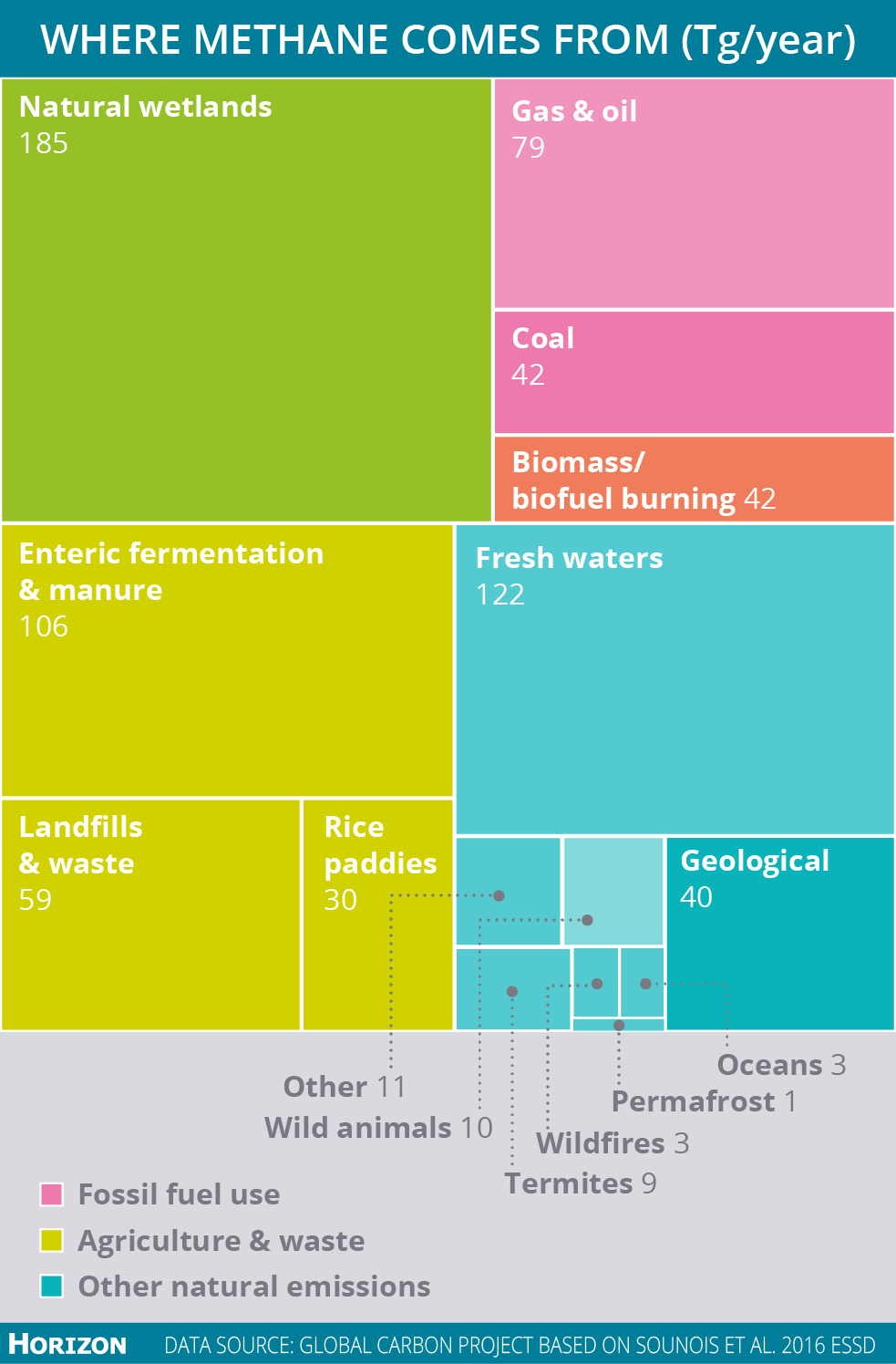
While global methane emission levels are much lower than for carbon dioxide, they have been increasing steadily in recent years, with figures from November 2019 showing a marked rise.

There are no definitive explanations yet of why this is the case, but some research has pointed to the dramatic increase in fracking for shale gas as a prime suspect for increases over the last decade.

But there’s also more to be understood about the detail of exactly what affects the methane budget and how this is changing.

Well-aerated soils, for example, act as net methane ‘sinks’ by absorbing about 4% of annual methane emissions globally, with underground microorganisms well known as methane consumers. But recent research shows this may be declining as climate change increases rainfall in temperate and tropical regions, and including methane emissions in these types of calculations may show a further decrease in the sink effect.

Among soil-dwelling animals, termites are significant methane emitters that are already factored into the global methane budget. But there has been little in-depth research on the role in the methane cycle of other underground creatures, such as beetles or millipedes, in well-aerated upland soils.

The methane emitted by insect larvae can be significant enough to warrant inclusion in the terrestrial methane cycle, said Dr Carolyn-Monika Görres, a soil ecologist in the Department of Applied Ecology at Hochschule Geisenheim University in Germany.

Doodlebugs

Her CH4ScarabDetect project included the first field research into methane emissions from the larvae of doodlebugs, or cockchafers, from the scarab beetle family.

Her field studies of the common cockchafer, Melolontha melolontha – a notable agricultural pest – and the forest cockchafer, M. hippocastani, showed significantly higher concentrations of methane than in laboratory conditions.

While the adults only live for about four to six weeks, their larvae live underground for three to four years, munching on roots – and producing methane.

Dr Görres and colleagues developed a system of acoustic sensors to monitor the doodlebug larvae underground, to record when they moved, ate and communicated.

The aim was to eavesdrop on the larvae without disturbing them, to see how their activities fit with methane flux measurements.

It may not be as simple as saying that because they emit methane, the larvae reduce the sink capacity of the soil, Dr Görres said.

The larval emissions create conditions conducive to methane-consuming microorganisms. And she thinks that over the longer term, when larvae are removed or reduce their methane emissions in certain phases of their life cycle, the soil could become a better sink as the microorganisms turn to atmospheric methane for food.

‘(Considering the entire methane budget), there is not a big difference between (total) global methane emissions and (total) global methane consumption, so if we can manage to increase the sink capacity of (upland) soils, then we have a chance of reducing methane concentrations in the atmosphere,’ Dr Görres said.

The research in this article was funded by the EU. If you liked this article, please consider sharing it on social media.

Imprimir Artigo
Publicação Anterior

FENAREG apresenta prioridades do regadio à Ministra da Agricultura

Próxima Publicação

Cotações – Ovinos e Caprinos – Informação Semanal – 30 Dezembro 2019 a 5 Janeiro 2020

Artigos Relacionados

Nacional

PS/Açores pede informação detalhada sobre execução do programa “Agroacrescenta”

12/06/2026
Copa Cogeca
Últimas

Crise dos fertilizantes: a Comissão conclui a sua resposta a curto prazo, mas esta continua a ser insuficiente

12/06/2026
Últimas

Porbatata acompanha debates estratégicos no Congresso Europatat 2026

12/06/2026
Próxima Publicação

Cotações – Ovinos e Caprinos – Informação Semanal – 30 Dezembro 2019 a 5 Janeiro 2020

Discussão sobre este post

Opinião

Últimas

Acordo UE-Mercosul: uma oportunidade estratégica para proteger e valorizar as marcas dos produtos agrícolas portugueses

por Luís Caixinhas
07/06/2026

Ler maisDetails
Últimas

Barragens Não Resolvem Desertificação; Resolvem Estatística

por Nuno Mamede Santos
24/05/2026

Ler maisDetails

Subscrever as nossas newsletteres

Subscrever as nossas Newsletters Agroportal

Verifique na sua caixa de correio ou na pasta de spam para confirmar a sua subscrição.

Comunicados

Copa Cogeca

Crise dos fertilizantes: a Comissão conclui a sua resposta a curto prazo, mas esta continua a ser insuficiente

12/06/2026

Porbatata acompanha debates estratégicos no Congresso Europatat 2026

12/06/2026
Advertisement

Temas em destaque

Candidaturas PU Guerra Médio Oriente Mercosul ovibeja PAC pós 2027 Simplificação PAC Temporais vinho Água que Une

Eventos

Junho 2026
STQQSSD
1 2 3 4 5 6 7
8 9 10 11 12 13 14
15 16 17 18 19 20 21
22 23 24 25 26 27 28
29 30      
« Mai   Jul »

Sobre Nós

O Agroportal.pt é uma plataforma de informação digital que reúne a informação relevante sobre agricultura. Tem um foco na Política Agrícola Comum e a sua aplicação em Portugal.

Menu

  • Quem somos
  • Relatórios anuais
  • Envie-nos informação
  • Publicidade
  • Newsletters
  • Estatuto Editorial
  • Ficha técnica
  • Proteção de Dados Pessoais
  • Disclaimer
Facebook twitter Circle Instagram Rss Feed

© Agroportal. All Rights reserved.

Bem-Vindo De Volta!

Sign In with Facebook
Sign In with Google
OR

Faça login na sua conta abaixo

Esqueceu-se da senha? Registar

Criar Uma Nova Conta!

Sign Up with Facebook
Sign Up with Google
OR

Preencha os campos abaixo para se registar

* Ao se registar-se no nosso site, você concorda com os Termos e Condições e a Política de Privacidade .
Todos os campos são necessários. Entrar

Obter a sua senha

Indique por favor o seu nome de utilizador ou endereço de E-mail para repor a sua senha.

Entrar
  • Login
  • Registar
Sem Resultado
Ver Todos Os Resultados
  • Sugeridas
  • Notícias
    • Nacional
    • Internacional
    • Comunicados
  • Opinião
  • Eventos
  • Dossiers
    • Agricultura Biológica
    • Apoios
    • Artigos Técnicos
    • Biossoluções
    • Cadeia Alimentar
    • Fertilizantes
    • Financiamento
    • Fitofarmacêuticos
    • Florestas
    • Futuro da PAC
    • Inovação
    • Mercados e Cotações agrícolas
    • Newsletters e Revistas
    • Recomendações Agroflorestais
    • Seguros agrícolas
  • Serviços
    • Diretório
    • Emprego
    • Máquinas Agrícolas
    • Meteorologia
    • Terrenos Agrícolas
    • Arquivo Agroportal

© Agroportal. All Rights reserved.

Este site usa cookies. Ao continuar a utilizar este site, está a dar consentimento à utilização de cookies. Visite a nossa Política de Protecção de dados e Cookies.