
















Sem Resultado
Ver Todos Os Resultados
Newsletters
Agroportal
  • Login
  • Registar
  • Sugeridas
  • Notícias
    • Notícias
    • Nacional
    • Internacional
    • Comunicados

    Gronelândia: Trump tem muito a perder com imposição de sobretaxas – ministra francesa

    UE-Mercosul: Preocupação, otimismo e fiscalização

    A Quadratura do Círculo Agro – Rui Veríssimo Batista

    navio contentores mar

    UE/Mercosul: Assinado acordo que cria a maior zona de livre-comércio do mundo

    canabis

    Iberfar quer chegar aos 200 milhões com canábis medicinal

    vinha no rio douro

    Deputado do JPP apresenta proposta para valorizar vinhos do Douro

    azeitonas em oliveira

    UE/Mercosul: UE estima aumento de 39% nas exportações totais e de 50% nos agroalimentares

    Créditos: Jorge Oliveira

    UE/Mercosul: Acordo assinado hoje representa “oportunidade” para Portugal

    Municípios do Alqueva esperam que PEAAP permita explorar melhor albufeira

  • Opinião
    Filipe Corrêa Figueira

    Estão a encurralar os Agricultores… e não vai acabar bem!

    Sinais dos tempos. Notas sobre a PAC e o Acordo UE-Mercosul

    Douro: não há excesso de produção, há excesso de oferta

    António Covas

    A inteligência coletiva territorial da 2ª ruralidade – As áreas de baixa densidade (ABD)

    Jaime Piçarra

    O que marcou 2025 e o que esperar para 2026

    Ines Marques Lopes

    Agribusiness: entre a profissionalização, o investimento e a sustentabilidade

    Biodiversidade da videira

    A doença do Fogo Bacteriano na pereira Rocha já destruiu 31% da produção nacional

    Manuel Chaveiro Soares

    Sobre a modernização das regras relativas ao bem-estar dos frangos

  • Eventos
  • Dossiers

    Dossiers I

    • Agricultura Biológica
    • Apoios
    • Artigos Técnicos
    • Biossoluções
    • Cadeia Alimentar
    • Fertilizantes
    • Financiamento
    • Fitofarmacêuticos

    Dossiers II

    • Florestas
    • Futuro da PAC
    • Inovação
    • Mercados
    • Newsletters e Revistas
    • Recomendações Agroflorestais
    • Seguros

    Últimas

    Almendras: sin apenas cambios en las cotizaciones

    18/01/2026

    Aceite de oliva: entre subidas y repeticiones en los precios

    18/01/2026

    Gronelândia: Trump tem muito a perder com imposição de sobretaxas – ministra francesa

    18/01/2026

    UE-Mercosul: Preocupação, otimismo e fiscalização

    18/01/2026

    UE/Mercosul: Assinado acordo que cria a maior zona de livre-comércio do mundo

    17/01/2026

    UE/Mercosul: UE estima aumento de 39% nas exportações totais e de 50% nos agroalimentares

    17/01/2026
  • Serviços
    • Diretório
    • Emprego
    • Máquinas Agrícolas
    • Meteorologia
    • Terrenos Agrícolas
    • Arquivo Agroportal
Agroportal
  • Sugeridas
  • Notícias
    • Notícias
    • Nacional
    • Internacional
    • Comunicados

    Gronelândia: Trump tem muito a perder com imposição de sobretaxas – ministra francesa

    UE-Mercosul: Preocupação, otimismo e fiscalização

    A Quadratura do Círculo Agro – Rui Veríssimo Batista

    navio contentores mar

    UE/Mercosul: Assinado acordo que cria a maior zona de livre-comércio do mundo

    canabis

    Iberfar quer chegar aos 200 milhões com canábis medicinal

    vinha no rio douro

    Deputado do JPP apresenta proposta para valorizar vinhos do Douro

    azeitonas em oliveira

    UE/Mercosul: UE estima aumento de 39% nas exportações totais e de 50% nos agroalimentares

    Créditos: Jorge Oliveira

    UE/Mercosul: Acordo assinado hoje representa “oportunidade” para Portugal

    Municípios do Alqueva esperam que PEAAP permita explorar melhor albufeira

  • Opinião
    Filipe Corrêa Figueira

    Estão a encurralar os Agricultores… e não vai acabar bem!

    Sinais dos tempos. Notas sobre a PAC e o Acordo UE-Mercosul

    Douro: não há excesso de produção, há excesso de oferta

    António Covas

    A inteligência coletiva territorial da 2ª ruralidade – As áreas de baixa densidade (ABD)

    Jaime Piçarra

    O que marcou 2025 e o que esperar para 2026

    Ines Marques Lopes

    Agribusiness: entre a profissionalização, o investimento e a sustentabilidade

    Biodiversidade da videira

    A doença do Fogo Bacteriano na pereira Rocha já destruiu 31% da produção nacional

    Manuel Chaveiro Soares

    Sobre a modernização das regras relativas ao bem-estar dos frangos

  • Eventos
  • Dossiers

    Dossiers I

    • Agricultura Biológica
    • Apoios
    • Artigos Técnicos
    • Biossoluções
    • Cadeia Alimentar
    • Fertilizantes
    • Financiamento
    • Fitofarmacêuticos

    Dossiers II

    • Florestas
    • Futuro da PAC
    • Inovação
    • Mercados
    • Newsletters e Revistas
    • Recomendações Agroflorestais
    • Seguros

    Últimas

    Almendras: sin apenas cambios en las cotizaciones

    18/01/2026

    Aceite de oliva: entre subidas y repeticiones en los precios

    18/01/2026

    Gronelândia: Trump tem muito a perder com imposição de sobretaxas – ministra francesa

    18/01/2026

    UE-Mercosul: Preocupação, otimismo e fiscalização

    18/01/2026

    UE/Mercosul: Assinado acordo que cria a maior zona de livre-comércio do mundo

    17/01/2026

    UE/Mercosul: UE estima aumento de 39% nas exportações totais e de 50% nos agroalimentares

    17/01/2026
  • Serviços
    • Diretório
    • Emprego
    • Máquinas Agrícolas
    • Meteorologia
    • Terrenos Agrícolas
    • Arquivo Agroportal
Sem Resultado
Ver Todos Os Resultados
Agroportal

Synthetic biology: Potential game changer for climate change adaptation in Africa

por Cornell Alliance for Science
31-08-2022 | 19:18
em Últimas, Internacional, Notícias inovação
Tempo De Leitura: 5 mins
A A
Partilhe no FacebookPartilhe no TwitterEnviar para o WhatsappEnviar para o TelegramEnviar para o LinkedIn

While the rapid expansion of synthetic biology has to date mainly focused on the microbial sciences and human health, it has capacity to impact diverse sectors of science including agriculture, climate change and the environment. This article focuses on examples of ongoing synbio innovations that could potentially contribute to improving the climate change adaptive capacity of communities in Africa.

The need for novel approaches to facilitate climate change adaptation in Africa has never been more urgent. The Inter-government Panel on Climate Change (IPCC) Working Group II Sixth Assessment Report puts a spotlight on countries in Africa as predicted “…to enter unprecedented high temperature climates earlier in this century than higher latitude countries…with the ability of adaptation responses to offset risk substantially reduced. Crop yield losses, even after adaptation, are projected to rise rapidly…limits to adaptation are already being reached in coral reef ecosystems… and many face more net losses than net gains in biodiversity.”

Synthetic biology (synbio) is a breakthrough technology that has potential to revolutionize scientific innovation for addressing some of the most systemic challenges of this century. Synbio involves artificially manufacturing of biological components, such as enzymes and cells, or functions and organisms, that don’t exist in nature. Existing organisms may also be altered to perform new useful functions. Synthetic biologists study gene sequences — the order of the four chemical building blocks called “bases” that make up the DNA molecule — to understand the relationship between the way these “bases” are laid out, and the functions and abilities of the organisms in which they are contained.  Once the “base sequence” of a certain section of DNA can be directly linked to a specific function, scientistic can then create imitations of that DNA section chemically in a laboratory, and cut out the undesirable section of and organism’s DNA and replace it with the new manufactured section, so that they produce the desired proteins, characteristics or functions.

Biodiversity conservation. Coral reefs, which are mostly found in shallow oceans along the coastline, provide the perfect place for marine life to thrive, especially colourful fish. African corals are a big tourist draw. Reefs along the east coast of Africa and the islands of Zanzibar, Seychelles and Madagascar provide jobs to thousands in diving and other allied industries. Bleaching and dying of coral reefs caused by ocean warming due to by climate change are one of the biggest threats to oceanic biodiversity. Scientists from Stanford University in California demonstrated how gene editing can be used to pinpoint genes involved in corals’ ability to withstand heat stress. This understanding strengthens efforts to identify potentially more resilient populations and develop and assess possible ameliorating actions.

Addressing challenges in agriculture due to rainfall variability. Much of African agriculture’s vulnerability to climate change lies in the fact that its agricultural systems remain largely rain-fed. Increased temperatures, especially in the number of extreme hot days, as well as changes in precipitation, are the main climatic variables affecting agriculture on the African continent. Synthetic biologists have identified the genes that encourage a plant’s root system to grow deeper into the soil to enable plants access lower water tables. They plan to engineer genetic pathways to prompt deeper roots, which will enable crop plants to resist stress, sequester more carbon and enrich the soil. This discovery could help scientists understand how plants address seasonal variance in rainfall and how to help plants adapt to changing climates.

Clean energy. The International Renewable Agency (IRENA) called for special attention to increase energy efficiency, electrify heating and capitalize on synthetic fuels and feedstocks in industry if the world was to try to limit the rise in global temperatures by 2050 to 1.5°C above pre-industrial levels . Africa, despite its vast natural resources for renewable energy lags behind in its lean energy transition aspirations due to limitations in technology and finance.  Synbio researchers have identified an organism that naturally makes ethanol from industrial waste gases. This organism was engineered with “pathways” from other organisms to improve its performance, and is able to produce unique molecules for valuable chemicals and fuels. The first commercial plant in China using this technology has produced over seven million gallons of ethanol from steel mill emissions that can be converted into jet fuel and other products.
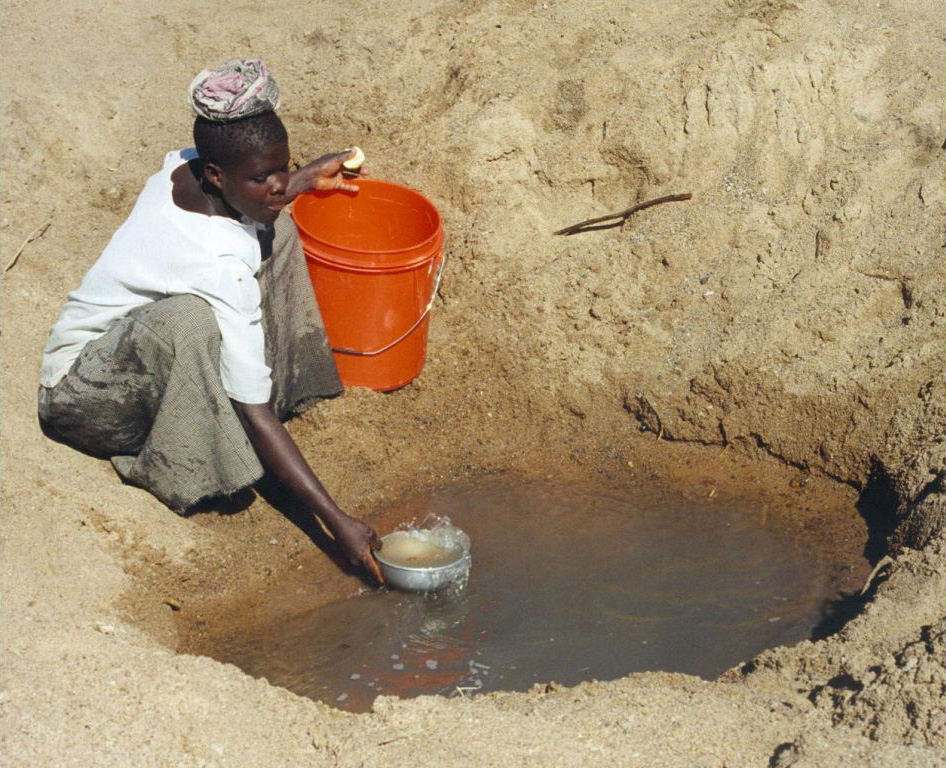
In Mwamanongu Village, Tanzania, water most often comes from open holes dug in the sand of dry riverbeds and is invariably contaminated. Photo: Wikipedia creative commons

Clean water. Portable scarcity is one of the predicted outcomes of climate change in Africa due to increase in the temporal and spatial variability of precipitation, coupled with increased unpredictability.  It has been estimated that by 2025, 14 countries Africa will face scarcity, and 11 countries will face water stress. Already, about one-third of the people in the region live in drought-prone areas, and there is one country where one-sixth of the drinking water supply in one city comes from recycled sewage that has been put through very sophisticated treatment processes.

Researchers are developing synthetic organisms as sentinels and signalers to engineer the formation and dissolution of biofilms and to optimize the recovery of valuable products in the anaerobic treatment of wastewater. One company uses synthetic biology to create a granular material that attracts and sticks to micropollutants such as pesticides, pharmaceuticals, and certain chemicals in wastewater.

The above examples in no way encompass the full scope of applications of synthetic biology for climate change adaptation in Africa, they are however, a primer to demonstrate the diversity of use and potential critical importance of this new technology to the region. Partnerships in developing the science and careful and efficient regulation have been highlighted as key drivers for the advancement of Sybio in Africa.

Celia Tebandeke Nalwadda conducted this research as a Hubert H. Humphrey Fellow.

O artigo foi publicado originalmente em Cornell Alliance for Science.
Imprimir Artigo
Publicação Anterior

“Setor do leite vive maior crise dos últimos 20 anos”, alerta líder da Agros

Próxima Publicação

Incêndios: Fogo que deflagrou em Sabrosa com 3 frentes, duas a ceder aos meios

Artigos Relacionados

faça chuva faça sol
Últimas

Faça Chuva Faça Sol – T10 Ep.2

18/01/2026
Últimas

Gronelândia: Trump tem muito a perder com imposição de sobretaxas – ministra francesa

18/01/2026
Internacional

UE-Mercosul: Preocupação, otimismo e fiscalização

18/01/2026
Próxima Publicação
bombeiros

Incêndios: Fogo que deflagrou em Sabrosa com 3 frentes, duas a ceder aos meios

Opinião

Filipe Corrêa Figueira
Últimas

Estão a encurralar os Agricultores… e não vai acabar bem!

por Filipe Corrêa Figueira
18/01/2026

Ler mais
Últimas

Sinais dos tempos. Notas sobre a PAC e o Acordo UE-Mercosul

por António Themudo Barata
11/01/2026

Ler mais

Subscrever as nossas newsletteres

Subscrever as nossas Newsletters Agroportal

Verifique na sua caixa de correio ou na pasta de spam para confirmar a sua subscrição.

Comunicados

Governo lança apoio de 12,1 milhões de euros para aquisição de máquinas para apoio à gestão florestal e prevenção contra incêndios

16/01/2026

Produtores de leite e de carne preocupados com baixa de preços à produção reclamam medidas do Governo

16/01/2026
Advertisement

Temas em destaque

Candidaturas PU Eleições PAC pós 2027 Presi Simplificação PAC Água que Une

Eventos

Janeiro 2026
STQQSSD
    1 2 3 4
5 6 7 8 9 10 11
12 13 14 15 16 17 18
19 20 21 22 23 24 25
26 27 28 29 30 31  
« Dez   Fev »

Sobre Nós

O Agroportal.pt é uma plataforma de informação digital que reúne a informação relevante sobre agricultura. Tem um foco na Política Agrícola Comum e a sua aplicação em Portugal.

Menu

  • Quem somos
  • Relatórios anuais
  • Envie-nos informação
  • Publicidade
  • Newsletters
  • Estatuto Editorial
  • Ficha técnica
  • Proteção de Dados Pessoais
  • Disclaimer
Facebook twitter Circle Instagram Rss Feed

© Agroportal. All Rights reserved.

  • Login
  • Registar
Sem Resultado
Ver Todos Os Resultados
  • Sugeridas
  • Notícias
    • Nacional
    • Internacional
    • Comunicados
  • Opinião
  • Eventos
  • Dossiers
    • Agricultura Biológica
    • Apoios
    • Artigos Técnicos
    • Biossoluções
    • Cadeia Alimentar
    • Fertilizantes
    • Financiamento
    • Fitofarmacêuticos
    • Florestas
    • Futuro da PAC
    • Inovação
    • Mercados e Cotações agrícolas
    • Newsletters e Revistas
    • Recomendações Agroflorestais
    • Seguros agrícolas
  • Serviços
    • Diretório
    • Emprego
    • Máquinas Agrícolas
    • Meteorologia
    • Terrenos Agrícolas
    • Arquivo Agroportal

© Agroportal. All Rights reserved.

Bem-Vindo De Volta!

Sign In with Facebook
Sign In with Google
OU

Faça login na sua conta abaixo

Esqueceu-se da senha? Registar

Criar Uma Nova Conta!

Sign Up with Facebook
Sign Up with Google
OU

Preencha os campos abaixo para se registar

* Ao se registar-se no nosso site, você concorda com os Termos e Condições e a Política de Privacidade .
Todos os campos são necessários. Entrar

Obter a sua senha

Indique por favor o seu nome de utilizador ou endereço de E-mail para repor a sua senha.

Entrar
Este site usa cookies. Ao continuar a utilizar este site, está a dar consentimento à utilização de cookies. Visite a nossa Política de Protecção de dados e Cookies.