

















Sem Resultado
Ver Todos Os Resultados
Newsletters
Agroportal
  • Login
  • Registar
  • Sugeridas
  • Notícias
    • Notícias
    • Nacional
    • Internacional
    • Comunicados
    IVV

    Apuramento da Produção de Vinho na Campanha 2025/2026

    Governo delega a organizações de agricultores apoio à submissão de ajudas

    Ministério da Agricultura e Mar reforça proximidade com agricultores

    Agricultura na UE: Preços sobem 3%, custos quase estagnados

    CM Paredes

    Município de Paredes faz balanço dos incêndios rurais e aposta na vigilância e prevenção em 2026

    Dia Internacional da Dieta Mediterrânica: um reconhecimento global de um património vivo

    Garantia Mútua conclui fusão para ganhar dimensão e eficácia

    centro pinus

    Votos de Boas Festas do Centro PINUS

    INE estatistica logo

    Estado do ambiente – 2024

  • Opinião

    A doença do Fogo Bacteriano na pereira Rocha já destruiu 31% da produção nacional

    Manuel Chaveiro Soares

    Sobre a modernização das regras relativas ao bem-estar dos frangos

    José Martino

    De indefinições a decisões: o que falta à política agrícola portuguesa

    Ricardo Dinis

    Açafrão – A ilusão das Culturas Caras

    Quando o preço da carne se torna arma política

    Da vontade à realidade – boas intenções de Bruxelas que deixam dúvidas

    José Martino

    Balcão Único do Prédio (BUPi)

    Não é o futuro: a IA deve ser o presente nas explorações agrícolas e florestais portuguesas

    António Covas

    Serviços de ecossistema, a prioridade estrutural da política agro rural

  • Eventos
  • Dossiers

    Dossiers I

    • Agricultura Biológica
    • Apoios
    • Artigos Técnicos
    • Biossoluções
    • Cadeia Alimentar
    • Fertilizantes
    • Financiamento
    • Fitofarmacêuticos

    Dossiers II

    • Florestas
    • Futuro da PAC
    • Inovação
    • Mercados
    • Newsletters e Revistas
    • Recomendações Agroflorestais
    • Seguros

    Últimas

    Governo delega a organizações de agricultores apoio à submissão de ajudas

    19/12/2025
    Alan Matthews

    2025 was a record year for farm income, though not for all

    19/12/2025

    Portugal registou o maior crescimento florestal (11,1%) da UE em 2023 – Eurostat

    19/12/2025

    China cumpriu já mais de metade do seu compromisso de compra de soja dos EUA – imprensa

    19/12/2025

    Governo da Madeira avalia apoio extraordinário aos agricultores afetados pela depressão Emília

    18/12/2025

    UE prolonga prazo para implementar regras que livram mercado de produtos da desflorestação

    18/12/2025
  • Serviços
    • Diretório
    • Emprego
    • Máquinas Agrícolas
    • Meteorologia
    • Terrenos Agrícolas
    • Arquivo Agroportal
Agroportal
  • Sugeridas
  • Notícias
    • Notícias
    • Nacional
    • Internacional
    • Comunicados
    IVV

    Apuramento da Produção de Vinho na Campanha 2025/2026

    Governo delega a organizações de agricultores apoio à submissão de ajudas

    Ministério da Agricultura e Mar reforça proximidade com agricultores

    Agricultura na UE: Preços sobem 3%, custos quase estagnados

    CM Paredes

    Município de Paredes faz balanço dos incêndios rurais e aposta na vigilância e prevenção em 2026

    Dia Internacional da Dieta Mediterrânica: um reconhecimento global de um património vivo

    Garantia Mútua conclui fusão para ganhar dimensão e eficácia

    centro pinus

    Votos de Boas Festas do Centro PINUS

    INE estatistica logo

    Estado do ambiente – 2024

  • Opinião

    A doença do Fogo Bacteriano na pereira Rocha já destruiu 31% da produção nacional

    Manuel Chaveiro Soares

    Sobre a modernização das regras relativas ao bem-estar dos frangos

    José Martino

    De indefinições a decisões: o que falta à política agrícola portuguesa

    Ricardo Dinis

    Açafrão – A ilusão das Culturas Caras

    Quando o preço da carne se torna arma política

    Da vontade à realidade – boas intenções de Bruxelas que deixam dúvidas

    José Martino

    Balcão Único do Prédio (BUPi)

    Não é o futuro: a IA deve ser o presente nas explorações agrícolas e florestais portuguesas

    António Covas

    Serviços de ecossistema, a prioridade estrutural da política agro rural

  • Eventos
  • Dossiers

    Dossiers I

    • Agricultura Biológica
    • Apoios
    • Artigos Técnicos
    • Biossoluções
    • Cadeia Alimentar
    • Fertilizantes
    • Financiamento
    • Fitofarmacêuticos

    Dossiers II

    • Florestas
    • Futuro da PAC
    • Inovação
    • Mercados
    • Newsletters e Revistas
    • Recomendações Agroflorestais
    • Seguros

    Últimas

    Governo delega a organizações de agricultores apoio à submissão de ajudas

    19/12/2025
    Alan Matthews

    2025 was a record year for farm income, though not for all

    19/12/2025

    Portugal registou o maior crescimento florestal (11,1%) da UE em 2023 – Eurostat

    19/12/2025

    China cumpriu já mais de metade do seu compromisso de compra de soja dos EUA – imprensa

    19/12/2025

    Governo da Madeira avalia apoio extraordinário aos agricultores afetados pela depressão Emília

    18/12/2025

    UE prolonga prazo para implementar regras que livram mercado de produtos da desflorestação

    18/12/2025
  • Serviços
    • Diretório
    • Emprego
    • Máquinas Agrícolas
    • Meteorologia
    • Terrenos Agrícolas
    • Arquivo Agroportal
Sem Resultado
Ver Todos Os Resultados
Agroportal
dna

What to Watch for in 2020 Crop Genetics

por Agroportal
20-02-2020 | 17:45
em Últimas, Internacional, Notícias inovação, Inovação, Dossiers
Tempo De Leitura: 6 mins
A A
Partilhe no FacebookPartilhe no TwitterEnviar para o WhatsappEnviar para o TelegramEnviar para o LinkedIn

By Kevin Folta

Two decades ago, we were waking up and celebrating that our computers didn’t melt down on New Year’s Day. We could still tote a bottle of iced tea through an airport security line, and we were on the front side of a stock market bubble bloated with tech stocks and ready to burst.

At the same time, scientists were painstakingly sorting out the genetic blueprint of the human being. They were also deciphering the genetic code of several plants and other organisms. New tools called microarrays allowed scientists to examine a snapshot of when, where and how genes were switched on — something they could always do one at a time, but now could analyze thousands in one experiment.

These breakthroughs marked the birth of the genomics era, a time when scientists were able to analyze large sets of genetic information en masse, rather than grinding along studying only one or maybe a few genes in a career.

Since the millennium rolled over 20 years ago, the pace of genetic discovery has only accelerated. Nobody could have predicted how far our technology would advance. However, in some cases, good technology has stalled due to politics and pushback. Here are some things you might expect to see in 2020:

1) PUTTING MICROBES TO WORK

The soil space around the plant’s roots is teeming with life, including millions of organisms that colonize this tiny universe. This soil microbiome is better understood every day, and scientists are isolating (or in some cases creating) bacteria that inhabit it and form tight associations with the plant — fixing nitrogen, competing against pathogens or helping resist drought stress.

While these breakthroughs are mostly in the lab, they are starting to reach the field, and the results are promising. Ultimately, growers also may be cultivating the microbial population, as microscopic farming may have great benefit for crop production.

2) MORE GENE-EDITED CROPS HIT THE FIELD

Gene editing is the process by which scientists create a custom change in DNA. The change is usually deletion of a single letter of the DNA code, removing one “base” of information from the billions that make up an organism. That’s like taking one second out of the last 100 years; it is that precise.

This innovation allows scientists to engineer traits in crops with great speed compared to standard breeding techniques. Traits are created one at a time, rather than by moving a good trait by breeding. Sexual crosses bring along other genetic baggage; you can’t move a good gene without adversely affecting something else. Gene editing means that new improved varieties can be produced in years instead of decades. It is much less expensive, too.

Gene editing is sometimes known by its technical acronym names (CRISPR, TALEN, etc.). It has only been widely used in crop plants for a few years. New designer plants have been evaluated in laboratories and field trials, and now will reach the farmers’ fields for full-scale production.

Current federal regulatory processes consider such minor and precise alterations to be non-consequential. No foreign DNA is added, so there are no significant regulatory hurdles. This means more products faster, made by a larger number of companies, universities and government laboratories.

Some improved crop varieties are already in the field, including high-oil soybean and herbicide-resistant canola. In 2020, more herbicide-resistant crops will allow sulfonylurea-based weed control strategies that may be used alone or in rotation with glyphosate-based herbicides. There will be new crops with improved yields, disease resistance, better postharvest quality and drought tolerance. Companies in this area include startups like Cibus, Calyxt and Yield10 Bioscience, along with large companies like Corteva, Bayer, BASF and Syngenta.

3) FASTER BREEDING WITH GWAS

Genome Wide Association Studies (GWAS) is a statistical method enabling rapid variety development by comparing massive data sets of DNA sequence information. Gene editing is helpful if you know the gene you want to edit out. However, if you want to move a trait but are unsure which gene causes the trait, alternative strategies like GWAS are extremely useful.

GWAS compares traits to the presence of DNA signatures called “markers.” The process tests which plant traits typically occur at the same time that a specific DNA marker is present. When plant breeders see strong agreement between the presence of a trait and a presence of a marker, the seedlings of crosses may be analyzed for those same DNA features. Young plants containing the markers are kept while the others are discarded. This process allows breeders to focus on the progeny that likely possess important traits, meaning new varieties are developed more quickly and with lower costs.

4) BIOFORTIFIED FOODS FINALLY REACH THE FOOD INSECURE

Just before Y2K, scientists announced that they had a potential solution to malnutrition in developing countries. While some malnourishment is based on a caloric deficit, millions of cases are directly caused by micronutrient deficiency, as diets lack vitamin A, iron or zinc.
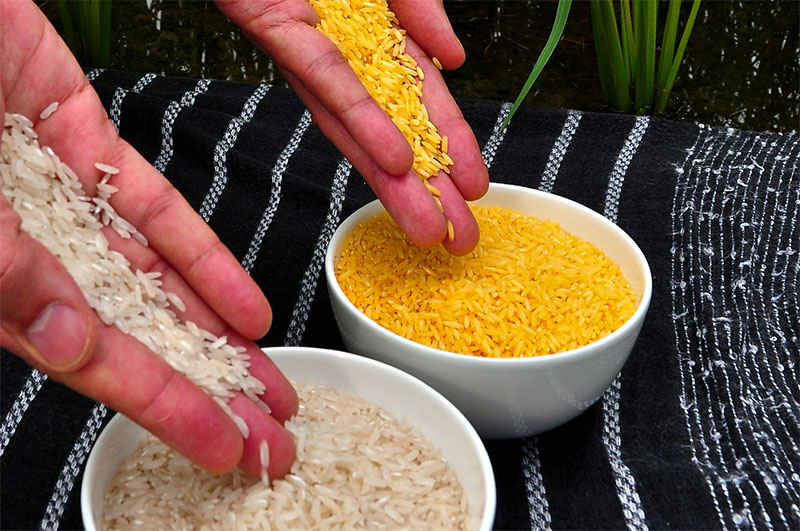
Genetically engineered golden rice (bowl on right) contains beta carotene to provide vitamin A. (Photo courtesy of the International Rice Research Institute)

In the late 1990s, scientists transferred genes from beta-carotene-rich plants (beta-carotene is the orange pigment in carrots) to rice, a world food staple. The new product, called golden rice, contains beta carotene to provide vitamin A to the food insecure. Because it was genetically engineered, many groups opposed its deployment, even if it could save lives. It also had some shortcomings with respect to affecting rice yields and possibly insufficient levels of beta carotene. However, the innovation was an important first step, and after 20 years it finally will reach consumers in developing countries this year.

5) NEW CROPS FOR OLD LAND

There are literally hundreds of crops, or varieties, that are not cultivated because they have a central flaw or two that make them unsuitable for large-scale production. While fruit quality might be good, issues like susceptibility to disease, poor shipping quality or insufficient yield limit their commercial propagation.

As mentioned previously, the practice of gene editing allows scientists to make the surgical genetic corrections that can adjust a deleterious trait or two. Companies like Pairwise are using gene editing to rapidly adapt these promising candidates to variety status. It is likely that novel specialty crops will make their way into farmers’ fields, producing high-value fruits and vegetables with unique consumer appeal.

Kevin Folta is a horticultural sciences professor at the University of Florida in Gainesville.

O artigo foi publicado originalmente em VSCNews.

Imprimir Artigo
Publicação Anterior

Nuno Russo: “A nossa missão é assegurar a manutenção das melhores condições para a preservação do nosso património agrícola”

Próxima Publicação

Infographic: Without improved crop yields, farmers would need a lot more land to feed us

Artigos Relacionados

IVV
Últimas

Apuramento da Produção de Vinho na Campanha 2025/2026

19/12/2025
Nacional

Governo delega a organizações de agricultores apoio à submissão de ajudas

19/12/2025
Últimas

Em 20 anos, o sistema Valorfito fez um ótimo trabalho

19/12/2025
Próxima Publicação
colheita trigo

Infographic: Without improved crop yields, farmers would need a lot more land to feed us

Discussão sobre este post

Opinião

Últimas

A doença do Fogo Bacteriano na pereira Rocha já destruiu 31% da produção nacional

por João Azevedo
14/12/2025

Ler mais
Manuel Chaveiro Soares
Últimas

Sobre a modernização das regras relativas ao bem-estar dos frangos

por Manuel Chaveiro Soares
07/12/2025

Ler mais

Subscrever as nossas newsletteres

Subscrever as nossas Newsletters Agroportal

Verifique na sua caixa de correio ou na pasta de spam para confirmar a sua subscrição.

Comunicados

IVV

Apuramento da Produção de Vinho na Campanha 2025/2026

19/12/2025

Ministério da Agricultura e Mar reforça proximidade com agricultores

19/12/2025
Advertisement

Temas em destaque

Candidaturas PU PAC pós 2027 Simplificação PAC Água que Une

Eventos

Dezembro 2025
STQQSSD
1 2 3 4 5 6 7
8 9 10 11 12 13 14
15 16 17 18 19 20 21
22 23 24 25 26 27 28
29 30 31     
« Nov   Jan »

Sobre Nós

O Agroportal.pt é uma plataforma de informação digital que reúne a informação relevante sobre agricultura. Tem um foco na Política Agrícola Comum e a sua aplicação em Portugal.

Menu

  • Quem somos
  • Relatórios anuais
  • Envie-nos informação
  • Publicidade
  • Newsletters
  • Estatuto Editorial
  • Ficha técnica
  • Proteção de Dados Pessoais
  • Disclaimer
Facebook twitter Circle Instagram Rss Feed

© Agroportal. All Rights reserved.

  • Login
  • Registar
Sem Resultado
Ver Todos Os Resultados
  • Sugeridas
  • Notícias
    • Nacional
    • Internacional
    • Comunicados
  • Opinião
  • Eventos
  • Dossiers
    • Agricultura Biológica
    • Apoios
    • Artigos Técnicos
    • Biossoluções
    • Cadeia Alimentar
    • Fertilizantes
    • Financiamento
    • Fitofarmacêuticos
    • Florestas
    • Futuro da PAC
    • Inovação
    • Mercados e Cotações agrícolas
    • Newsletters e Revistas
    • Recomendações Agroflorestais
    • Seguros agrícolas
  • Serviços
    • Diretório
    • Emprego
    • Máquinas Agrícolas
    • Meteorologia
    • Terrenos Agrícolas
    • Arquivo Agroportal

© Agroportal. All Rights reserved.

Bem-Vindo De Volta!

Sign In with Facebook
Sign In with Google
OU

Faça login na sua conta abaixo

Esqueceu-se da senha? Registar

Criar Uma Nova Conta!

Sign Up with Facebook
Sign Up with Google
OU

Preencha os campos abaixo para se registar

* Ao se registar-se no nosso site, você concorda com os Termos e Condições e a Política de Privacidade .
Todos os campos são necessários. Entrar

Obter a sua senha

Indique por favor o seu nome de utilizador ou endereço de E-mail para repor a sua senha.

Entrar
Este site usa cookies. Ao continuar a utilizar este site, está a dar consentimento à utilização de cookies. Visite a nossa Política de Protecção de dados e Cookies.