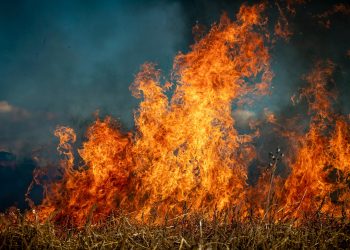


















The 2024 report on Forest Fires in Europe, Middle East and North Africa, published today, shows that last year’s wildfire season ended with a total burnt area of 383 317 hectares. While this is lower than the 500 000 hectares burnt in 2023, it is still above the 17-year average (354 185 hectares). The more moderate figures can be attributed in part to the intermittent rainfall across the Mediterranean during the spring and summer.
Fires are becoming longer and more intense
The 2024 data shows that the traditional fire season (from early June to mid-September) continues to expand, with serious wildfires happening both earlier and later. In total, 8 753 fires were reported in the EU Civil Protection Mechanism (UCPM) countries. Bulgaria, Greece, Italy, Portugal and Spain were among the worst-affected EU countries, with a combined burnt area of 334 940 hectares. Among the non-EU countries that are part of the UCPM, Albania, Bosnia and Herzegovina, North Macedonia, Türkiye and Ukraine suffered the heaviest losses.
While most fires were small, a series of significant wildfires ignited on the Iberian Peninsula in September, burning 100 000 hectares in just one week – nearly a quarter of the season’s total burnt area. 2024 also saw wildfires bring extensive damage to the Balkans, both inside and outside EU territory. Ukraine accounted for half of the total area burnt within EU Civil Protection Mechanism countries, with most wildfires seen across the combat frontlines.
A changing reality
Data gathered by the European Forest Fire Information Service (EFFIS) suggests that Europe’s wildfire reality is changing. Fires seasons are growing longer, and more frequent and intense heatwaves are creating ideal conditions for larger and more uncontrollable wildfires.
Facing this growing challenge will require a more balanced approach: shifting from a reactive fire suppression approach to one that includes proactive measures, such as developing integrated wildfire risk management, promoting nature-based solutions, and landscape management to reduce the vulnerability to wildfire.
2025 already setting records
The data gathered so far for the 2025 fire season seems to confirm this growing trend, with 2025 on track to be the worst year since EFFIS records began.
Since January 2025, EFFIS has recorded over 7 200 fires across the 37 countries in the EU Civil Protection Mechanism. At present, over 1 million hectares have burnt in the EU – an area approximately the size of Lebanon, and twice the area burnt in 2024.
How does the JRC support firefighting efforts?
Throughout the fire season, the JRC continuously monitors the danger level, made public via the daily updated “Wildfire situation in Europe” webpage. These data are useful for national forest fire services and civil protection authorities, as well EU institutions looking for harmonised data, and researchers and scientists in the areas of climate change or land-use changes. Environmental NGOs, regional and local authorities, and disaster-response coordination bodies also benefit from EFFIS data.
Background
The 2024 report contains an annual summary of the fire season with official data provided by 33 countries and EFFIS satellite-based data for 45 countries. The country reports are voluntarily provided to EFFIS from May to October. The reports focus on the number of fires and burnt areas, with some reports also including information on prevention, firefighting, restoration efforts and more. The EFFIS section provides a standardised mapping of burnt areas and seasonal fire danger analyses highlighting trends, impact, and cross-country patterns.
As a component of the Copernicus Emergency Management Service run by the JRC, EFFIS plays an essential role in mitigating the effects of wildfires and boosting EU preparedness, offering reliable, timely and standardised wildfire data across Europe. Since its inception in 2000, the service has consistently leveraged the latest advances in weather forecasting and Earth Observation data to provide critical information before, during and after wildfires.
The EU Civil Protection Mechanism (UCPM) pools resources from the 27 EU Member States and 10 UCPM Participating States, including firefighting personnel and equipment. The EU recently doubled the number of firefighting planes and helicopters in its rescEU air fleet, which are reinforced by a further 4 aircraft, 26 ground forest fire fighting teams and one firefighting assessment team from the European Civil Protection Pool, as well as spontaneous offers from Member States.
O artigo foi publicado originalmente em JRC.