






















The CAP Strategic Plans Regulation (EU) 2021/2115 established the governance and strategic planning framework for the Common Agricultural Policy (CAP) for the 2023–2027 period. It operationalised the “new delivery model”, granting Member States significant autonomy in designing and implementing CAP Strategic Plans, with the European Commission exercising oversight primarily through ex post performance clearance and conformity checks.
The Commission’s proposal COM(2025) 545 for a Budget Performance and Tracking Regulation (Performance Regulation) would replace 2021/2115 and embed the CAP within a horizontal EU-wide budgetary governance framework. This framework extends beyond agriculture, applying uniform rules for performance tracking, indicator use, data reporting, and transparency across all EU budget expenditure. This shift implies a rebalancing of competences: more standardisation at EU level, earlier and more structured Commission involvement, and integration of CAP governance into a broader performance cycle.
The proposed Performance Regulation has three main objectives set out in the Explanatory Memorandum:
– Making consistent the provisions for supporting horizontal principles across the EU budget (e.g. ‘do no significant harm’ and gender equality), thereby reducing complexity for beneficiaries and increasing the coherence of EU action.
– Streamlining and harmonising the system for monitoring EU spending and the performance of the budget, making it possible to aggregate data across programmes, increasing transparency and reducing costs for stakeholders.
– Harmonising and rationalising the reporting of performance information and the provision of information about funding opportunities across the EU budget, increasing transparency for stakeholders and facilitating access to EU funds for potential beneficiaries.
The proposed Performance Regulation aligns with requirements introduced in the 2024 Financial Regulation. This mandates that all programmes and activities be implemented (where relevant and appropriate) without doing significant harm to the environmental objectives and taking into account the principle of gender equality. In addition, it requires that indicators be designed to allow for data aggregation, and requires transparency about the publication of data on beneficiaries supported by the EU budget.
In this post, we look in more detail at what these changes might mean for governance and strategic planning of the CAP. There are additional requirements for financial management for Member State administrations which are not elaborated here. For example, Art. 69 on durability and reversals requires that any targets (for example, numbers of farmers covered by an agri-environment measure) for which the Commission has made payments should be ensured for at least five years after the date of payment. Does this mean, if the number of farmers enrolled in the scheme subsequently falls, that the Member State must then pay back some of the funding received.
The new performance framework
Under Regulation 2021/2115, CAP Strategic Plans were stand-alone instruments, approved and monitored separately from other EU-funded programmes. The proposed NRPP Regulation envisages the CAP “chapter” as part of a single National and Regional Partnership Plan (NRPP), aligning agricultural policy with cohesion, climate, and other EU priorities. This integration will subject the CAP to the same planning, approval, and monitoring procedures as other budget lines, promoting cross-sectoral coherence but reducing the degree of procedural autonomy previously enjoyed.
Regulation 2021/2115 introduced a Performance Monitoring and Evaluation Framework (PMEF) to demonstrate progress towards established targets and to assess the impact and efficiency of policy implementation. The PMEF is based on a common set of output, result, impact and context indicators used as the basis for monitoring, evaluation, and annual performance reporting. Targets and annual milestones are established in relation to the several CAP specific objectives using the relevant result indicators. Member States report annually to the Commission on the progress made in Annual Performance Reports. This information then forms the basis for the Commission reporting on the progress towards the achievement of the specific objectives over the whole CAP Strategic Plan period, using for that purpose a core set of indicators. An annual review meeting is held between the Commission and each Member State following submission of the Performance Reports to examine the performance of each plan. If planned targets are not achieved, the Commission can ask Member States to submit action plans in the case of significant and non-justified underperformance at the biennial performance review.
COM(2025) 545 replaces the PMEF with a common EU list of intervention fields and associated indicators which are set out in Annex I of the proposed Regulation. The concept of ‘intervention fields’ has previously been used in EU cohesion policy and was introduced in the Common Provisions Regulation (EU) 2021/1069 for the European Structural and Investment Funds. Article 22(1) of that Regulation mandated that “types of intervention shall be based on a nomenclature set out in Annex 1.” In the proposed Performance Regulation, 33 intervention fields are defined for agricultural policy (40 if we include forestry).
These range from very broad intervention fields (for example, ‘Targeted support to farmers’ income’ or ‘Support for environment and climate transition, including climate resilience measures’) to much narrower fields (for example, ‘Outermost regions and Aegean islands – support to local agricultural production’). In general, the intervention fields track the list of interventions and other mandatory requirements in both the proposed NRPP and CAP Regulations. In this sense, although the idea of intervention fields is to introduce greater uniformity in reporting, account is taken of the specificities of CAP measures in the list of intervention fields in Annex 1.
Each intervention field in Annex 1 is associated with two sets of indicators (Figure 1). One set of indicators assigns EU coefficients (0/40/100) to aggregate climate, adaptation/resilience, environment, and social tracking across the budget. This is intended to allow the Commission to aggregate expenditure across all programmes to assess the extent to which the EU budget is focused on these cross-cutting priorities (I discussed these horizontal priorities in detail in a previous post).
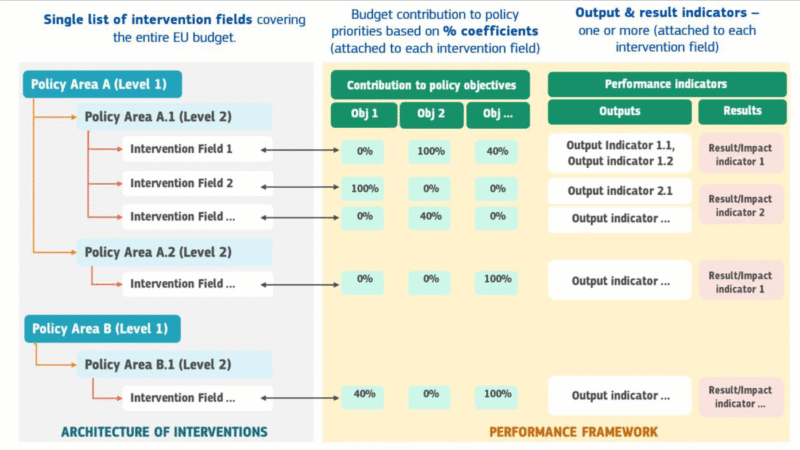
Source: Commission, Impact Assessment Report accompanying the Performance Regulation SWD(2025) 590
Each intervention field is also associated with common output and result indicators which are listed in Annex 1 to the proposed Performance Regulation. Member States must assign at least one intervention field to each CAP measure. For each intervention field, the Member State must select one output indicator defining the final milestone or target for that measure from the list, which will be subject to the agreement of the Commission. It must also select one or more result indicators for that intervention field from the list in Annex 1. The Plan must provide both the baseline and an estimated value for the result indicator, including the expected year of achievement of that value. For the CAP intervention fields, this would usually mean setting a value for the result indicator by the end of Plan but not for intermediate years. However, for area- and animal-based income support under the CAP, such an estimated value should not be cumulative and should correspond to the maximum value reached during the programming period. The Member State may update this estimated value during the mid-term revision or any amendment of the plan (Art. 14, Performance Regulation).
Annual review meetings as now will be organised between the Commission and each Member State to examine the performance of the Plan or its chapters. Member States should follow up on issues raised during the review meeting and should inform the Commission within three months of the measures taken (Art. 49 NRPP Regulation).
We can identify the following changes in the CAP performance framework that would be introduced by the proposed Performance Regulation.
- In future, milestones and targets would be set for the output indicator but not for the result indicators for each intervention field. As defined in Art. 4 of the NRRP Regulation, a milestone now means a qualitative achievement while a target means a quantitative achievement used to measure progress towards the achievement of a measure (in the CAP Strategic Plan Regulation, a milestone means intermediate pre-established values set by Member States to ensure timely progress in relation to the result indicators). The indicators proposed for the targets shall be based on the output indicators listed in Annex I except where duly justified (Art. 22, NRPP Regulation).
- Member States will set values for result indicators which can be varied if necessary during the Plan period. Both progress in the selected output indicator and in actual results of each measure against the estimated value of the results indicator shall be reported to the Commission (in the case of the results indicator, the information should be updated by 15 February each year until 2037) (Art. 14, Performance Regulation).
- Unlike in the current CAP Strategic Plans Regulation, there are no formal actions foreseen if a Member State is off-course in achieving its Plan output indicator targets. It simply means that it would not receive the funding it had anticipated under its Plan. The tracking/performance system is for monitoring, reporting and evaluation. However, the Commission has some indirect levers. A Member State can submit a reasoned request for an amendment to its Plan and the Commission can make observations on this request. The Commission is also empowered “in duly justified cases” to propose to a Member State to amend existing measures or to propose new ones (Art. 24, NRRP Regulation). But there is no automatic link to an adjustment mechanism or financial sanction in the proposed Regulation. This means that the distinction made between ‘targets’ for output indicators and ‘values’ for result indicators may be largely immaterial.
- There is no explicit reference to impact or context indicators in the proposed Performance Regulation, which are key indicators for evaluation purposes. As noted in the recitals to the CAP Strategic Plans Regulation, “In order to ensure a comprehensive and meaningful evaluation of the CAP at Union level, the Commission should rely on context and impact indicators.” However, Recital (1) of the Regulation states that “The Commission may put in place additional elements for monitoring and reporting, including relevant indicators, for the purpose of measuring the impact of Union policies and actions more widely”. This may open the door to allowing the Commission to come forward with requirements for impact and/or context indicators at a later stage.
- The Commission has upgraded its list of result indicators for use with CAP intervention fields (these are really ‘outcome indicators’ but the Commission apparently uses the phrase ‘result indicators’ because ‘outcome indicators’ does not translate easily into other languages). In some cases, these are now closer to impact indicators. Three examples in the environmental area stand out. Annex 1 now permits the use of GHG emissions avoided and removals in tCO2e; ammonia emissions reduction; and the increase or protection of soil organic content as result indicators. These options for result indicators are invariably combined with others in the relevant CAP intervention fields, so Member States can easily avoid using them if they wish.
- A question for discussion is whether the output and particularly the result indicators are sensible or could they be further improved. There are 44 result indicators listed in Annex 1 of the CAP Strategic Plans Regulation; not all have been carried forward into the new proposed Regulation. I have not made a close comparison of the two sets of result indicators, and there is no point in collecting data if it cannot subsequently be usefully used. This is an area that would repay further study. For example, for the output indicators that Member States can choose, for several intervention fields the indicator ‘Number of smallholders in third countries’ is provided as an indicator. This is hardly a relevant indicator for CAP interventions in the EU. The Commission would have the power to detail further the definition of the performance indicators (Art. 8, Performance Regulation).
- For discussion on the use of EU coefficients to track expenditure on cross-cutting priorities, I refer to my previous post.
Performance monitoring moves from ex post to ex ante and real-time oversight
Under the CAP Strategic Plan Regulation, the Commission’s oversight is largely retrospective. Member States submit Annual Performance Reports, which are assessed after the close of the reporting year. These annual reports set out key qualitative and quantitative information on the implementation of the CAP Strategic Plan by reference to financial data and to output and result indicators, including at regional level where relevant. As noted above, the Commission can ask for remedial action if a result indicator has a significant shortfall below the target milestone at the biennial performance review.
The proposed Performance Regulation introduces automated, interoperable data transmission from national systems to the Commission enabling continuous monitoring (Art. 14 Performance Regulation and Annex XVI of the NPPR Regulation). As soon as data is entered into the system by a national administration, it will also be available to the Commission. Thus, the Commission will have visibility of delivery trends during the year, including the automated transmission of pre-defined datasets. The Commission should in any case prepare an annual report for the Council and Parliament on the level of implementation of the programmes and activities, as well as the progress made towards the achievement of programme objectives.
The Commission would also establish a publicly available Single Gateway which, among other functions, would publish the progress of the financial implementation and progress of the budget, broken down by programme and by chapter of a Plan by a Member State, as well as information on the aggregated performance broken down by programme and intervention field using the relevant performance indicators (Art. 12, Performance Regulation). This should be updated regularly.
For example, if the uptake of a CAP agri-environment-climate action appeared to be going slowly in the spring, the Commission would see this in near real-time via automated data feeds. Under the current framework, such a trend might only be visible in the following year’s performance report. The new system allows for earlier dialogue with the Member State and potential mid-year corrective action. However, there is no formal procedure identified where the Commission should ask for a remedial action plan if a significant shortfall with an output target arises.
There are in addition obligations on both the Commission and the Member States to carry out evaluations to examine “the effectiveness, efficiency, relevance, coherence and [for the Commission] Union value added” (Art. 10 and 11, Performance Regulation). For the Commission, there is an obligation to carry out an implementation report no later than four years after the start of implementation, and an ex post evaluation at the latest three years after the end of the programming period. The Commission can also carry out evaluation of specific programmes, which for the CAP can also cover interventions under the Common Market Organisation Regulation.
The big change for Member States is that there is no longer a requirement for an ex ante evaluation. However, Member States would be required to carry out at least one interim evaluation covering the entirety of their Plans within the first three years of implementation. They should also carry out an ex post evaluation within two years of the end of the programming period. The text here is very specific that “Member States shall carry out evaluations to assess the impact of measures implemented in shared management by means of quantitative techniques, including counterfactual approaches and findings from experimental design, where appropriate, at the latest two years after the end of the programming period” (Art. 11(2). This emphasis on using modern evaluation methodologies is very welcome, and will require support from the EU CAP Network for implementation. Member States would be required to draw up an evaluation roadmap for submission to the monitoring committee and the Commission within one year of the approval of this Plans.
Horizontal principles as operational conditions for funding
The proposed Performance Regulation applies horizontal principles such as Do No Significant Harm (DNSH), climate and environment focus, social standards, and gender mainstreaming, at the programme design stage. Compliance must be evidenced before plan approval, with gender relevance scores and DNSH checks forming part of the legal requirements. This elevates these principles from policy aspirations to operational conditions for funding. For agriculture ministries preparing the CAP chapter this will be an additional layer of requirements, although compliance with the DNSH principle is greatly simplified because compliance with farm stewardship is assumed to also ensure compliance with the DNSH principle.
Conclusion
The proposed NPRR and Performance Regulations represent a structural shift in CAP governance. By embedding agriculture within a horizontal EU performance framework, it moves oversight from predominantly ex post checks to a model combining ex ante compliance verification with real-time monitoring. This will require significant adaptation by Member States and CAP actors but offers the potential for earlier intervention, greater transparency, and stronger alignment with EU-wide objectives.
Agriculture ministers preparing the CAP chapter of the national Plan will have to adapt in various ways. Existing output and result indicators will have to be mapped to the new intervention fields. Compliance with the horizontal priorities and principles will have to be demonstrated when the Plan is drawn up. A major requirement will be a significant investment in IT systems. This will be necessary to enable the CAP-specific systems in agriculture ministries to talk to the IT systems of the ministry coordinating the preparation of the national Plan, and also to enable the CAP-specific systems to transfer the necessary data to the Commission SFC2028 system. For national officials, the almost real-time monitoring of their performance may not be a welcome prospect.
The fundamental question is whether the proposed changes make genuine strategic planning in the CAP more likely or not. Good strategic planning in the EU budget context requires that objectives are specific and clearly defined, measurable, achievable, relevant, and time-bound (SMART). It also requires that interventions are logically linked to these objectives through a coherent theory of change. Resources should be allocated in ways that reflect political priorities and trade-offs rather than institutional inertia. Monitoring and evaluation should provide timely and credible evidence both for accountability and for course correction, while the system as a whole should allow learning and adaptation. Strategic planning is about much more than indicator reporting: it aligns objectives, resources, and accountability mechanisms.
The Commission’s proposal would establish a uniform performance framework across all EU programmes. It introduces a single taxonomy of intervention fields and a harmonised set of indicators, aiming to improve coherence and comparability. Cross-cutting priorities such as climate, biodiversity, gender equality and social objectives are integrated through standardised coefficients and scoring systems. Monitoring will be greatly enhanced by automated data transfer allowing more timely corrections. Transparency is reinforced by the establishment of a Single Gateway where financial and performance data will be made public. Evaluation requirements are specified for both Member States and the Commission which will facilitate learning. Taken together, these provisions are intended to provide the architecture for more consistent and harmonised strategic planning.
Still, several limitations in the Commission proposal might be highlighted. I am not convinced that linking output and result indicators to intervention fields rather than specific objectives is a positive step. The CAP alone (including forestry) has 40 different intervention fields, and there are hundreds specified in Annex 1. This proliferation in the number of intervention fields is hardly conductive to making reasoned choices between strategic priorities. There is a danger of formalism, where indicator compliance substitutes for genuine strategic steering.
Given that the CAP is a Union policy, one would like to see targets and indicators set for objectives and interventions that have real value and importance for the EU as a whole (such as the Farm to Fork targets in 2020, without necessarily being committed to the specific targets or their values in that document), while also allowing for secondary targets that reflect specific Member State needs. One would then like to see achievement of the EU targets linked to financial consequences. If a Member State fails to pull its weight in helping to achieve EU-level targets, then it should lose access to financial resources. This would be less important in the case of national targets where resources could be reallocated as necessary. But there are no SMART objectives for agriculture set in the NPRR Regulation, only general aspirations, which makes this recommendation inoperable.
Ultimately, we must recognise that agricultural policy can never be reduced to solely technical considerations and trade-offs. Strategic planning will always be subject to political dictates. But a question for debate could be whether the proposed strategic planning framework for the CAP does as much as it could to align the incentives of Member States with the needs of the Union as a whole.
This post was written by Alan Matthews.
O artigo foi publicado originalmente em CAP Reform.