
















Sem Resultado
Ver Todos Os Resultados
Newsletters
Agroportal
  • Login
  • Registar
  • Sugeridas
  • Notícias
    • Notícias
    • Nacional
    • Internacional
    • Comunicados

    Habitantes autorizados a regressar a casa após cercado fogo florestal na Bélgica

    vinho barril adega

    Madeira prevê ocupação hoteleira de 90% durante a Festa do Vinho

    Incêndios: Quase 1.250 operacionais nos incêndios de Torre de Moncorvo, Arouca e Santo Tirso

    Novos parceiros institucionais reforçam papel do Portugal Food Safety 2026 como ponto de encontro do setor

    Incêndios: Fogo que deflagrou em Torre de Moncorvo com uma frente ativa em Carrazeda de Ansiães

    Incêndios: Fogo em Santo Tirso com duas frente ativas que estão a ceder

    Cabaz-de-bens-alimentares-para-uma-semana-esta-20-euros-mais-caro

    Cabaz alimentar sobe 1,48 euros na última semana para 253,55 euros

    Incêndios: Queimas e queimadas na origem da maior parte dos fogos até 15 de agosto

    Cinco hotéis do Algarve juntam-se à AlgarOrange para promover os Citrinos do Algarve IGP

  • Opinião

    As cooperativas não pagam IRC. E depois?

    500 milhões de Euros por Ano Não Chega Sem Planeamento

    António Covas

    O mundo paradoxal do nosso rural tardio e remoto

    Azeites de Portugal: tratar diferente o que é diferente

    Manuel Chaveiro Soares

    Sobre a excelência da alimentação em Portugal

    Produzir bem já não chega: eficiência, estratégia e os desafios da engorda de bovinos

    Segurança Alimentar Europeia Como Ativo Estratégico

    Sabemos distinguir um frango do campo. Porque não conseguimos distinguir um Azeite de Olival Tradicional?

    Carlos Neves

    Promoções que despromovem a produção de leite de Portugal

  • Eventos
  • Dossiers

    Dossiers I

    • Agricultura Biológica
    • Apoios
    • Artigos Técnicos
    • Biossoluções
    • Cadeia Alimentar
    • Fertilizantes
    • Financiamento
    • Fitofarmacêuticos

    Dossiers II

    • Florestas
    • Futuro da PAC
    • Inovação
    • Mercados
    • Newsletters e Revistas
    • Recomendações Agroflorestais
    • Seguros

    Últimas

    centeio

    Cotações – Cereais – 10 a 16 de agosto de 2026

    19/08/2026

    IA na gestão florestal: benefícios e limitações

    19/08/2026

    Cotações – Azeite e Azeitona – 10 a 16 de agosto de 2026

    18/08/2026

    Cotações – Cortiça – 10 a 16 de agosto de 2026

    18/08/2026

    Dietas saudáveis ​​e sustentáveis ​​podem remodelar a agricultura global. Mas são mais caras

    18/08/2026

    Produção de maçã na UE deverá cair para o nível mais baixo em nove anos

    14/08/2026
  • Serviços
    • Diretório
    • Emprego
    • Máquinas Agrícolas
    • Meteorologia
    • Terrenos Agrícolas
    • Arquivo Agroportal
Agroportal
  • Sugeridas
  • Notícias
    • Notícias
    • Nacional
    • Internacional
    • Comunicados

    Habitantes autorizados a regressar a casa após cercado fogo florestal na Bélgica

    vinho barril adega

    Madeira prevê ocupação hoteleira de 90% durante a Festa do Vinho

    Incêndios: Quase 1.250 operacionais nos incêndios de Torre de Moncorvo, Arouca e Santo Tirso

    Novos parceiros institucionais reforçam papel do Portugal Food Safety 2026 como ponto de encontro do setor

    Incêndios: Fogo que deflagrou em Torre de Moncorvo com uma frente ativa em Carrazeda de Ansiães

    Incêndios: Fogo em Santo Tirso com duas frente ativas que estão a ceder

    Cabaz-de-bens-alimentares-para-uma-semana-esta-20-euros-mais-caro

    Cabaz alimentar sobe 1,48 euros na última semana para 253,55 euros

    Incêndios: Queimas e queimadas na origem da maior parte dos fogos até 15 de agosto

    Cinco hotéis do Algarve juntam-se à AlgarOrange para promover os Citrinos do Algarve IGP

  • Opinião

    As cooperativas não pagam IRC. E depois?

    500 milhões de Euros por Ano Não Chega Sem Planeamento

    António Covas

    O mundo paradoxal do nosso rural tardio e remoto

    Azeites de Portugal: tratar diferente o que é diferente

    Manuel Chaveiro Soares

    Sobre a excelência da alimentação em Portugal

    Produzir bem já não chega: eficiência, estratégia e os desafios da engorda de bovinos

    Segurança Alimentar Europeia Como Ativo Estratégico

    Sabemos distinguir um frango do campo. Porque não conseguimos distinguir um Azeite de Olival Tradicional?

    Carlos Neves

    Promoções que despromovem a produção de leite de Portugal

  • Eventos
  • Dossiers

    Dossiers I

    • Agricultura Biológica
    • Apoios
    • Artigos Técnicos
    • Biossoluções
    • Cadeia Alimentar
    • Fertilizantes
    • Financiamento
    • Fitofarmacêuticos

    Dossiers II

    • Florestas
    • Futuro da PAC
    • Inovação
    • Mercados
    • Newsletters e Revistas
    • Recomendações Agroflorestais
    • Seguros

    Últimas

    centeio

    Cotações – Cereais – 10 a 16 de agosto de 2026

    19/08/2026

    IA na gestão florestal: benefícios e limitações

    19/08/2026

    Cotações – Azeite e Azeitona – 10 a 16 de agosto de 2026

    18/08/2026

    Cotações – Cortiça – 10 a 16 de agosto de 2026

    18/08/2026

    Dietas saudáveis ​​e sustentáveis ​​podem remodelar a agricultura global. Mas são mais caras

    18/08/2026

    Produção de maçã na UE deverá cair para o nível mais baixo em nove anos

    14/08/2026
  • Serviços
    • Diretório
    • Emprego
    • Máquinas Agrícolas
    • Meteorologia
    • Terrenos Agrícolas
    • Arquivo Agroportal
Sem Resultado
Ver Todos Os Resultados
Agroportal
moçambique

Is conservation agriculture a ‘climate smart’ solution for African farmers?

por Cornell Alliance for Science
15-07-2021 | 15:14
em Últimas, Internacional, Notícias inovação, Inovação, Dossiers
Tempo De Leitura: 6 mins
A A
Partilhe no FacebookPartilhe no TwitterEnviar para o WhatsappEnviar para o TelegramEnviar para o LinkedIn

Zimbabwean farmer Sinikiwe Sibanda defines a successful harvest by how many bags of maize (corn) she gets from a hectare of land each season. A good yield guarantees enough food to feed her family and a surplus to sell.

African smallholder farmers like Sibanda are increasingly on the lookout for technologies to improve their yields. Finding new ways to grow more and healthier food has become a priority for Africa’s smallholder farmers, who are battling climate change-induced extreme weather events, such as droughts, floods and high temperatures.

Growing yields and income

Conservation agriculture (CA) is one of the Climate Smart Agriculture (CSA) tools that farmers are adopting to grow food even in harsh conditions. Many scientists have praised conservation agriculture as a method of farming that can help farmers to reduce water use while boosting soil fertility and crop yields.

In her own trial of conservation agriculture, Sibanda dug small holes in the ground on a plot less than a hectare in size near her home in the city of Bulawayo, Zimbabwe, filling each with manure before planting maize. She admits the technique was laborious, which could be a turn off for many smallholder farmers with little labor to spare. But she found it worthwhile because it did improve her yield.

“I harvested a lot of maize on the small plot and I sold green mealies too,” says Sibanda, who maintains a 42-hectare farm in Nyamandlovu, northwest of Bulawayo.

“One can yield a lot if done on several plots but there is a lot of labor required, which is why my family could not practice this on our bigger plot in Nyamandlovu,” she added.

The Zimbabwe government recently adopted a national program, Intwasa/Pfumvudza, based on conservation agriculture principles in an effort to boost nutrition and food self-sufficiency at the household level. The CA program will be working with 1.8 million smallholder farmers to increase production and productivity, making them more resilient to climate change shocks.

“Pfumvudza means a new season of increased productivity — a season of producing more on less land and with less resources, a season of climate-proofing our agriculture through…[the] adoption of conservation agriculture,” says John Basera, permanent secretary of the Ministry of Lands, Agriculture, Fisheries, Water and Rural Resettlement.
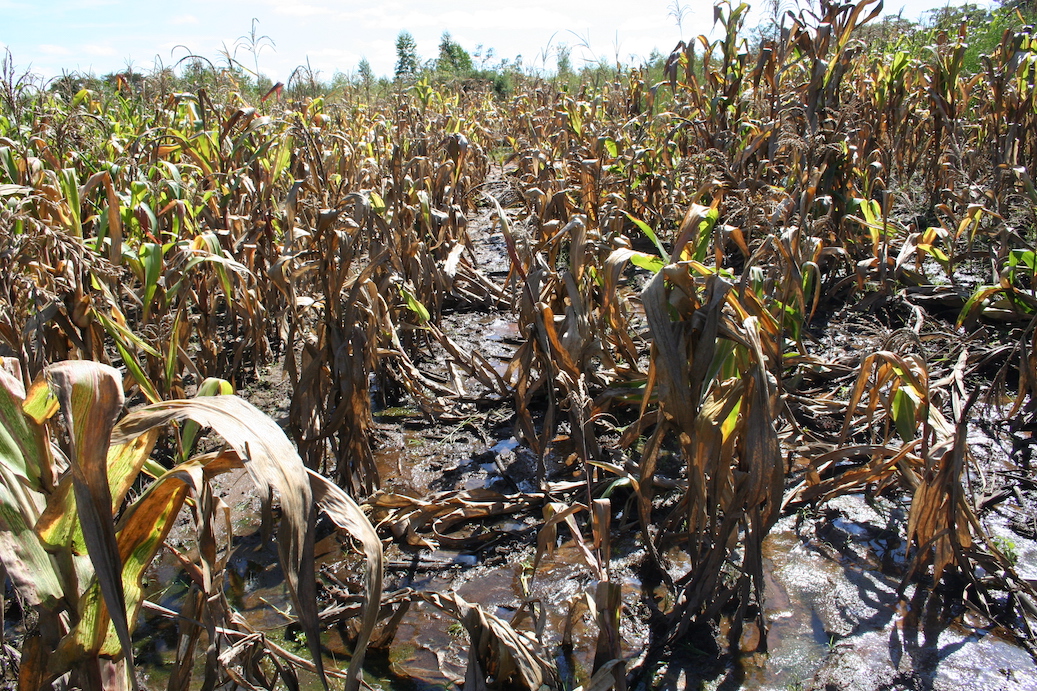
Climate change is reducing agricultural productivity in Africa. Photo: Busani Bafana

Farmer Elizabeth Mpofu does not feel that the CA concept is a solution to food sovereignty or food security. As general coordinator of the La Via Campesina movement, which advocates for family-farm-based sustainable agriculture, she advocates for agroecology, a farming method that applies ecological and social concepts to managing food and agriculture systems by optimizing relationships between plants, animals, people and the environment.

“It is a very different farming practice from agroecology farming practices,” Mpofu says of CA, contending that Pfumudza promotes what she calls “industrial agriculture,” with an emphasis on synthetic fertilizers and herbicides. She also thinks CA is more labor intensive than agroecology, a claim that’s open to debate. She uses wood ashes, compost and cattle manure to grow open pollinated varieties of maize and sunflower.

Rich solution, poor adoption

Climate-smart agriculture, commonly referred to as CSA, is a broad term developed by the United Nation’s Food and Agriculture Organization (FAO) to cover a range of agricultural practices expected to produce more food to meet the demands of a growing population in a dramatically changing climate. According to the UN, the three pillars of CSA are increasing food production, building resilient food systems and reducing agriculture’s greenhouse gas emissions. A 2009 report by the FAO estimates that crop yields will need to increase by 70 percent to feed the world of 2050.

As one tool in CSA, conservation agriculture has shown benefits for smallholder farmers in terms of improving soil health, enhancing soil moisture retention and maintaining or improving crop yields.

In Southern Africa, an estimated 1.5 million hectares have transitioned to CA since 2016, with up to 2 million farmers practicing several forms of CA. Still, Africa has more than 30 million smallholder farmers who need a sustainable, drudgery-free way of producing food, according to the International Fund for Agriculture Development (IFAD). Why have they apparently been slow to adopt CA?

“We have tried to answer that question for the last 15 years and we have looked at it from different angles,” said Christian Thierfelder, a Zimbabwe-based senior cropping systems agronomist with the International Maize and Wheat Improvement Center (CIMMYT) who has been involved in several CA projects in Malawi, Mozambique, Namibia, Zambia and Zimbabwe.

“We know that the agronomic part is not the biggest challenge because the system works under this environment. It gives a lot of benefits even under drought and this challenging environment that we have.”
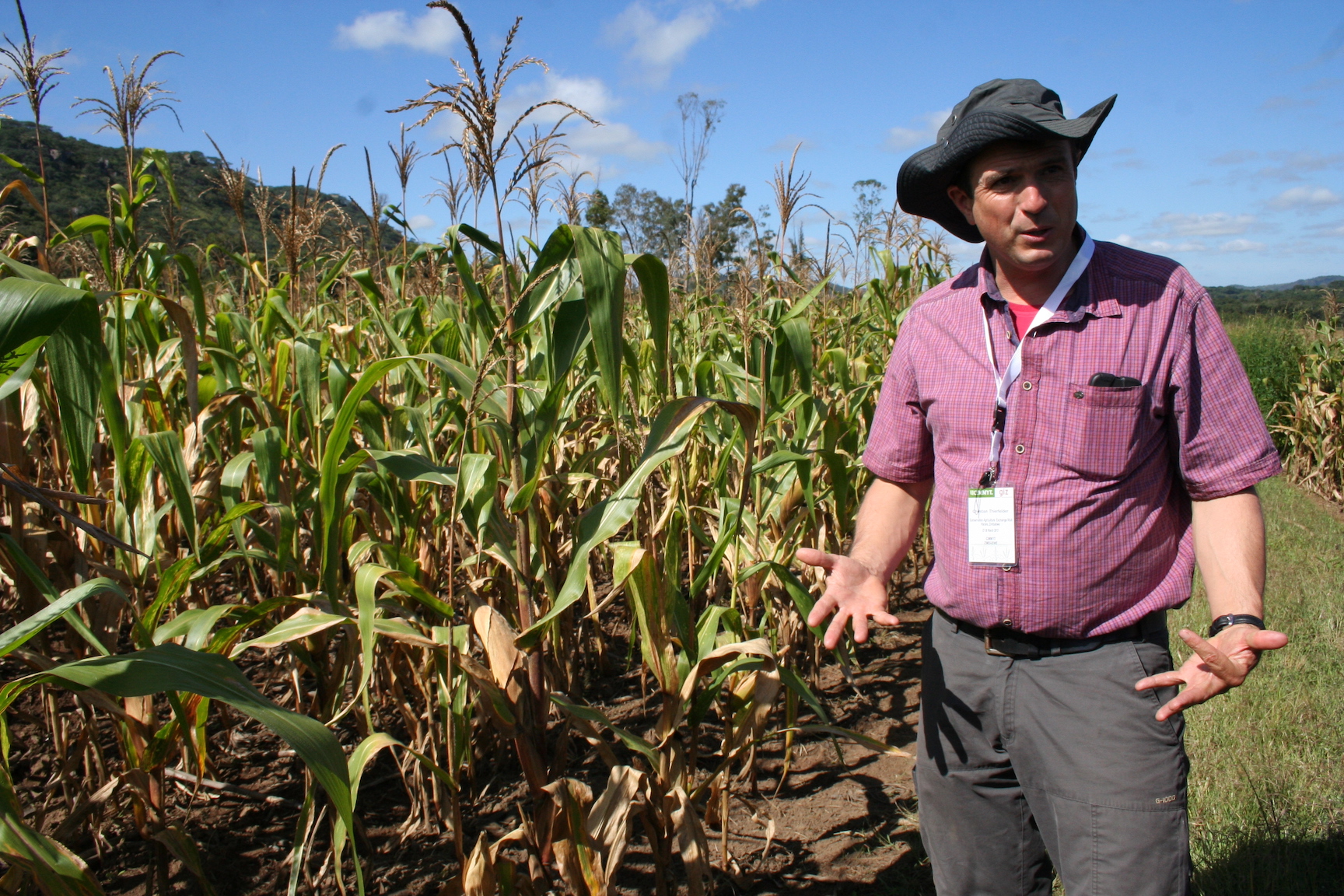
Christian Thierfelder at a conservation agriculture demonstration plot in Zimbabwe. Photo: Busani Bafana

Thierfelder describes the low adoption of CA practices as a socio­-economic problem that is not unique to conservation agriculture. Other useful agricultural tools and methods, such as agro-forestry, improved legume systems, crop diversification and mineral fertilizer, have proven benefits, but are not widely adopted. The reasons are related to market availability, accessibility and also limited financial resources among farmers.

“If you look at CA, it has been widely adopted in areas where labor or farm power was short and where there were a lot of problems with soil degradation and limited soil moisture availability,” Thierfelder said. “In those areas, for example Brazil, Argentina, Australia and the US, economic factors were more of the drivers for adoption.”

Most of the farmers in the Southern Africa region do not run large commercial farms, as has been the case where CA has been widely adopted, and they often lack access to machinery and affordable inputs like herbicides or fertilizer, Thierfelder explained. Instead, if African farmers lack machinery or labor, family members work the land manually. Thierfelder also believes farmers generally are risk-averse and hesitant to change.

“Knowledge and capacity also play a big role,” he said. “A lot of farmers still do not know about CA and how it is being done. Then culture and beliefs are very important. In some areas the reason why it is not adopted is because if you do not till your soil you are seen as a lazy farmer or if you try something new with [leaving] crop residues, your field is ‘dirty.’ So these are cultural beliefs causing problems for CA adoption.”

Scientists have started probing the economic drivers that can help increase CA adoption, as cropping systems that give more financial benefits from the start will be adopted more willingly by farmers.

Is there a future for CA in Africa?

“This is a good question. I would probably change the sentence around a bit and say, there is no future for conventional agriculture,” Thierfelder said, pointing to the increasing challenges of climate change and the fact that there is no harvest in three out of five seasons in some regions of Africa because conventional systems do not support any crop production.

“CA would do if it was supported on a wide scale,” he said. “Increasing costs for production and farmers increasingly less willing to do the drudgery of farming with a fully plowed system are all leading towards CA. We can address all of these problems with CA.”


Imprimir Artigo
Publicação Anterior

African swine fever: campaign extended to new countries

Próxima Publicação

Governo aprova diploma que adota regras da UE contra práticas desleais na cadeia alimentar

Artigos Relacionados

Internacional

Habitantes autorizados a regressar a casa após cercado fogo florestal na Bélgica

19/08/2026
vinho barril adega
Nacional

Madeira prevê ocupação hoteleira de 90% durante a Festa do Vinho

19/08/2026
centeio
Cotações PT

Cotações – Cereais – 10 a 16 de agosto de 2026

19/08/2026
Próxima Publicação
talheres

Governo aprova diploma que adota regras da UE contra práticas desleais na cadeia alimentar

Discussão sobre este post

Opinião

Últimas

As cooperativas não pagam IRC. E depois?

por Francisco António Vilela Ribeiro
16/08/2026

Ler maisDetails
Últimas

500 milhões de Euros por Ano Não Chega Sem Planeamento

por Nuno Mamede Santos
09/08/2026

Ler maisDetails

Subscrever as nossas newsletteres

Subscrever as nossas Newsletters Agroportal

Verifique na sua caixa de correio ou na pasta de spam para confirmar a sua subscrição.

Comunicados

Novos parceiros institucionais reforçam papel do Portugal Food Safety 2026 como ponto de encontro do setor

19/08/2026

Cinco hotéis do Algarve juntam-se à AlgarOrange para promover os Citrinos do Algarve IGP

19/08/2026
Advertisement

Temas em destaque

Candidaturas PU Guerra Médio Oriente Mercosul ovibeja PAC pós 2027 Simplificação PAC Temporais vinho Água que Une

Eventos

Agosto 2026
STQQSSD
      1 2
3 4 5 6 7 8 9
10 11 12 13 14 15 16
17 18 19 20 21 22 23
24 25 26 27 28 29 30
31       
« Jul   Set »

Sobre Nós

O Agroportal.pt é uma plataforma de informação digital que reúne a informação relevante sobre agricultura. Tem um foco na Política Agrícola Comum e a sua aplicação em Portugal.

Menu

  • Quem somos
  • Relatórios anuais
  • Envie-nos informação
  • Publicidade
  • Newsletters
  • Estatuto Editorial
  • Ficha técnica
  • Proteção de Dados Pessoais
  • Disclaimer
Facebook twitter Circle Instagram Rss Feed

© Agroportal. All Rights reserved.

Bem-Vindo De Volta!

Sign In with Facebook
Sign In with Google
OR

Faça login na sua conta abaixo

Esqueceu-se da senha? Registar

Criar Uma Nova Conta!

Sign Up with Facebook
Sign Up with Google
OR

Preencha os campos abaixo para se registar

* Ao se registar-se no nosso site, você concorda com os Termos e Condições e a Política de Privacidade .
Todos os campos são necessários. Entrar

Obter a sua senha

Indique por favor o seu nome de utilizador ou endereço de E-mail para repor a sua senha.

Entrar
  • Login
  • Registar
Sem Resultado
Ver Todos Os Resultados
  • Sugeridas
  • Notícias
    • Nacional
    • Internacional
    • Comunicados
  • Opinião
  • Eventos
  • Dossiers
    • Agricultura Biológica
    • Apoios
    • Artigos Técnicos
    • Biossoluções
    • Cadeia Alimentar
    • Fertilizantes
    • Financiamento
    • Fitofarmacêuticos
    • Florestas
    • Futuro da PAC
    • Inovação
    • Mercados e Cotações agrícolas
    • Newsletters e Revistas
    • Recomendações Agroflorestais
    • Seguros agrícolas
  • Serviços
    • Diretório
    • Emprego
    • Máquinas Agrícolas
    • Meteorologia
    • Terrenos Agrícolas
    • Arquivo Agroportal

© Agroportal. All Rights reserved.

Este site usa cookies. Ao continuar a utilizar este site, está a dar consentimento à utilização de cookies. Visite a nossa Política de Protecção de dados e Cookies.