
















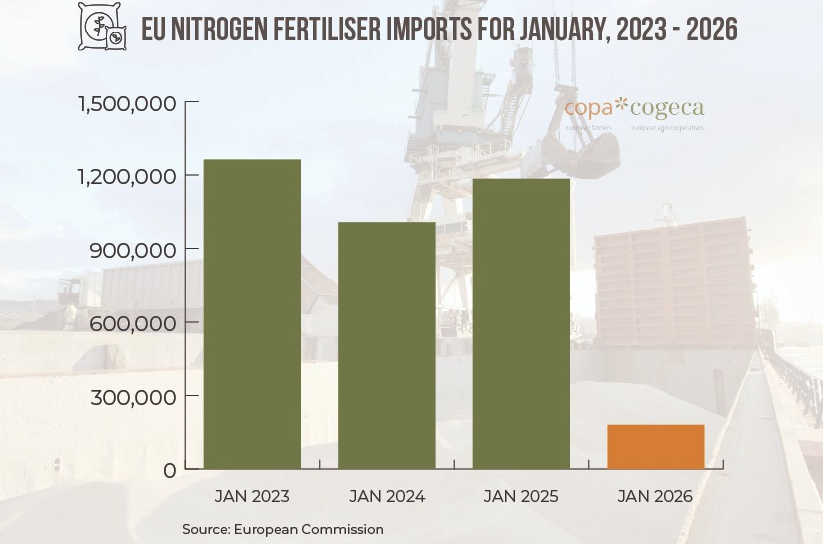
The latest figures from the European Commission confirm a dramatic and unprecedented collapse in EU nitrogen fertiliser imports following the entry into force of the Carbon Border Adjustment Mechanism (CBAM). In January 2026, the EU imported only 179,877 tonnes of nitrogen fertilisers, compared with 1,183,728 tonnes in January 2025[1]. Imports have therefore fallen to less than 16% of their usual level, a harsh reality that is now knocking at the EU’s door.
These figures validate the repeated warnings from Copa and Cogeca over recent years. Farmers and agri-cooperatives organisations have consistently cautioned EU institutions that, without the necessary technical safeguards and market preparedness, the implementation of CBAM on fertilisers would disrupt supply flows and increase costs for European farmers.
Nitrogen fertilisers, which are directly affected by CBAM, account for approximately 46% of total EU fertiliser consumption, with more than 30% of this volume traditionally imported[2]. A reduction of this magnitude cannot be absorbed without consequences. It poses a direct threat to the stability of agricultural production across the EU, destabilising markets by triggering anticipatory behaviours, as seen in December 2025 just prior to the mechanism’s implementation.
Meanwhile, domestic fertiliser prices continue to rise. In January 2026, they were 25% higher than the 2024 average[3]. Considering that fertilisers account for 15% to 30% of farmers’ input costs in average, and that the arable crops sector is already under severe pressure, with negative margins recorded for the third consecutive year, this situation could quickly become the tipping point in many Member States.
Stock levels are equally concerning. On average, current stocks cover only around 45 to 50% of farmers’ fertiliser needs for the 2026 harvest[4], with significantly lower levels in certain Member States such as Italy and Ireland. This situation does not consider preparations for the 2027 harvest and highlights the growing vulnerability of EU food production.
Copa and Cogeca have repeatedly called for a pragmatic and responsible approach. Among the key demands voiced in the December and January protests were postponing CBAM implementation for fertilisers until technical conditions ensure price predictability at import and invoicing, avoiding supply disruptions throughout the chain, and introducing long-term measures to offset CBAM-related costs for farmers.
The data now leave no room for doubt. When imports collapse by more than 80%, when prices continue to rise and availability becomes uncertain, this is no longer a theoretical concern. It is an immediate risk to EU agricultural production and food security!
The European Union must acknowledge this reality and act accordingly. Copa and Cogeca call for the immediate suspension of CBAM on fertilisers to prevent further disruption and safeguard European agriculture. Structural measures are also needed to ensure the long-term availability and affordability of fertilisers within the EU. In this context, Copa and Cogeca stand ready to contribute concrete proposals to the forthcoming Fertilisers Action Plan. However, without immediate short-term actions, the sector risks sliding into a major crisis.
Fonte: Copa and Cogeca