



















Sem Resultado
Ver Todos Os Resultados
Newsletters
Agroportal
  • Login
  • Registar
  • Sugeridas
  • Notícias
    • Notícias
    • Nacional
    • Internacional
    • Comunicados

    PRR. Portugal recebe 2,3 mil milhões de euros do 9.º pedido de pagamento

    uvas

    Viticultores em protesto na Régua contra baixo preço da uva

    helicóptero de incêndios céu azul

    Incêndios: Treze meios aéreos e 301 operacionais combatem fogo em Fornos de Algodres às 16:50

    Calor

    Calor extremo na Europa afeta agricultura, turismo e infraestruturas energéticas

    thermometer

    Calor extremo na Europa afeta agricultura, turismo e infraestruturas energéticas

    fogo bombeiros

    Incêndios florestais continuam a alastrar-se enquanto a Europa sofre com o calor extremo

    “Alimentar Portugal” – workshop participativo vai debater prioridades nacionais de investigação e inovação nos setores agroalimentar e agroflorestal

    Produtores de amêndoa perspetivam uma colheita com um aumento de produção de 30%

    Calor e seca podem levar produção de milho em França a mínimos de 1980 – Governo

  • Opinião
    António Covas

    O mundo paradoxal do nosso rural tardio e remoto

    Azeites de Portugal: tratar diferente o que é diferente

    Manuel Chaveiro Soares

    Sobre a excelência da alimentação em Portugal

    Produzir bem já não chega: eficiência, estratégia e os desafios da engorda de bovinos

    Segurança Alimentar Europeia Como Ativo Estratégico

    Sabemos distinguir um frango do campo. Porque não conseguimos distinguir um Azeite de Olival Tradicional?

    Carlos Neves

    Promoções que despromovem a produção de leite de Portugal

    Georgete Felix

    O balanço invisível da agricultura

    Acordo UE-Mercosul

  • Eventos
  • Dossiers

    Dossiers I

    • Agricultura Biológica
    • Apoios
    • Artigos Técnicos
    • Biossoluções
    • Cadeia Alimentar
    • Fertilizantes
    • Financiamento
    • Fitofarmacêuticos

    Dossiers II

    • Florestas
    • Futuro da PAC
    • Inovação
    • Mercados
    • Newsletters e Revistas
    • Recomendações Agroflorestais
    • Seguros

    Últimas

    Reino Unido prepara apoio de 20 milhões de libras para robótica agrícola

    07/08/2026

    Preços mundiais dos alimentos atingem máximo devido às ondas de calor e aos conflitos

    07/08/2026

    Agricultores afetados pela depressão Kristin vão ter novo apoio

    07/08/2026

    Cotações – Suínos – 27 de julho a 02 de agosto de 2026

    06/08/2026

    Agricultura de precisão é usada por 18% das explorações agrícolas da UE

    06/08/2026

    Cotações – Aves e Ovos – 27 de julho a 02 de agosto de 2026

    06/08/2026
  • Serviços
    • Diretório
    • Emprego
    • Máquinas Agrícolas
    • Meteorologia
    • Terrenos Agrícolas
    • Arquivo Agroportal
Agroportal
  • Sugeridas
  • Notícias
    • Notícias
    • Nacional
    • Internacional
    • Comunicados

    PRR. Portugal recebe 2,3 mil milhões de euros do 9.º pedido de pagamento

    uvas

    Viticultores em protesto na Régua contra baixo preço da uva

    helicóptero de incêndios céu azul

    Incêndios: Treze meios aéreos e 301 operacionais combatem fogo em Fornos de Algodres às 16:50

    Calor

    Calor extremo na Europa afeta agricultura, turismo e infraestruturas energéticas

    thermometer

    Calor extremo na Europa afeta agricultura, turismo e infraestruturas energéticas

    fogo bombeiros

    Incêndios florestais continuam a alastrar-se enquanto a Europa sofre com o calor extremo

    “Alimentar Portugal” – workshop participativo vai debater prioridades nacionais de investigação e inovação nos setores agroalimentar e agroflorestal

    Produtores de amêndoa perspetivam uma colheita com um aumento de produção de 30%

    Calor e seca podem levar produção de milho em França a mínimos de 1980 – Governo

  • Opinião
    António Covas

    O mundo paradoxal do nosso rural tardio e remoto

    Azeites de Portugal: tratar diferente o que é diferente

    Manuel Chaveiro Soares

    Sobre a excelência da alimentação em Portugal

    Produzir bem já não chega: eficiência, estratégia e os desafios da engorda de bovinos

    Segurança Alimentar Europeia Como Ativo Estratégico

    Sabemos distinguir um frango do campo. Porque não conseguimos distinguir um Azeite de Olival Tradicional?

    Carlos Neves

    Promoções que despromovem a produção de leite de Portugal

    Georgete Felix

    O balanço invisível da agricultura

    Acordo UE-Mercosul

  • Eventos
  • Dossiers

    Dossiers I

    • Agricultura Biológica
    • Apoios
    • Artigos Técnicos
    • Biossoluções
    • Cadeia Alimentar
    • Fertilizantes
    • Financiamento
    • Fitofarmacêuticos

    Dossiers II

    • Florestas
    • Futuro da PAC
    • Inovação
    • Mercados
    • Newsletters e Revistas
    • Recomendações Agroflorestais
    • Seguros

    Últimas

    Reino Unido prepara apoio de 20 milhões de libras para robótica agrícola

    07/08/2026

    Preços mundiais dos alimentos atingem máximo devido às ondas de calor e aos conflitos

    07/08/2026

    Agricultores afetados pela depressão Kristin vão ter novo apoio

    07/08/2026

    Cotações – Suínos – 27 de julho a 02 de agosto de 2026

    06/08/2026

    Agricultura de precisão é usada por 18% das explorações agrícolas da UE

    06/08/2026

    Cotações – Aves e Ovos – 27 de julho a 02 de agosto de 2026

    06/08/2026
  • Serviços
    • Diretório
    • Emprego
    • Máquinas Agrícolas
    • Meteorologia
    • Terrenos Agrícolas
    • Arquivo Agroportal
Sem Resultado
Ver Todos Os Resultados
Agroportal
Alan Matthews

The EU’s proposed ‘net 55%’ reduction target for 2030 – a clarification

por CAP Reform
15-12-2020 | 16:59
em Últimas, Notícias futuro da PAC, Blogs, Futuro da PAC, Dossiers
Tempo De Leitura: 5 mins
A A
Partilhe no FacebookPartilhe no TwitterEnviar para o WhatsappEnviar para o TelegramEnviar para o LinkedIn

One of the decisions taken at the European Council summit last week was an agreement that “To meet the objective of a climate-neutral EU by 2050 in line with the objectives of the Paris Agreement, the EU needs to increase its ambition for the coming decade and update its climate and energy policy framework. To that end, the European Council endorses a binding EU target of a net domestic reduction of at least 55% in greenhouse gas emissions by 2030 compared to 1990.”

The European Council thus endorsed the Commission’s proposal in its 2030 Climate Target Plan Communication for an EU-wide, economy-wide greenhouse gas emissions reduction target by 2030 compared to 1990 of at least 55% including emissions and removals. Note that this is a ‘net’ target including GHG removals through land use and forests, in contrast with the existing 40% target, which mainly concerns emissions only.

This means one cannot directly compare the current 2030 reduction target of 40% with the proposed reduction target of 55%, both relative to 1990. The 40% target refers mainly to emissions in the European Trading System (ETS) and Effort Sharing Regulation (ESR) sectors with only a very limited possibility to make use of Land use, Land use change and Forestry (LULUCF) credits as offsets (a maximum of 262 million tonnes CO2e for the EU27 over the 10-year 2021-2030 period). In addition, whether there are LULUCF credits or not is determined by policy-determined accounting rules and not by the inventory numbers. The net 55% target, however, will allow full offsetting of the LULUCF sink based on the LULUCF inventory numbers reported to the UNFCCC.

The proposed shift from a targeted reduction of 40% in gross emissions to a 55% reduction in net emissions has been criticised by environmental NGOs, partly on the grounds that the 55% figure is itself too low, but also because the shift from a gross to a net target is seen as a climate fudge and as creative accounting.

A coalition of environmental NGOs in a statement last September noted that “The Commission’s proposal to change the current 2030 target into a ‘net’ emissions target, including carbon sinks, is a serious mistake and – depending on the size of the net LULUCF sink – could mean real cuts in emissions of only 50.5-52.8%.” Greenpeace was quoted in this Guardian article as saying: “This accounting trick by the Commission would make any new target sound higher than it actually is.”

I drew the same conclusion in a table that I had included in this previous post where I mistakenly compared the proposed ‘net 55%’ reduction target to 1990 gross emissions. As the Guardian article makes clear, although it was not fully clear in the Commission’s presentation of its 2030 Climate Target Plan, the Commission will also change the 1990 base to a ‘net’ figure to be consistent with the format of the revised 2030 target. I therefore reproduce the corrected table below.

What we are interested in showing is what the change from gross to net accounting means for the level of ambition in reducing emissions from fossil fuels and agriculture (the ETS and ESR sectors combined). As the table below shows, changing to net accounting implies a lower level of ambition than if the 55% reduction was applied to gross ETS + ESR emissions as under the current 2030 framework (though not as low as were we to use 1990 gross emissions as the base as I had previously done).

The table shows the impact on the Commission’s 2030 climate ambition of allowing a larger LULUCF sink to offset emissions in the ETS and ESR sectors as they are currently defined (i.e. before adopting any of the proposed changes to the EU’s climate architecture put forward in the 2030 Climate Target Plan). Currently, flexibility is allowed only with the ESR sector, but the Impact Assessment opens the possibility for flexibility to the ETS as well. Two scenarios are shown. The first is the current 2030 target of a 40% reduction on 1990 levels with very limited integration of LULUCF credits.

The possibility to use some very limited offsets from the LULUCF sector against emissions in the ETS+ESR sectors reduces the necessary reduction in emissions in the ETS+ESR sectors very slightly, by 0.5%. According to the Impact Assessment for the 2018 ESR, the limited flexibility between the LULUCF and ESR sectors was a deliberate decision to avoid reducing the level of ambition in the ESR sector.
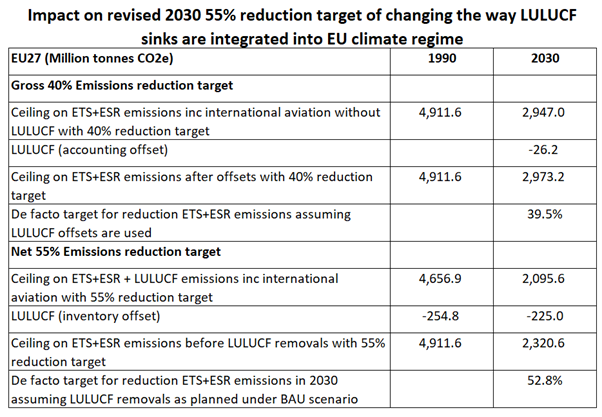
Source:  Own calculations. 1990 data from EEA GHG data viewer. For the 40% emissions reduction target, the assumption is that the total allowed LULUCF offset of 262 million tonnes CO2e for the 2021-2030 period will be utilised evenly over the period, so that 26.2 million tonnes will be available in 2030. For the 55% emissions reduction target, the figure of 225 million tonnes is the Commission’s estimate of the LULUCF sink in a ‘no-debit’ scenario without additional efforts to enhance the sink.

The second scenario is where the overall level of ambition is increased to a net 55% reduction in emissions by 2030, but the full LULUCF sink is included as an offset in both the base and target years. The projected LULUCF sink in 2030 is based on the Commission’s estimate of the size of the sink under the ‘no-debit’ rule in the Impact Assessment. This sink number would be higher in scenarios where additional sequestration in the LULUCF sector is incentivised. However, in assessing the stringency of the net 55% target the impact of additional effort in the LULUCF sector induced by the target should not be included.

The Impact Assessment also proposes a policy option where accounting rules would apply to make the contribution from the LULUCF sector more stringent, thus limiting the credits that could be transferred to other sectors but still permitting more flexibility than at present. However, the policy scenarios examined in the Impact Assessment all assume the full inclusion in the emission profile of removals in the LULUCF sector.

If an offset of the full LULUCF sink were allowed, it would reduce the reduction ambition in the ETS+ESR sectors to a reduction target of 53% rather than 55%. This implies that the level of ambition in the Commission’s Green Deal is less than what it first appears.

This post was written by Alan Matthews

O artigo foi publicado originalmente em CAP Reform.

Imprimir Artigo
Publicação Anterior

Eurodeputada Isabel Estrada Carvalhais: “Atrair jovens para o mundo rural é um grande desafio”

Próxima Publicação

Candidaturas aos Rural Inspiration Award 2021 até 18 de Janeiro

Artigos Relacionados

Últimas

PRR. Portugal recebe 2,3 mil milhões de euros do 9.º pedido de pagamento

08/08/2026
uvas
Nacional

Viticultores em protesto na Régua contra baixo preço da uva

07/08/2026
helicóptero de incêndios céu azul
Nacional

Incêndios: Treze meios aéreos e 301 operacionais combatem fogo em Fornos de Algodres às 16:50

07/08/2026
Próxima Publicação

Candidaturas aos Rural Inspiration Award 2021 até 18 de Janeiro

Discussão sobre este post

Opinião

António Covas
Últimas

O mundo paradoxal do nosso rural tardio e remoto

por António Covas
02/08/2026

Ler maisDetails
Últimas

Azeites de Portugal: tratar diferente o que é diferente

por José Martino
26/07/2026

Ler maisDetails

Subscrever as nossas newsletteres

Subscrever as nossas Newsletters Agroportal

Verifique na sua caixa de correio ou na pasta de spam para confirmar a sua subscrição.

Comunicados

PRR. Portugal recebe 2,3 mil milhões de euros do 9.º pedido de pagamento

08/08/2026

Grande iniciativa de luta dos viticultores pelo futuro do Douro

07/08/2026
Advertisement

Temas em destaque

Candidaturas PU Guerra Médio Oriente Mercosul ovibeja PAC pós 2027 Simplificação PAC Temporais vinho Água que Une

Eventos

Agosto 2026
STQQSSD
      1 2
3 4 5 6 7 8 9
10 11 12 13 14 15 16
17 18 19 20 21 22 23
24 25 26 27 28 29 30
31       
« Jul   Set »

Sobre Nós

O Agroportal.pt é uma plataforma de informação digital que reúne a informação relevante sobre agricultura. Tem um foco na Política Agrícola Comum e a sua aplicação em Portugal.

Menu

  • Quem somos
  • Relatórios anuais
  • Envie-nos informação
  • Publicidade
  • Newsletters
  • Estatuto Editorial
  • Ficha técnica
  • Proteção de Dados Pessoais
  • Disclaimer
Facebook twitter Circle Instagram Rss Feed

© Agroportal. All Rights reserved.

Bem-Vindo De Volta!

Sign In with Facebook
Sign In with Google
OR

Faça login na sua conta abaixo

Esqueceu-se da senha? Registar

Criar Uma Nova Conta!

Sign Up with Facebook
Sign Up with Google
OR

Preencha os campos abaixo para se registar

* Ao se registar-se no nosso site, você concorda com os Termos e Condições e a Política de Privacidade .
Todos os campos são necessários. Entrar

Obter a sua senha

Indique por favor o seu nome de utilizador ou endereço de E-mail para repor a sua senha.

Entrar
  • Login
  • Registar
Sem Resultado
Ver Todos Os Resultados
  • Sugeridas
  • Notícias
    • Nacional
    • Internacional
    • Comunicados
  • Opinião
  • Eventos
  • Dossiers
    • Agricultura Biológica
    • Apoios
    • Artigos Técnicos
    • Biossoluções
    • Cadeia Alimentar
    • Fertilizantes
    • Financiamento
    • Fitofarmacêuticos
    • Florestas
    • Futuro da PAC
    • Inovação
    • Mercados e Cotações agrícolas
    • Newsletters e Revistas
    • Recomendações Agroflorestais
    • Seguros agrícolas
  • Serviços
    • Diretório
    • Emprego
    • Máquinas Agrícolas
    • Meteorologia
    • Terrenos Agrícolas
    • Arquivo Agroportal

© Agroportal. All Rights reserved.

Este site usa cookies. Ao continuar a utilizar este site, está a dar consentimento à utilização de cookies. Visite a nossa Política de Protecção de dados e Cookies.