













Sem Resultado
Ver Todos Os Resultados
Newsletters
Agroportal
  • Login
  • Registar
  • Sugeridas
  • Notícias
    • Notícias
    • Nacional
    • Internacional
    • Comunicados

    Azeite português é um dos mais saudáveis do mundo

    Presidente da Fundação quer Mata do Bussaco no mapa turístico nacional

    Fundação quer Bussaco como referência internacional de conservação da natureza

    Solos vivos em destaque na Flavour School ACE2EU

    Madeira: Nuno Maciel em Santana para apresentar o PEPAC

    In Loco distinguida pelos 35 anos do Programa LEADER

    Plano de gestão da Zona Especial de Conservação Serra da Estrela em consulta pública

    Rewilding Portugal

    Renato Lainho é o Fotógrafo Rewilding do Ano

    Estudo mostra como as abelhas usam a paisagem agrícola para orientar o voo

  • Opinião

    O azeite vale mais do que o preço que aparece na prateleira

    Acordo UE-Mercosul: uma oportunidade estratégica para proteger e valorizar as marcas dos produtos agrícolas portugueses

    Barragens Não Resolvem Desertificação; Resolvem Estatística

    Água, agricultura e adaptação climática no Algarve: estamos a escolher as soluções certas?

    Manuel Chaveiro Soares

    Importa criar condições para melhorar a competitivade agrícola

    António Covas

    O mundo agro rural, entre o bio produtivismo e o pós-produtivismo

    Valorizar o azeite português: um desígnio coletivo para o futuro

    Apoios ao Investimento Agrícola: Permanentes, Estruturados e sem Ilusões

    A Falácia das Taxas: Quem paga aos agricultores pelo carbono que sequestram?

  • Eventos
  • Dossiers

    Dossiers I

    • Agricultura Biológica
    • Apoios
    • Artigos Técnicos
    • Biossoluções
    • Cadeia Alimentar
    • Fertilizantes
    • Financiamento
    • Fitofarmacêuticos

    Dossiers II

    • Florestas
    • Futuro da PAC
    • Inovação
    • Mercados
    • Newsletters e Revistas
    • Recomendações Agroflorestais
    • Seguros

    Últimas

    Presidente da Fundação quer Mata do Bussaco no mapa turístico nacional

    15/06/2026

    Irão: Agroalimentar tem sido amortecedor de custos – FIPA

    14/06/2026

    Agroalimentar quer ultrapassar 5.000 ME de VAB até 2030 – FIPA

    14/06/2026

    Cordero: se mantiene la tónica bajista en los precios

    14/06/2026

    Vacuno: los precios acumulan tres meses a la baja

    14/06/2026

    Luís Rochartre lidera o CoLAB ForestWISE – Laboratório Colaborativo para Gestão Integrada da Floresta e do Fogo

    13/06/2026
  • Serviços
    • Diretório
    • Emprego
    • Máquinas Agrícolas
    • Meteorologia
    • Terrenos Agrícolas
    • Arquivo Agroportal
Agroportal
  • Sugeridas
  • Notícias
    • Notícias
    • Nacional
    • Internacional
    • Comunicados

    Azeite português é um dos mais saudáveis do mundo

    Presidente da Fundação quer Mata do Bussaco no mapa turístico nacional

    Fundação quer Bussaco como referência internacional de conservação da natureza

    Solos vivos em destaque na Flavour School ACE2EU

    Madeira: Nuno Maciel em Santana para apresentar o PEPAC

    In Loco distinguida pelos 35 anos do Programa LEADER

    Plano de gestão da Zona Especial de Conservação Serra da Estrela em consulta pública

    Rewilding Portugal

    Renato Lainho é o Fotógrafo Rewilding do Ano

    Estudo mostra como as abelhas usam a paisagem agrícola para orientar o voo

  • Opinião

    O azeite vale mais do que o preço que aparece na prateleira

    Acordo UE-Mercosul: uma oportunidade estratégica para proteger e valorizar as marcas dos produtos agrícolas portugueses

    Barragens Não Resolvem Desertificação; Resolvem Estatística

    Água, agricultura e adaptação climática no Algarve: estamos a escolher as soluções certas?

    Manuel Chaveiro Soares

    Importa criar condições para melhorar a competitivade agrícola

    António Covas

    O mundo agro rural, entre o bio produtivismo e o pós-produtivismo

    Valorizar o azeite português: um desígnio coletivo para o futuro

    Apoios ao Investimento Agrícola: Permanentes, Estruturados e sem Ilusões

    A Falácia das Taxas: Quem paga aos agricultores pelo carbono que sequestram?

  • Eventos
  • Dossiers

    Dossiers I

    • Agricultura Biológica
    • Apoios
    • Artigos Técnicos
    • Biossoluções
    • Cadeia Alimentar
    • Fertilizantes
    • Financiamento
    • Fitofarmacêuticos

    Dossiers II

    • Florestas
    • Futuro da PAC
    • Inovação
    • Mercados
    • Newsletters e Revistas
    • Recomendações Agroflorestais
    • Seguros

    Últimas

    Presidente da Fundação quer Mata do Bussaco no mapa turístico nacional

    15/06/2026

    Irão: Agroalimentar tem sido amortecedor de custos – FIPA

    14/06/2026

    Agroalimentar quer ultrapassar 5.000 ME de VAB até 2030 – FIPA

    14/06/2026

    Cordero: se mantiene la tónica bajista en los precios

    14/06/2026

    Vacuno: los precios acumulan tres meses a la baja

    14/06/2026

    Luís Rochartre lidera o CoLAB ForestWISE – Laboratório Colaborativo para Gestão Integrada da Floresta e do Fogo

    13/06/2026
  • Serviços
    • Diretório
    • Emprego
    • Máquinas Agrícolas
    • Meteorologia
    • Terrenos Agrícolas
    • Arquivo Agroportal
Sem Resultado
Ver Todos Os Resultados
Agroportal
Alan Matthews

Measuring food system emissions

por CAP Reform
10-03-2021 | 08:09
em Artigos científicos, Últimas, Artigos Técnicos, Notícias futuro da PAC, Blogs, Futuro da PAC, Dossiers
Tempo De Leitura: 5 mins
A A
Partilhe no FacebookPartilhe no TwitterEnviar para o WhatsappEnviar para o TelegramEnviar para o LinkedIn

A paper just published in Nature Food by researchers from the EU Joint Research Centre (JRC) and FAO has for the first time provided a consistent database of food system greenhouse gas (GHG) emissions globally and for every country with yearly frequency for the period 1990-2015. The authors justifiably claim that it represents a milestone in our understanding of how the global food system has developed. This post looks at some of the main messages provided by the paper.

It is first important to understand what the data are measuring. Although they cover food system emissions, these data are not consumption-based food system emission estimates or footprints. There is no international trade in the estimating framework. The emissions from animal feed imported from one country to another, or deforestation in one country caused by the export of beef to another country, remain with the source country and not with the country of consumption. The data are thus consistent with the production-based or territorial accounting system used in national inventories.

The paper is based on the EDGAR global emissions database version 5.0 maintained by the JRC and the Netherlands Environmental Assessment Agency (PBL). This provides emissions using the standard IPCC source categories including Agriculture on a territorial basis as well as emissions from international transport. As this is a harmonised database, the data are not drawn from the national inventory reports submitted by countries to the UNFCCC but are based directly on activity data multiplied by mostly Tier 1 emissions factors as estimated by the IPCC. The activity data for the Agriculture sector are drawn from FAOSTAT.

The EDGAR 5.0 database is extended in two directions. First, emissions due to land use and land use change (LULUC) but not forestry are included based on FAOSTAT figures. Second, and more interestingly, it identifies emissions arising from a country’s Energy, Industrial and Waste sectors that are linked to food system activity.

The result is a database, EDGAR-FOOD, that provides a two-way breakdown of territorial food system emissions. One decomposition presents a breakdown of food system emissions arising at different stages of the food chain where six stages are identified: 1) LULUC: land use and land use change; 2) production: primary production of food commodities, including the production of inputs such as fertiliser; 3) processing: food processing; 4) distribution: food distribution including packaging, transport and retail; 5) food consumption: including domestic activities of food preparation; and 6) end of life: end of life of food, including food residues management and management of non-food residues used in previous food system stages.

The other sectorial disaggregation in based on the food system structure, distinguishing four sectors: 1) land-based sector, including crops and livestock production and LULUC; 2) energy; 3) industry; and 4) waste. The contribution of the database is to calculate how much of the total emissions from these various sectors is due to the food system (for example, for primary agriculture in the land-based sector, emissions from the cultivation of non-food crops are removed).

Key messages

The paper estimates that a third of global GHG emissions comes from the food system. Its estimate of the contribution of food systems to total anthropogenic GHG emissions was 34% for the year 2015 (for comparison, the IPCC Special Report on Land and Climate Change estimated the share at between 21% and 37% of total GHG emissions). Note that all the estimates quoted in this post and taken from the paper are just that, estimates, and come with a margin of uncertainty. The paper itself reports uncertainty ranges but in reporting the figures here I have omitted these uncertainty bands. All estimates are based on aggregating different gases to CO2e equivalents with the GWP100 values in the IPCC Fifth Assessment Report, AR5.

Global GHG emissions from the food system were 18 Gt CO2e in 2015, with 27% (or 4.9 Gt CO2e) emitted by industrialised countries and the remaining 73% (or 13 Gt CO2e) emitted by developing countries including China.

Examining the trend over time, food system GHG emissions increased from 16 to 18 Gt CO2e between 1990 and 2015 (an increase of 12.5%). At the same time, global food production, taking cereals as a proxy, increased by over 40%, indicating an overall decrease in the emission intensity of food during the same period.

Emissions from non-food activities increased at a much faster rate so the food system share of total GHG emissions has decreased over time from 44% in 1990 to 34% in 2015. These trends differ between industrialised and developing countries. The food system share was stable and relatively low for industrialised countries (around 24%). On the contrary, in developing countries the share of food system emissions significantly decreased, from 68% in 1990 to 39% in 2015. Weighting these two shares gives the global share of 34% in 2015.

What is interesting is the distribution of food system emissions by stage in the food chain. In 2015, 72% of global GHG emissions from the food system was associated with the land-based sector (agriculture and LULUC). In industrialised countries, the contribution of the downstream sectors beyond the farm gate (43%) was much larger than in developing countries (24%) and is as big as the share coming from primary production (including the production of inputs).

The share of transport and retail emissions is much higher in industrialised countries (the former mainly in the form of regional road transport and the latter driven by refrigeration), while the share of LULUC (which includes deforestation) is much higher in developing countries. In both country groups, there is a high contribution of around 9% from end of life emissions when waste and waste products are disposed of.
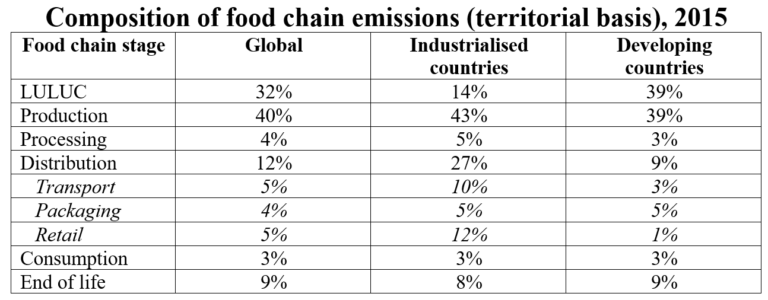
Source: Crippa et al, 2021.

An Excel file in the Supplementary Information provides disaggregated data by country over time. The following table shows the same food chain data for three EU Member States chosen to represent different stages of development. Despite having the highest income per head of the three selected Member States, Denmark has the lowest proportion of food system emissions arising in the downstream sectors. This could reflect the high export orientation of Danish agriculture, its high share of renewable energy, and the high awareness around waste management policy. Italy stands out for the very high share of its food system emissions generated in distribution, while in Bulgaria the stand-out feature is the high share of emissions coming from end of life disposal.

Disaggregating food system emissions in this way can help to identify ‘hotspots’ in a country’s emissions profile where efforts to reduce emissions could be intensified.
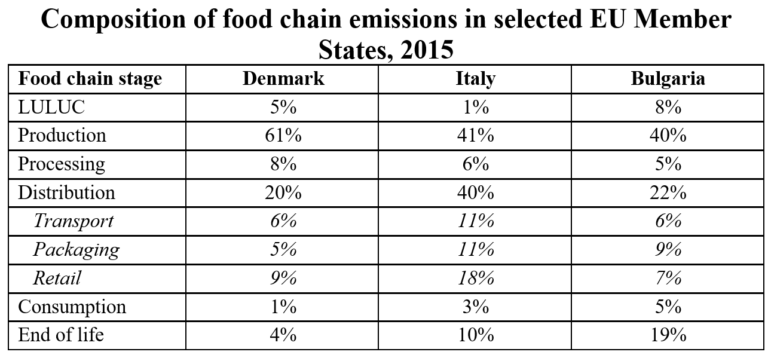
Source: Crippa et al., 2021, Supplementary Data

This post was written by Alan Matthews

Print Friendly, PDF & Email

O artigo foi publicado originalmente em CAP Reform.
Imprimir Artigo
Publicação Anterior

Oferta de emprego – Consultor Agrícola – Engenheiro Agrónomo – Gondomar

Próxima Publicação

Carne, leite e ovos podem ficar mais caros devido ao aumento do custo das rações

Artigos Relacionados

Últimas

Azeite português é um dos mais saudáveis do mundo

15/06/2026
Nacional

Presidente da Fundação quer Mata do Bussaco no mapa turístico nacional

15/06/2026
Nacional

Fundação quer Bussaco como referência internacional de conservação da natureza

15/06/2026
Próxima Publicação

Carne, leite e ovos podem ficar mais caros devido ao aumento do custo das rações

Discussão sobre este post

Opinião

Últimas

O azeite vale mais do que o preço que aparece na prateleira

por Susana Sassetti
14/06/2026

Ler maisDetails
Últimas

Acordo UE-Mercosul: uma oportunidade estratégica para proteger e valorizar as marcas dos produtos agrícolas portugueses

por Luís Caixinhas
07/06/2026

Ler maisDetails

Subscrever as nossas newsletteres

Subscrever as nossas Newsletters Agroportal

Verifique na sua caixa de correio ou na pasta de spam para confirmar a sua subscrição.

Comunicados

Azeite português é um dos mais saudáveis do mundo

15/06/2026
Rewilding Portugal

Renato Lainho é o Fotógrafo Rewilding do Ano

15/06/2026
Advertisement

Temas em destaque

Candidaturas PU Guerra Médio Oriente Mercosul ovibeja PAC pós 2027 Simplificação PAC Temporais vinho Água que Une

Eventos

Junho 2026
STQQSSD
1 2 3 4 5 6 7
8 9 10 11 12 13 14
15 16 17 18 19 20 21
22 23 24 25 26 27 28
29 30      
« Mai   Jul »

Sobre Nós

O Agroportal.pt é uma plataforma de informação digital que reúne a informação relevante sobre agricultura. Tem um foco na Política Agrícola Comum e a sua aplicação em Portugal.

Menu

  • Quem somos
  • Relatórios anuais
  • Envie-nos informação
  • Publicidade
  • Newsletters
  • Estatuto Editorial
  • Ficha técnica
  • Proteção de Dados Pessoais
  • Disclaimer
Facebook twitter Circle Instagram Rss Feed

© Agroportal. All Rights reserved.

Bem-Vindo De Volta!

Sign In with Facebook
Sign In with Google
OR

Faça login na sua conta abaixo

Esqueceu-se da senha? Registar

Criar Uma Nova Conta!

Sign Up with Facebook
Sign Up with Google
OR

Preencha os campos abaixo para se registar

* Ao se registar-se no nosso site, você concorda com os Termos e Condições e a Política de Privacidade .
Todos os campos são necessários. Entrar

Obter a sua senha

Indique por favor o seu nome de utilizador ou endereço de E-mail para repor a sua senha.

Entrar
  • Login
  • Registar
Sem Resultado
Ver Todos Os Resultados
  • Sugeridas
  • Notícias
    • Nacional
    • Internacional
    • Comunicados
  • Opinião
  • Eventos
  • Dossiers
    • Agricultura Biológica
    • Apoios
    • Artigos Técnicos
    • Biossoluções
    • Cadeia Alimentar
    • Fertilizantes
    • Financiamento
    • Fitofarmacêuticos
    • Florestas
    • Futuro da PAC
    • Inovação
    • Mercados e Cotações agrícolas
    • Newsletters e Revistas
    • Recomendações Agroflorestais
    • Seguros agrícolas
  • Serviços
    • Diretório
    • Emprego
    • Máquinas Agrícolas
    • Meteorologia
    • Terrenos Agrícolas
    • Arquivo Agroportal

© Agroportal. All Rights reserved.

Este site usa cookies. Ao continuar a utilizar este site, está a dar consentimento à utilização de cookies. Visite a nossa Política de Protecção de dados e Cookies.