
















Sem Resultado
Ver Todos Os Resultados
Newsletters
Agroportal
  • Login
  • Registar
  • Sugeridas
  • Notícias
    • Notícias
    • Nacional
    • Internacional
    • Comunicados
    assembleia da republica logo

    Audição às Organizações de Agricultores na AR

    Setor Florestal Unido Face aos Danos Depressão Kristin

    Álvaro Mendonça cedida

    CAP diz que AR está a pôr sobrevivência do setor em risco com decisão sobre aguardente

    Agricultores pedem aos governantes que se entendam após 16 reprogramações do PDR

    Floresta: da gestão ativa no território aos novos bioprodutos de valor acrescentado

    Comunicado de Organizações de Agricultores do Douro sobre uso exclusivo de aguardente vínica da Região na produção de Vinho do Porto

    ESAC

    Estudo indica que movimento das aves aquáticas tem implicações na propagação do vírus da gripe aviária

    José Maria Vilhena designado como vogal para a AG PEPAC no continente

    Associação Zero critica Governo por premiar “má gestão do regadio” em Alqueva

  • Opinião

    Notas sobre a Sustentabilidade Operacional do PEPAC

    luis caixinhas

    Marca tridimensional ou desenho ou modelo: como proteger a forma dos produtos agroalimentares

    Francisco Avillez

    A Reforma da PAC pós-2027: breves reflexões sobre o orçamento proposto pela CE

    Filipe Corrêa Figueira

    Estão a encurralar os Agricultores… e não vai acabar bem!

    Sinais dos tempos. Notas sobre a PAC e o Acordo UE-Mercosul

    Douro: não há excesso de produção, há excesso de oferta

    António Covas

    A inteligência coletiva territorial da 2ª ruralidade – As áreas de baixa densidade (ABD)

    Jaime Piçarra

    O que marcou 2025 e o que esperar para 2026

    Ines Marques Lopes

    Agribusiness: entre a profissionalização, o investimento e a sustentabilidade

  • Eventos
  • Dossiers

    Dossiers I

    • Agricultura Biológica
    • Apoios
    • Artigos Técnicos
    • Biossoluções
    • Cadeia Alimentar
    • Fertilizantes
    • Financiamento
    • Fitofarmacêuticos

    Dossiers II

    • Florestas
    • Futuro da PAC
    • Inovação
    • Mercados
    • Newsletters e Revistas
    • Recomendações Agroflorestais
    • Seguros

    Últimas

    Floresta: da gestão ativa no território aos novos bioprodutos de valor acrescentado

    03/02/2026

    Mau tempo: Setor das frutas e legumes pede apoios ao governo além de linhas de crédito

    02/02/2026

    Fumo, fogo e atmosfera

    02/02/2026

    Federação Minha Terra | Newsletter nº 338

    02/02/2026

    OGM | Canadá aprova para consumo porcos geneticamente modificados resistentes ao vírus PRRSV  

    02/02/2026

    Folha Informativa do INIAV – Dois Portos | Edição nº 345

    02/02/2026
  • Serviços
    • Diretório
    • Emprego
    • Máquinas Agrícolas
    • Meteorologia
    • Terrenos Agrícolas
    • Arquivo Agroportal
Agroportal
  • Sugeridas
  • Notícias
    • Notícias
    • Nacional
    • Internacional
    • Comunicados
    assembleia da republica logo

    Audição às Organizações de Agricultores na AR

    Setor Florestal Unido Face aos Danos Depressão Kristin

    Álvaro Mendonça cedida

    CAP diz que AR está a pôr sobrevivência do setor em risco com decisão sobre aguardente

    Agricultores pedem aos governantes que se entendam após 16 reprogramações do PDR

    Floresta: da gestão ativa no território aos novos bioprodutos de valor acrescentado

    Comunicado de Organizações de Agricultores do Douro sobre uso exclusivo de aguardente vínica da Região na produção de Vinho do Porto

    ESAC

    Estudo indica que movimento das aves aquáticas tem implicações na propagação do vírus da gripe aviária

    José Maria Vilhena designado como vogal para a AG PEPAC no continente

    Associação Zero critica Governo por premiar “má gestão do regadio” em Alqueva

  • Opinião

    Notas sobre a Sustentabilidade Operacional do PEPAC

    luis caixinhas

    Marca tridimensional ou desenho ou modelo: como proteger a forma dos produtos agroalimentares

    Francisco Avillez

    A Reforma da PAC pós-2027: breves reflexões sobre o orçamento proposto pela CE

    Filipe Corrêa Figueira

    Estão a encurralar os Agricultores… e não vai acabar bem!

    Sinais dos tempos. Notas sobre a PAC e o Acordo UE-Mercosul

    Douro: não há excesso de produção, há excesso de oferta

    António Covas

    A inteligência coletiva territorial da 2ª ruralidade – As áreas de baixa densidade (ABD)

    Jaime Piçarra

    O que marcou 2025 e o que esperar para 2026

    Ines Marques Lopes

    Agribusiness: entre a profissionalização, o investimento e a sustentabilidade

  • Eventos
  • Dossiers

    Dossiers I

    • Agricultura Biológica
    • Apoios
    • Artigos Técnicos
    • Biossoluções
    • Cadeia Alimentar
    • Fertilizantes
    • Financiamento
    • Fitofarmacêuticos

    Dossiers II

    • Florestas
    • Futuro da PAC
    • Inovação
    • Mercados
    • Newsletters e Revistas
    • Recomendações Agroflorestais
    • Seguros

    Últimas

    Floresta: da gestão ativa no território aos novos bioprodutos de valor acrescentado

    03/02/2026

    Mau tempo: Setor das frutas e legumes pede apoios ao governo além de linhas de crédito

    02/02/2026

    Fumo, fogo e atmosfera

    02/02/2026

    Federação Minha Terra | Newsletter nº 338

    02/02/2026

    OGM | Canadá aprova para consumo porcos geneticamente modificados resistentes ao vírus PRRSV  

    02/02/2026

    Folha Informativa do INIAV – Dois Portos | Edição nº 345

    02/02/2026
  • Serviços
    • Diretório
    • Emprego
    • Máquinas Agrícolas
    • Meteorologia
    • Terrenos Agrícolas
    • Arquivo Agroportal
Sem Resultado
Ver Todos Os Resultados
Agroportal

Trade and climate change increase pest threat to Europe’s forests

por Horizon - EU
04-08-2020 | 22:00
em Últimas, Internacional
Tempo De Leitura: 7 mins
A A
Partilhe no FacebookPartilhe no TwitterEnviar para o WhatsappEnviar para o TelegramEnviar para o LinkedIn

Pests are responsible for damaging 35 million hectares of forest around the world every year. In the Mediterranean region alone an area the size of Slovakia – five million hectares – is affected by pests annually, according to the UN Food and Agriculture Organization (FAO).

And the threat posed by insects and pathogens appears to be growing. Climate change is allowing some native pests to breed more frequently, while international trade is spreading exotic insects and pathogens more widely.

Only a tiny proportion of exotic pests that arrive in Europe end up damaging trees. ‘But these are very harmful, and there are more and more (of them),’ said Dr Hervé Jactel, director of research for forest entomology and biodiversity at the French National Research Institute for Agriculture, Food and Environment. 

On average, six new species of tree pests are being introduced to Europe every year, up from two a year in the 1950s, says Dr Jactel. They arrive in potted plants and wooden products or packaging.

Many of the emerging threats to Europe’s forests originate in Asia.

The emerald ash borer, for example, spread from Asia to the United States where it killed more than 150 million trees and may have cost more than $10 billion in the last decade. It is now knocking at Europe’s door.

‘We know it will kill all ash trees, or most of them,’ said Dr Jactel, who is the coordinator of the HOMED project which is developing new ways to detect such exotic pests early.

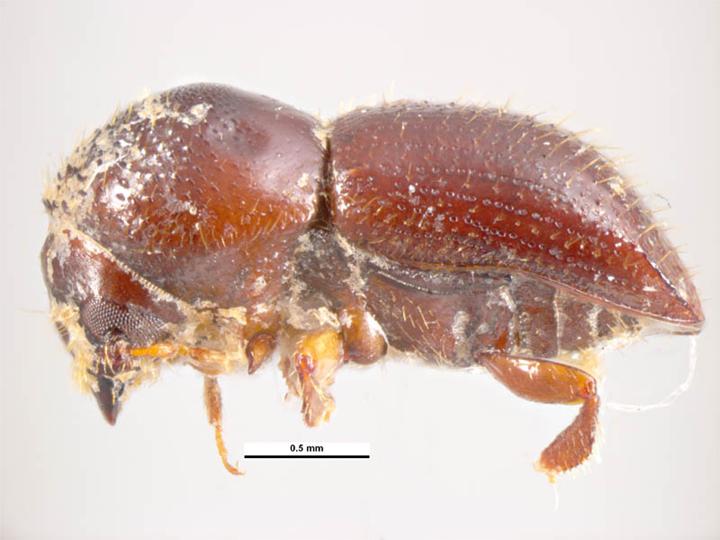
The polyphagous shot-hole borer is another major threat. It can attack virtually all deciduous tree species in Europe, says Dr Jactel.

‘It’s a very, very dangerous tiny beetle,’ he said. ‘This is probably the next big issue for Europe.’

This little insect originated in Asia, spread to Israel, California, and then South Africa where it has killed hundreds of thousands of trees. In April this year it was discovered for the first time in Italy, in a tropical garden. There is no sign yet that it has spread anywhere else in Europe.

Despite all of the countries affected by the beetle being on the alert for it, none were able to detect it until it had already caused damage, says Dr Jactel. The problem is spotting exotic pests and pathogens before they start attacking trees.

Hundreds of thousands of containers filled with goods arrive in Europe’s harbours and airports every day. Tiny insects or spores from fungal diseases can stow away in shipments containing wooden products, pallets or packaging, or live plants. The sheer number of shipments is overwhelming the resources of sanitary inspectors to detect insects and spores, says Dr Jactel.

‘It’s like finding a needle in a haystack.’

Solutions

Once the containers are opened, pests can then easily escape to nearby trees. So increasing surveillance of trees growing around ports and airports is a good starting point, says Dr Jactel.

Finding solutions to these pests is vital. Forests cover 43% of the EU’s land area – 182 million hectares in total – and growing. The forestry sector accounts for approximately 1% of EU GDP, and provides jobs for some 2.6 million people. If allowed to run rampant – without the natural predators found in their native habitats and among trees that have not evolved defences against them – the pests could be devastating.

But new tools are also needed to alert inspectors to the presence of pests in containers before they can escape, he adds.

The HOMED team are developing generic traps to attract a wide variety of insects. These will be placed in shipping containers before they set off from their country of origin, and in airports, harbours and train stations where the imports arrive.

Light traps placed in shipping containers can help capture novel insects on arrival in Europe. Image credit: Matteo Marchioro

The teams are also developing traps for fungal spores, and DNA tools and databases of species to help identify whether a spore is local or imported.

The project is also planting ‘sentinel’ European trees in Asia, North America and elsewhere that can help scientists identify early which pests might pose a particular threat to European trees.

For pests that have already taken hold in Europe, one possible solution is to import that pest’s natural enemies from its country of origin, says Dr Jactel.

Scientists in France and Switzerland are investigating whether the natural enemies of the destructive box tree moth – which has spread from China across Europe –  can be imported and used to contain it. But releasing this parasitic wasp to target the moths might bring other problems.

‘We need to be very cautious to check the Chinese parasitoids won’t affect European species,’ said Dr Jactel.

Native pests

Many threats to Europe’s forests, however, are closer to home. A warming climate in many regions is helping some native pests to become more common.

The bark beetle is one of the most damaging pests currently attacking Europe’s forests, destroying spruce trees in Central Europe.

The Czech Republic has had to cull so many infected trees in recent years the price of wood has plummeted as the resulting timber has been sold off, says Dr Julia Yagüe, project manager of My Sustainable Forest (MSF), which monitors the health of Europe’s forests. Spruce trees take up to 140 years to fully grow, so the loss of so many trees will be felt for a long time.

This is largely because warming temperatures have allowed the beetles to breed more frequently.

‘Some 20 years ago, we’d have one breeding cycle per summer, but nowadays we have up to four breeding cycles of bark beetle in the Czech Republic and southern Germany,’ said Dr Yagüe.

Warmer, longer and drier summers also mean trees are more vulnerable to attack because the conditions leave them less able to cope with pests, she says.

Some 20 years ago, we’d have one breeding cycle per summer, but nowadays we have up to four breeding cycles of bark beetle in the Czech Republic and southern Germany.

Scientists are creating variations of native spruce trees, which they hope will be more resistant to higher temperatures and drought, and so better able to fight off attacks from pests.

But in the meantime, forests urgently need closer monitoring, says Dr Yagüe. Forest managers usually take an inventory once every five to ten years. 

‘Because climate change is pressuring so hard, we need to update our data on forests much more often,’ she said.

The most efficient way to monitor large forests is with satellite observations, which can help detect the early warning signs of trees that are under water or heat stress, and so are more susceptible to attack.

They can also allow forest managers to spot the first signs of an infestation, such as dryness, loss of foliage, or dieback.

‘With remote sensing from satellites we can spot this sickness before even the human eye can detect it,’ said Dr Yagüe, who is a remote sensing expert at the Spanish aerospace company GMV.

MSF’s job of gathering data became easier with the launch of Europe’s Copernicus satellites in 2014, and the development of technology able to process huge amounts of information.

MSF now receives snapshots of Europe’s forests every five days instead of every 15 to 30 days before Copernicus. ‘We get this information for free,’ said Dr Yagüe.

But there is another crucial element to improving the health of Europe’s forests which is much closer to home.  

Many of Europe’s forests have been abandoned. While they were once carefully managed landscapes, as people moved to cities, ‘the knowledge of living together with nature has been lost’, said Dr Yagüe. ‘Recovering this is super important.’

The research in this article was funded by the EU. If you liked this article, please consider sharing it on social media.


Imprimir Artigo
Publicação Anterior

Cotações – Cereais – Informação Semanal – 20 a 26 Julho 2020

Próxima Publicação

Secar batata-doce em estufa preserva melhor composto antioxidante

Artigos Relacionados

assembleia da republica logo
Últimas

Audição às Organizações de Agricultores na AR

03/02/2026
Últimas

Setor Florestal Unido Face aos Danos Depressão Kristin

03/02/2026
Álvaro Mendonça cedida
Nacional

CAP diz que AR está a pôr sobrevivência do setor em risco com decisão sobre aguardente

03/02/2026
Próxima Publicação
As análises laboratoriais serviram para determinar em qual método de secagem a redução nos teores de substâncias bioativas é menos expressiva - Foto: Lucimeire Pilon

Secar batata-doce em estufa preserva melhor composto antioxidante

Discussão sobre este post

Opinião

Últimas

Notas sobre a Sustentabilidade Operacional do PEPAC

por Marisol Cardoso
01/02/2026

Ler mais
luis caixinhas
Últimas

Marca tridimensional ou desenho ou modelo: como proteger a forma dos produtos agroalimentares

por Luís Caixinhas
25/01/2026

Ler mais

Subscrever as nossas newsletteres

Subscrever as nossas Newsletters Agroportal

Verifique na sua caixa de correio ou na pasta de spam para confirmar a sua subscrição.

Comunicados

assembleia da republica logo

Audição às Organizações de Agricultores na AR

03/02/2026

Setor Florestal Unido Face aos Danos Depressão Kristin

03/02/2026

Temas em destaque

Anpromis Candidaturas PU Eleições Mercosul PAC pós 2027 Simplificação PAC Temporais Água que Une
Advertisement

Eventos

Fevereiro 2026
STQQSSD
       1
2 3 4 5 6 7 8
9 10 11 12 13 14 15
16 17 18 19 20 21 22
23 24 25 26 27 28  
« Jan   Mar »

Sobre Nós

O Agroportal.pt é uma plataforma de informação digital que reúne a informação relevante sobre agricultura. Tem um foco na Política Agrícola Comum e a sua aplicação em Portugal.

Menu

  • Quem somos
  • Relatórios anuais
  • Envie-nos informação
  • Publicidade
  • Newsletters
  • Estatuto Editorial
  • Ficha técnica
  • Proteção de Dados Pessoais
  • Disclaimer
Facebook twitter Circle Instagram Rss Feed

© Agroportal. All Rights reserved.

  • Login
  • Registar
Sem Resultado
Ver Todos Os Resultados
  • Sugeridas
  • Notícias
    • Nacional
    • Internacional
    • Comunicados
  • Opinião
  • Eventos
  • Dossiers
    • Agricultura Biológica
    • Apoios
    • Artigos Técnicos
    • Biossoluções
    • Cadeia Alimentar
    • Fertilizantes
    • Financiamento
    • Fitofarmacêuticos
    • Florestas
    • Futuro da PAC
    • Inovação
    • Mercados e Cotações agrícolas
    • Newsletters e Revistas
    • Recomendações Agroflorestais
    • Seguros agrícolas
  • Serviços
    • Diretório
    • Emprego
    • Máquinas Agrícolas
    • Meteorologia
    • Terrenos Agrícolas
    • Arquivo Agroportal

© Agroportal. All Rights reserved.

Bem-Vindo De Volta!

Sign In with Facebook
Sign In with Google
OU

Faça login na sua conta abaixo

Esqueceu-se da senha? Registar

Criar Uma Nova Conta!

Sign Up with Facebook
Sign Up with Google
OU

Preencha os campos abaixo para se registar

* Ao se registar-se no nosso site, você concorda com os Termos e Condições e a Política de Privacidade .
Todos os campos são necessários. Entrar

Obter a sua senha

Indique por favor o seu nome de utilizador ou endereço de E-mail para repor a sua senha.

Entrar
Este site usa cookies. Ao continuar a utilizar este site, está a dar consentimento à utilização de cookies. Visite a nossa Política de Protecção de dados e Cookies.