










[Fonte: Comissão Europeia]
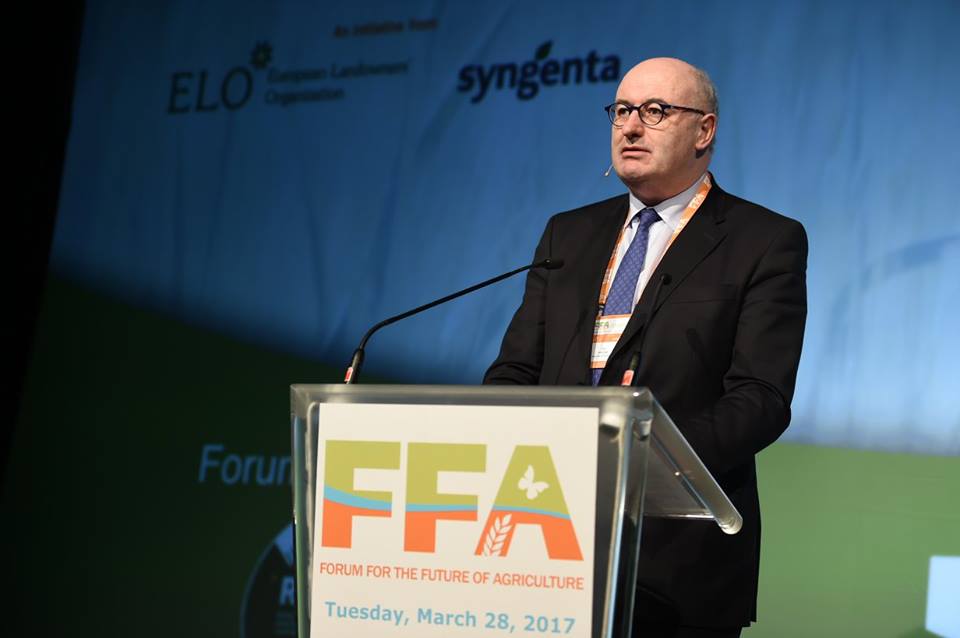
Distinguished guests, fellow panellists, ladies and gentlemen,
It is a pleasure to be here again at the FFA this year. Those of you were here last year will recall that this event coincided with the horrific bombings which claimed 32 innocent lives, which we remembered last week.
It’s a sobering note on which to start, but deserves acknowledgement. I am though genuinely pleased to be back again and I want to congratulate the organisers of this event, not alone on your tenth anniversary but on the fact that you have now established this event as one of the key stakeholder events of the year and an event that seems to go from strength to strength.
I want to congratulate you too on this on the title for this session. It is appropriate and timely and the question you pose is one that I too have posed and can be seen as a key part of the backdrop to the Commission’s decision to propose the “Simplification and Modernisation of the CAP.”
Since the start of the Juncker Commission, the European Union has significantly enhanced its environmental and climate-related credentials, notably through our commitments to the Paris Agreement and the UN Sustainable Development Goals.
Agriculture and forestry have an enormous role to play in contributing to the EU’s commitments and, in order to realise that potential, we need to have a policy that enhances environmental sustainability and climate-resilience.
Before anybody jumps to the conclusion that the Commission’s decision to proceed with the simplification and modernisation of the CAP is an acknowledgement that the policy is somehow not fit for the SDG age, let’s look at some facts.
As we mark the 60th anniversary of the Treaty of Rome, there has been much reflection on the successes and failures of the European Union, in its different manifestations. In my view, the Common Agricultural Policy has been one of the real successes of the EU and this year it marks 55 years of existence and support for European farmers and European food production.
The CAP has ensured food security in Europe since shortly after the end of the Second World War. Today it provides food security to millions of people way beyond the EU and, despite all the laudable objectives of helping people to feed themselves, that will continue to be the case, at least for decades to come.
The CAP also ensures that the people of Europe have access to high quality food, produced to the highest standards in the world.
If we are to maintain food security and the highest food standards in the world, we must continue to support European farmers through the CAP.
In addition, the CAP is a policy that reaches out to all parts of Europe, even to the most marginal rural areas. And this is where we need to act. The highest rate of poverty in the EU nowadays is to be found in rural areas.
The CAP is a policy that enables jobs, economic development and growth in those areas where it is most needed. The CAP is at the root of a vibrant agri-food sector, which provides for 44 million jobs in the EU. We should use this potential more.
Having said this about the policy, it is clear that it needs to adapt and modernise for the 21st century. Food has to be put at the centre of the debate and farmers actions have to be directed accordingly.
We must remember that the CAP is an economic, environmental and social policy and each one of these objectives is as important as the other. The choice is not a binary choice between one objective and another. It is a choice between a policy that delivers effectively for its stakeholders, including taxpayers, and one that doesn’t.
A system of agricultural production that delivers on the Paris Agreement and the SDGs will ensure a more resilient agricultural system, based on healthy ecosystems and a production system that integrates innovation and more value across the whole chain, from primary production to the consumer.
The last reform of the CAP moved the policy in a direction from which I believe there is no turning back. The introduction of ‘greening’ and the increased emphasis on environmental performance was a central element of the 2013 CAP reform.
All of us must accept that more needs to be done in terms of the environmental performance of the policy and the frustrations of both those who believe that greening has not gone far enough and those who believe that it places a disproportionate burden on farmers and agricultural production have to be addressed.
I am the first to acknowledge that the economic viability of the farming sector is a pre-condition not only for production of quality and safe food, but also for the sustainable management of resources (including water) and the provision of environmental public goods. Indeed, we are fortunate that we have a whole category of economic operators who looks after the environment for us – farmers, who are our “boots on the ground” to deliver on these goals.
Thus, in supporting our farmers, we can and must ask them to do more in terms of their contribution to the priorities of this Commission, our international obligations for climate and environment, the Sustainable Development Goals and other societal goals and objectives. Crucially, though, those farmers deserve to be rewarded, in the same way that other providers of public goods are.
My colleague, EU Climate Action Commissioner Arias Canete, makes the very valid argument that “agriculture is too often overlooked when discussing EU climate and energy policy.” Yes, agriculture is clearly a source of emissions, but it also has the potential to provide a range of solutions, notably in relation to the storage of carbon. I agree with Commissioner Arias Canete when he says that “this is an element a reformed CAP should promote.”
As an environmental policy, the CAP is already making a significant contribution but, in the words of the school report, “it can do better.”
We need to invest more and better in knowledge transfer and innovation in order to produce more from less and to produce better. This may include more use of new technologies like precision farming but it can also include the reintroduction of traditional farming techniques in certain areas.
We need to make good use of research and new technologies. New IT systems, improved breeding, new feedstocks and better use of nutrients or manure treatment can change the way of today’s agricultural production towards a well working circular economy.
And all these developments can also bring additional economic value. For example the bioeconomy offers incredible potential for new jobs – especially at local and regional level and especially in rural areas. The global biorefinery product market is expected to grow by 13 per cent annually – this provides enormous opportunities for agriculture. The bioeconomy could be a new driver for climate-smart development in rural areas which could also provide new and reliable income streams for farmers.
I could easily continue with more examples, but the point I want to make is the following: sustainable use of our scarce natural resources and economic activity are not mutually exclusive. There are many ways in which this development can be combined and the approach of the circular economy reflects this fact.
And farmers must be placed at the centre of the solutions to these issues and ensure that agricultural activity and environment performance meet.
Thus, we have a balance to strike in modernising the CAP – a balance between maintaining the policy’s core objectives such as food security, which were first enunciated in the Treaty of Rome 60 years ago. And the need to adapt our policy even further to the SDG age.
Striking that balance between ensuring the Treaty objectives and the EU’s duty, as one of the world’s responsible citizens, to address the global climate challenge and those less fortunate citizens throughout the world, means that our system of food production has to be much more sustainable than it has been.
Quite apart from the interests of anybody else, it is in the interests of our own farmers and citizens in terms of soil, water and air quality. Sustainability has been something of a buzzword for some time and is included in speeches etc. as some kind of rhetoric and platitude.
Well, the days of rhetoric and platitudes should stop. It is now time for reality and action.
Consumers – that’s all of us – have a role to play. We have to become more demanding, more discerning.
Several of the SDGs relate to agriculture and food production and agriculture has a key role to play in ensuring that the EU can meet its commitment to achieving the targets set. But, as the UN acknowledges, the achievement of the goals depends on multiple actors.
I and my colleagues in the College of Commissioners are determined that the EU will not alone be one of those actors, but will be a leader in the achievement of these goals.
I could get into goal-by-goal analysis of the SDGs to see what role the CAP can play, but I don’t propose to do so.
Instead I would like to conclude my contribution by saying that the Common Agricultural Policy
- is already contributing positively in very many of the areas that became SDGs two years ago, but it can do more;
- it adds value to so much of what concerns us, whether that is in terms of the rural environment, climate change, rural connectivity, research and innovation, social policy, healthy living, job creation economic growth, trade performance and migration
- it is an ever-evolving policy which is robust and responsive. It now needs to evolve further to meet new challenges and it will;
- and I need your input and constructive contribution so that the CAP can deliver on the demands of society and to ensure that, in the future, it is a policy that is fit for the SDG age.
Thank you.













Discussão sobre este post